Showing posts with label Springtime. Show all posts

Friday, April 16, 2010

Spring rejuvenation

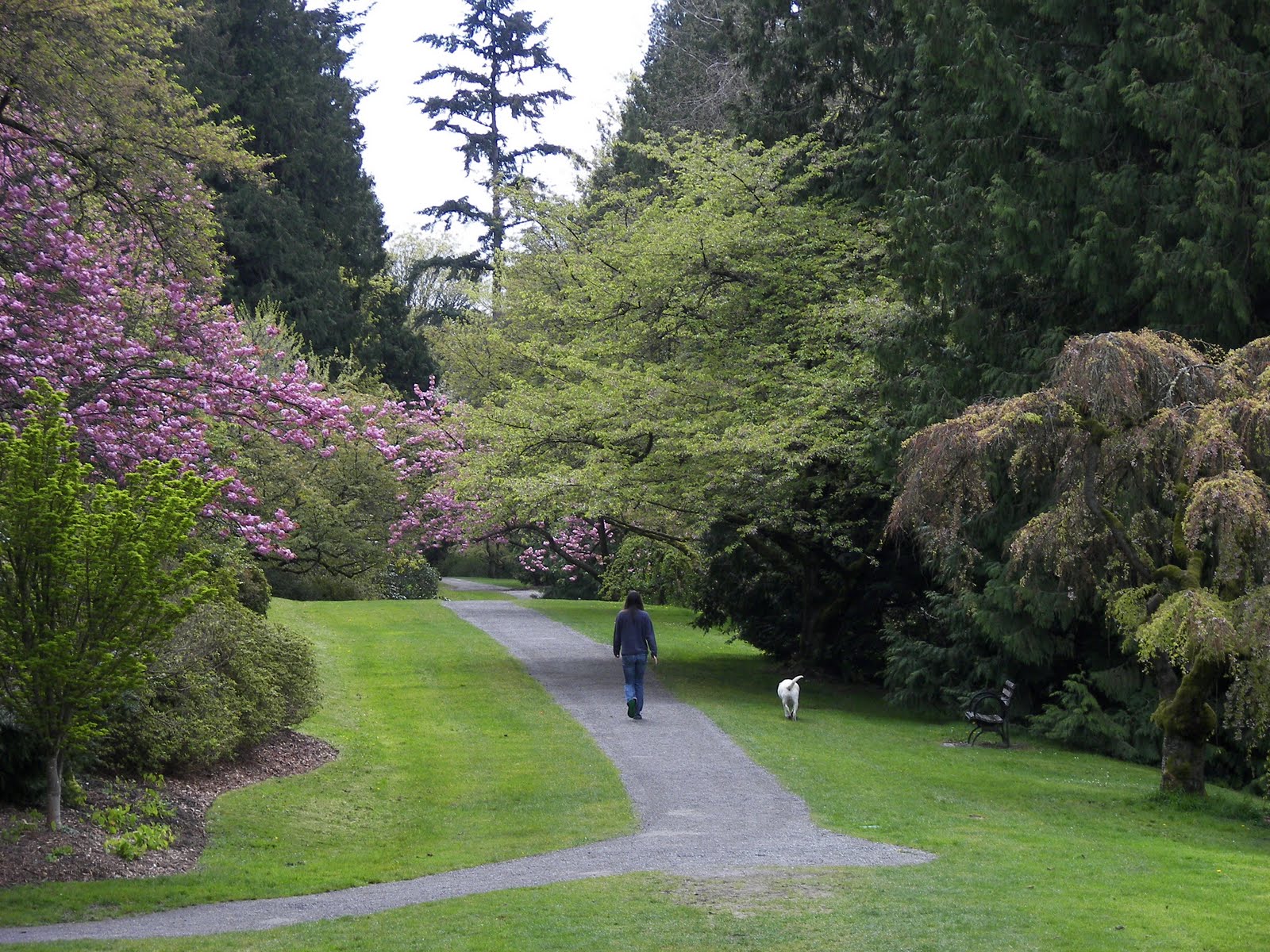
The outing started out dubiously.  The stainless steel sky became thick with droplets, pelting our parkas as we entered the Seattle Arboretum's "Azalea Way" for our annual gazing-and-gasping foray. Those first photos showed omnious shadows, indistinct blossoms, muddy grass passages.

Undeterred, my adventurous friend and I slogged on. This was the day we'd determined would be the season's peak.

Tenacity paid off: as we strolled, the blanket of gray separated into discernable clouds, then parted further to reveal a cerulean backdrop, then, with time, cheerful sunshine glistened off the fresh drops.

Rows of gnarled trunks propped dark branches drooping with fluffy lushness, clusters of fluttery pink petals that closer looked like tutus on stems.  Once again I was flummoxed at the speed God had carried dull branches from bony stiffness to life-giving bearers of froufy poufs; billions of petals sprouted from nothing into breathless arrays, soon to be scattered like pink snow carried by the breeze.  The display is humbling, exhilarating, heartening.

The azaleas are yet to pop from their closed-umbrella buds into cheerful clusters; we must return in a week or two for our next dose of awe.

Sunday, March 21, 2010

The promise of blossoming cherry trees


I'm not through with Israel revelations, but first this interruption for...springtime.  The cherry trees lining the quad at the University of Washington campus burst into flower for one week per year, a time that finds it crowded with picnicking families, camera-toting tourists, parents bringing adorably-clad little ones for their portraits in their Sunday best.  Being among the 30 or so old and spreading trees brings exhilaration and promise. And speaks of God's wonder--allowing these boughs to slumber and then create the billions of petals that soon drift downward like pink snow.  I took the photos above over the last week.

Monday, April 27, 2009

Joy in the Tulip Fields


Springtime is rejuvenating, and little enthralls me the way a visit to the Skagit Valley Tulip Festival does. I can well understand Tulipomania, the Dutch phenomenon in the 1630s that led to wild speculative prices for particularly hoarded hybrids. Here in the Northwest, many await the opening of the tulip cups with similar enthusiasm, and this year we've waited longer than I can remember--Al Gore's Global Warming brought us an icier winter that delayed the fields' splendor nearly a month.

But we who consult Tulip Maps like astrologers plot the planets were overjoyed to find this weekend peak. And so my husband, son and I got in the car, singing along with oldies, and drove the hour north of Seattle to the Mount Vernon flats.

Unfortunately, pent-up eagerness for the flowers' bloom brought out masses of fans of fringed, parrot, Triumph and double (a great number of them, for reasons I can't really understand, East Indian, many in sparkly saris and other delightfully-hued garb). Out in the fields, where narrow roads transverse open acres, cars were lined up helplessly, stopped dead for quarter-hours at a time. We were among them, frustrated. But quiet about it.

The sun wove between the clouds and haze, and even infrequent advancement was bearable on a Sunday where your fellow traffic victims join you in such a pleasant purpose. Admittedly, Skagit Valley is far less hospitable in its April display than it had been in the early years we attended, 1996, 7 and 8. In those days, more farmers opened up their fields freely. Cars parked alongside the fields or on the host's turf; there were no fluorescent-orange-vested traffic directors, no ticket booths, no merchants offering $6 packs of tulip-themed paper napkins, lawn pinwheels or imported-from-China trivets painted with quaint European street scenes.

There was an art show in a a barn (which continues) and a grower who let kids pet his tame alpacas. More family farms carried on the Dutch flower-growing traditions, and welcomed yours to stroll into the field, gawk at the rows of color, and chat a bit.

Now, only two farms remain, and they've made tulip-admiration into almost as big a business as bulb-vending. Parking lots are cordoned off into rows, and entering the fields or displays requires a fee, $4 at Roosengaarde, and $5 at Tulip Town. Cut flowers and especially, bulbs, offered with "deals" like a fifth bunch free, or 20 extra bulbs when ordering others, are for sale by plentiful clerks. Kiosks for Kettle Corn, corn dogs, nachos and other fair fare provide a pungency more conducive to nausea than communing with nature.

But pass the distractions and there are the flower fields. Even when lined with tourists, God provides there a breathtaking spectacle. Astonishing rainbow rows of intense color bring smiles, gratitude and praise. Families squat, smiling, arms linked for the camera, among the sturdy stems, vibrant bowls of vivid petals enveloping them, joining them together in exhilaration.

Everyone is snapping photos, eager to capture the intensity, the brilliance, the astounding beauty. I've made the tulip pilgrimage many times; how many ways can you photograph a flower? "Say cheese!" "Don't move!" my verdant subject cooperates and I giggle, grateful for digital cameras and giant photo storage. It's all here for the imbibing, the enjoying.

That's why the interminable traffic was bearable. Little is troubling when God colors the world.

Sunday, April 19, 2009

A Voice for the Unconventionally Attractive


Settling back down to the home-bound routine after being away for the 9-day Passover holiday is a bit tough. Flying home from the sunshine into the overcast was the least of it--piles of mail, phone messages, email, unpacking and uploading my photos all had to wait as I prepared for Shabbat.

Kindly friends had invited us for lunch today, and among the catch-up of Pesach anecdotes were some mentions of the world that passed over while we floated in the time-warp of Passover. I was ignorant to one story that, later, I saw was covered in the New York Times: the worldwide instantaneous rise of a 47-year-old, virginal, portly, unstylish, unemployed woman from Blackburn, Scotland, named Susan Boyle.

Her appearance last week on the English TV reality show "Britain's Got Talent" was considered a triumph because her voice trumped her frump. The YouTube video of her audition, watched by more than 20 million viewers, shows polite judges welcoming her, a few plucky responses to their questions, and then a powerful rendition of "I Dreamed a Dream" from Les Miserables.

Why is this such a phenomenon? Apparently, feminists are emailing links to the performance, proud that a relatively elderly, no-makeup, fashionless, double-chinned person could inspire tears in listeners. Unfortunately, I think the tears are because Susan Boyle is the ugly duckling that bursts into swan as she bursts into song. Amanda Holden, cute, pert judge of "Talent," told The Daily Mirror" she wouldn't "let her near" a hairdresser: "The minute we turn her into a glamourpuss is when it's spoilt."

In other words, her hook is her homeliness.

On the one hand, that one of Miss Boyle's age and physique can leap to stardom is encouraging to others not conventionally attractive. We root for the underdog, and, alas, women who don't fit the Hollywood mold often are caninely compared. Therefore, when she clearly displays vocal talent, we are not only surprised, but delighted. She even told Larry King she sees no need to revamp her image, saying, "Why should I change?" Her brother Gerard told the "Daily Mirror," “She doesn’t wear make-up or fancy clothes. It’s not that she doesn’t care, she just doesn’t see why other people should care how she looks. When me or my sisters see her we always say ‘Och Susan, you could have put a comb through your hair’. But she can’t see what the problem is."

On the other hand, that we snicker when she strides onto the stage reminds us that Miss Boyle is indeed the exception, and we're still going to hold by the rule. And frankly, the whole thing looks like a set-up. She's the "gotcha!" producers and publicists pursue, and it's working great.

But there's a message here. Just as we often dismiss the handicapped or elderly, we dismiss or demote anyone not pretty or potent.

Not long enough ago, I decided that when I encountered old people, or individuals in wheelchairs, I would look them in the eye, smile, and say hello, recognizing them, and reminding me never to disregard a soul who can breathe and feel. Every elder in a walker struggling to step was once virile and energetic, and led a life as worthy, and often more so, than the venerated stars who grace tabloid covers.

In the same Saturday paper, next to the piece on Susan Boyle, was a disgusting article by Michael Creepy, uh, Cieply, sniggling over the few pounds it appears to him that some male stars exhibit in recent films. Jeff Daniels and Russell Crowe in "State of Play" are described as "Two men. One notebook. Four chins." Denzel Washington and John Travolta star "cheek to jowl" in "The Taking of Peham 1 2 3." Hugh Grant's "dimples pop out where they used to pop in" in "Did you Hear About the Morgans?" And Vince Vaughn's "sized up" form will star next year in "Couples Retreat." It seems media can't help perpetuating debilitating stereotypes even as they cheer one who breaks them.

Is that just the way the world works? Yes. But the good news is that we're now talking about it. "You can't judge a book by its cover" is now the code phrase for the ascent of Susan Boyle.

What a wonderful season. The trees are heavy with pink blossoms and the daffodils coloring the yard with sunshine. The tulips are a bit late this year, but tomorrow we'll take a hike in search of trilliums. The air feels crisp with possibility.

Monday, April 6, 2009

A Rare Holiday


With the weather here in the glorious 70s with sunshine, I had to take advantage. Yesterday I joined throngs of camera-wielding families at the quad of the University of Washington, where a circle of grandly gnarled cherry trees are in magnificent full bloom. Spring has arrived, at last, in the northwest.

And with it Wednesday arrives a very special Jewish spring day. It only occurs once every 28 years, the last time in 1981. And because it is attached to the solar, rather than the usual lunar Jewish calendar, it moves--but dawns this year on the morning of another festival called "Chag Aviv," the holiday of spring, Passover. The last time the rare special day occurred on Passover eve was in 1925; the time before that, in 1309.

What is this unusual day called? I'm not sure the day has a name, but the action we perform does--reciting a blessing called "birkat ha chamma," acknowledging God's creation of His "works," when the sun returns to the position it occupied in the sky when it was created.

The hitch here is that you need to actually see the sun, at least through the clouds, in order to say this blessing. In Seattle, we can only pray that we get another couple luscious warm and clear days like yesterday and today. Because if we don't, and the sky reverts to its usual low-hanging curtain of gray, we're out of luck until 2037.

We've got a three-hour window of time to say these few magic words (well, many hold that you can say them when you see other of God's awesome works) but the profound thought for me is that we humans can agree (based on biblical calculations) when and where the sun was created. And that people for millenniums knew and agreed and said the same words, looking up (very briefly!) at that same burning orb.


This is the kind of natural phenomenon that my late father-in-law, a scientist who wrote about the confluence of the bible with the natural world, would have savored. We'll look up at the sky (if clear), and know he's reciting with us.

Meanwhile, approaching Passover, most everyone I know is scurrying.

Either they're setting aside the "chumetz" (leavened food ) in their homes and attacking the residues and residuals with various implements, be it blow torch or toothbrush--or, if they're very fortunate like me, they're packing to abandon their beer and Cheerios-stocked houses, sell all that chumetz to a non-Jew, and flee to a Passover hotel.

At these mostly sun-belt "resorts," a synagogue, kosher food purveyor, recreation and activities specialist, day care emporium and mini-university are magically assembled for the period of eight days. Families gather together from far-flung corners of the world to conduct seders and reunite in the re-enactment of our peoples' delivery from slavery to Egypt's Pharoah, to slavery instead to God. The rest of the time is divided between holidays of restricted activity similar to Shabbat, and "chol ha moed" days that are still part of the passover festival, but allow a modicum of non-holiday activity such as car travel, electricity use, necessary work and Facebook. Just kidding.

Much preparation goes into Passover, including study of the Hagada, the book containing the fifteen-step "order" that is the seder ceremony. Participants come up with novel and complex questions, and deep analyses of each aspect of the hours-long evening's discussion. Many people mistakenly think of the seder as indoctrination "for the children," but serious Jews stay up debating and querying long after the children and morning-types have drooped. Sometimes they debate how long the debate can go on.

I don't plan to take my laptop in the suitcase with the twelve fancy outfits I'll need for all the dressy meals and synagogue services that characterize the holiday, (not to mention the casual togs and walking shoes and seder-prep and speech-giving materials) so I'm afraid my blog will probably languish until my return after the holiday. I'm scurrying today not with a blow-torch but errand-running and laundry washing and okay, helping my son with his term paper on James Bond that he should have done weeks ago but must be turned in tomorrow.

I wish my Jewish friends a "Pesach kasher v'sameach," my Christian friends a Happy Easter, and for all of us, a springtime blossoming with new possibility.

Monday, May 5, 2008

Our Charming Visitor: A Luminescent Hummingbird


Buy yourself a hummingbird feeder and marvel at the amazing delicacy of a creature of just one ounce.

It doesn't matter where you live, you can probably hang a hummingbird feeder, which costs just a few dollars at your local drug store, outside a window or on a nearby tree branch. In our case, we hung ours underneath a balcony. It's an inexpensive glass bottle with a red plastic cap and four screw on plastic perches. I fill it with a mixture of one-fourth sugar to three-fourths water, and color it with a few drops of red food coloring.

My reward is a shimmering green visitor with a needle beak that flits from our ornamental cherry tree to the perch, sips a minute or two, then flits back to his
branch in the tree, about 15 feet away. His metallic green body is so luminescent, so beautiful, similar to the inside of an abalone shell. I hope he brings some friends.

This little fellow captivates me and all our guests, because the beauty, the flittering wings, the teeny beak is so small, yet so profound. Why would God make such a glorious creature? What could have been the Darwinistic superiority of this tiny bird that let it develop with so much showy intensity and yet remain but a sweet ounce?


Help me figure this out. But in the meantime, head to your nearest five-and-dime
and buy a hummingbird feeder to revel in the astounding rebirth of spring.

Sunday, May 4, 2008

Tulips in my Own Back Yard


Every year, our family makes the hour-and-ten-minute drive northward to Washington's Skagit Valley to see the annual Tulip Festival. It is the highlight of my year, signaling the advent of springtime, and renewing in me the exhilaration of the outdoors, as a gasp-worthy display of brilliant blooms undulates with the boggy terrain spread to the ends of a massive valley. If anything can revive a perfunctory relationship with God, it is this mega-dose of grandeur and beauty--stripes of intense reds, yellows, purples under a cerulean sky of lilting clouds.

My photographer's eye dances from one shot to its superior. My photographed children grimace.
Eleven years ago, when we first made our tulip trek, they were cooperative, posing in the rows of flowers, their own fresh bloom happy and perfect. Over the years, however, they grew weary of this ritual, and ever more reluctant to smile while squatting in the mud. This was, of course, frustrating to me as I switched from film to digital, since now I could click unlimitedly, putting them to ever greater duress and torture.

This year, to my consternation, we missed the Tulip Festival entirely. The flowers came out two weeks late, I was deep into writing deadlines, and Passover inserted its 10-day interlude, when we were in Los Angeles, far from the swaying color-cups of the Skagit.

But--we grew tulips in pots on our patio! And one closeup of a tulip is as good as another! So, I took photos of the flowers. But, sigh, not of my squatting children, who now are much more assertive about refusing to fulfill their mother's wish.

There is no way to capture the beauty of the the tulip fields, and no way to recapture the children who skipped through the dirt aisles picking up broken flowers, collecting them into a bouquet and presenting them to me. Come on, Mom, time to move on. Here's a glimpse of my patio...

Tuesday, May 8, 2007

Invigorated by Springtime, Eh?


I seem to have a string of "awesome nature" posts going here, so I cannot resist touting my most recent communing with the bounties of spring. One might have said the Mounties of spring, since this close encounter of the plant kind happened over this last weekend in...Canada, eh?

Butchart Garden, located a pleasant half-hour bus ride outside Victoria, BC on Tod Inlet, is 55 acres that, according to their brochure, "began [in 1906] with an idea by Jennie Butchart to beautify a worked-out limestone quarry which had supplied her husband Robert Pim Butchart's nearby Portland cement plant." The quarry was dug with a mind toward profit--less valuable streaks of limestone were left as pillars and dug around, creating a moonscape bowl of rock transformed into what is now the Sunken Garden (photo, left). The surrounding acres indulged Mrs. Butchart's gardening hobby by becoming the Japanese, Italian, rose, and side gardens and an expanse with fountains where concerts are held on the lawn.

Sounds nice, the kind of thing you'd take your grandmother to...eh? Then why did we make a rather expensive pilgrimage there with the family, timed precisely for THIS last weekend? I'm no grandmother (yet!). And I'm not the only one in my family who appreciates the eye candy of flowers--but we came the first weekend in May to see my passion, my delight...tulips.

You've already read about the breathtaking vistas at the Skagit Valley, where the fields striped in brilliant colors stretch to the horizon. This is nothing like that. Butchart Gardens is the Disneyland of horticulture--if there are tulips, they're
monster-sized, crazily-shaped or wildly-colored, and always under-planted with little BLUE flowers. Blue is everywhere at Butchart, which is famous for its blue poppies (in fact the restaurant there is called the Blue Poppy Cafe.) This trip we only saw a few of those precious and finicky blooms, but on my last visit, I thrilled at them from all angles (photo).

No, this trip was all about tulips. We saw deep rust-colored ones with "fringed" edges so sharp they looked like Venus Flytraps. We saw scarlet open-faced tulips with sun-yellow centers with a fillip of odd scarlet curly petal jutting forth from them (photo, below). We saw black tulips. And green tulips. All of such generous size, in such profusion, as to make me...gasp.

The weather was chilly, and rain fell as if from God's watering can, tipped and then righted with passing clouds. Available at every turn were clear plastic umbrellas, a logical choice as no one wants to miss the blooms drinking from the sky. After each cloudburst, the raindrops beaded on the petals, fresh and cool, and the flowers smiled again, aware of being even more photogenic in dewy newness.

A bus-ful of Japanese tourists, all quite small and brandishing cameras, shared my eagerness to capture the beauty on their photo cards (you can't say "on film" anymore). Watching them crouch, squat, stand on tiptoe and perch cameras on
tripods was entertaining...but made me want to emulate their positions to find out exactly what it was they found so irresistible. Could it be the navy blue Columbine? Don't know...but being in this place where the earth's rebirth was so celebrated and God's ingenuity so obvious filled me with optimism and possibility. You must go to Butchart in May--and inhale springtime.

Tuesday, May 1, 2007

Created for our EnJOYment


With my new view opened up, and the days now exuberantly long, it's easy to feel celebratory. And what could bring out the feelings of ecstasy and joy more than brilliant azaleas? Ho-hum, you say. What are they but bushes, right? "Stay Out da Bushes!" as Jesse Jackson famously said.

But come with me to the University of Washington's famed Japanese Garden, and you will see much more. There, in a carefully tended oasis of tranquility, are growing spheres clipped so that now, in the epitome of springtime, they become brilliant balls of magenta, scarlet and peach. Come closer. You'll see that the solid mass of shocking hue is really made up of
thousands of perfect, individual flowers, each one in itself worthy of display. Together, they sound a chorus of color. Each small, seven-petaled bloom, opening like a hungry baby bird to the sun, with its arching stamens and contrasting freckles in its throat, cries out abundance. We are given more gifts than we can collect.

The rhododendron is the state flower of Washington. It grows wild, with crimson flowers that burst forth in clusters, lighting verdant fir forests. Evergreen, rhododendrons have been cultivated as front-yard favorites, and now, at the UW Arboretum, "Azalea Way" is aflame with pinks, whites, and mottled psychedelic mounds, amid periwinkle meadows of field hyacinths, fluffy dandelions, and paths of unmown grass richly and intensely green.

Enough procrastinating. Time to be bookish...but my head turns toward my window as I unsuccessfully resist the exhilarating call of spring.

Wednesday, April 25, 2007

Opening Up my View


Yes, it's springtime here in the glorious Great Northwest, and though the sky still remains gray most of the time, the chickadees are making a nest in the hanging birdhouse with the Tlingit Indian design on it that hangs from the Ornamental Cherry tree over our patio. The lilac are blooming on the side of our house, and I watch the purple, frilly bunches form, reminding myself to run out and clip some to perfume my bedroom at night. The days are blissfully long, and it's even light when we arise now, a major treat after the slap an extended daylight savings time dealt us early this year. Unless you live in the northerly regions, you don't realize how daunting hearing your clock-radio click on in pitch darkness can be.

But I have an additional reason for my mirth--my view is opening up before my eyes. No, I didn't get new contact lenses, though every morning when I put my lenses on, my gratitude in seeing the world is born anew--"Blessed are you our God...who gives sight to the blind!" I always say this blessing, "pokayach ivrim" when I have finally gotten in both lenses, and look up to have the world in focus. What a joy. That's when the day begins.

Instead, my view expands because of a peculiar fellow named James.

James walked into my life this morning wearing scruffy jeans, a sweatshirt, and thick canvas cinches around his waist. Hanging from rings on the cinches were heavy metal connecting rings, dangling like a prisoner's chains. James came into my home, walked through my house to the backyard and the deck, came into my house again and mounted the stairs to my office, where he went out on my balcony. "Yep, I see what you mean," he said in the drawl of one who might have inhaled too many marijuana joints. "Those have really got to go."

Anyone who knows me understands how my heart leapt at those words. He was pointing to the fir trees that in the ten years we've lived in this house have grown up to crowd out our once panoramic view of Lake Washington and Mt. Rainier. James is a tree man.

He loves to climb trees, and he doesn't mind cutting them, either. His card says he's an arborist, a specialist in ornamental trees, but he just loves being in them. It didn't daunt him that these trees had grown to easily more than 100 feet tall, and their spindly branches, having been chopped off probably the year before we moved in to increase the property value, now jutted in pairs and trios, growing up from the original trunk. James is awed by our view potential, and he even seems to enjoy it when I pluck my stack of photos from the drawer and show him, "This was our view in 1998...see, there's no tree there!" and "this is our view in 2006...see, the mountain's almost gone!" Yes, yes, he completely sympathizes. A man after my own heart.

Then there's the REAL man who's GOT my heart...my tree-hugging husband, the villain of the story. He has planted, oh fifty trees between us and our view. If he sees a wee patch of dirt, he is sure it's perfect for what will too-soon be a ten-story-tall Douglas fir. When we moved in, he went to a tree nursery with the horrid question, "what evergreens grow the fastest?" He just couldn't wait to jam our view-space with conifers. Well, now those Leland Cyprus require merciless chopping and they pushed a retaining wall down the ravine. Still, my tree-hugger would pay more to live enclosed in a forest than to see Mt. Rainier. And some people have deigned to publicly call this man a "right winger." Then he's likely to be the only one of his ilk sitting in a tree with Julia Butterfly to protect it. I love this man, and so, despite my irresistible inclination to tell James, "Go for it!" I told him my husband's one requirement: No killing any trees.

The good news is, James merely said "OK" and then swaggered his way down the ravine to do his work, with a hand saw, not a chain saw, throwing ropes up into the thickly needled treetops, clicking them onto his harness, and digging his spurs into the bark to shimmy so high, I'd have gotten vertigo.

A few hours later, there are lovely naked poles allowing me to see the shore on the other side of the lake, crowned by cute little toppers of branches, like a neat poodle after its show-cut. James got halfway done with the view, inspiring my great ecstasy that at this time tomorrow, I'll be able to sit in this very seat and see the vast expanse of fresh water that flows from the Cascades, and, as the backdrop, majestic Mt. Rainier. They're a major reason why I love this house. The reason I feel privileged to wake up every morning in my own personalized "resort."

Shortly after we moved here, my dear tree-hugger wrote an article comparing Mt. Rainier to God. Sounds a bit grandiose, but he suggested that just as we know that Mt. Rainier is there, looming large at more than 14,000 feet, even when we can't see it in the shroud of gray clouds that often blanket our horizon, we trust that God is continuing to propel our world, even when the evidence might cause us to doubt. Now that I'll have my view of the mountain again, I'll thank my husband for increasing my faith--for seeing it is not only is a reminder of God's continuing presence, but that we are in every way so richly blessed, in this greatest nation on God's green earth.

Saturday, April 21, 2007

Tiptoe thru the Skagit Valley Tulips with me


It's tulip time in the Great Northwest, and those of you in other parts of the world--unless it's Holland--probably don't know exactly what that means. Visitors come from all over the globe to see the Skagit Valley's fields of brilliant blooms, in colors so shockingly vibrant that your immediate reaction is to thank Hashem for the ability to see them. For our family, a trek to The Skagit Valley Tulip Festival (April 1-30) is an annual event. Over the years, the children have perhaps had more than their fill of their mother's insistence that they squat down level with the blooms in the bouncy clay unique to the fields for my incessant photos. They used to enjoy this family outing, picking up the stray decapitated tulip to make bouquets, running down the lanes between the brilliant stripes of color, and cheerfully poking their heads through the plywood stand-ups of dutch maidens, with tulips behind, stretching in eye-popping rows to the horizon. As they got older, they'd temper their grousing if they could bring a friend, and lately, they grumble and consider the opportunity to view this most beautiful and miraculous demonstration of Hashem's generosity as merely my cruel need for them to pose for photos. (Happily, my eldest daughter has gained renewed enthusiasm for the tulips, since living in New York, where the most picturesque sights in her Midtown neighborhood are the mobs of women snatching up dresses at H & M to sell later on EBay.)

Last Sunday, my husband cajoled our son to accompany us and some family friends on our 2007 Tulip Trek. The hour ride from our home northward is spectacular, with stands of majestic firs, winding rivers, fields, mountains and even a pocket where you can count on freakishly horrid weather before emerging on the other side to sunshine. Once at tulip headquarters in Mt. Vernon, picked a couple years ago by Rand McNalley as "the most liveable town in America," we followed the eager hoardes beyond the modest city limits--
its 1920s fading storefronts only half-Yuppified--to the wide open fields. Straight, two-lane roads criss-cross the terrain, which is hospitable to tulips as it is low-lying and often floods in the winter, leaving fertile beige mud with huge air bubbles trapped just beneath the surface. Walking on this earth is springy, in the most peculiar way, with each step giving and then popping you up.

Our first stop was Tulip Town, which, when we began our tulip mania a decade ago, was open fields with free entry, a few porta-potties and a food trailer near the parking aisles just off the road. It was a spectacular day, temperatures near 60, with the sun strong through fluffy white puff-clouds. They say that photographing the tulips is better in overcast, as the bright sun makes harsh shadows, but the happiness of the light made the day all the more festive. Tulip Town is now an "attraction," with three-dollar admission, all sorts of confections and fair-food, vendors of artwork and kites and crafts, and the centerpiece--a long building with huge sprays of each type of tulip, which may be purchased for delivery in September as bulbs to plant in your garden.
Tulip Town is the business of Dutch immigrants, the DeGoede family, passed down through generations now. (http://www.tuliptown.com/history.htm) At the very entrance to the fields, prominent from the first time we visited, is a mural on the side of a building of the fields in bloom, with a banner proclaiming, "To God Goes the Glory." The present DeGoedes running the farm, Anthony and Jeannete, were featured in a big article in the Seattle Times because they have created an official International Tulip Peace Garden. Jeannete explained that they are simple people who don't really understand politics but disdain war, and they felt that a garden flying 16 flags and displaying 60 varieties of tulips could be their statement along the lines of motorist Rodney King's, "Can't we all just get along?" In the garden is a replica of DeGoede Village Windmill, and a mini Statue of Liberty. The Peace Garden is too hokey to express, but in its noble purpose, sweet as the wholesome families who come to pose their children amongst the flowers.

Then there are the tulip fields...the most magnificent flowers with their variety of shapes, richness of colors and vast stripes of hue splashing across the landscape. With the sunshine illuminating them, the petals glisten, becoming translucent, softly bobbing in the crisp breeze. But the sun is so warm, no one needs a coat. The rows of red flowers (inside each a pattern of bright yellow and black, unseen) give way to canary yellow, then pink, then dark purple, nearly black. Tulips' petals can be fringed, as if clipped with nail scissors into short tines. They can have pointy petals, striped, or two or three-toned. The magnificence of each flower is only enhanced when you peek inside to discover its uniquely patterned secret.

After a walk around the fields--perhaps a mile--and a spin around the displays, we get in the car again to visit Roozengarde, the second major tulip destination in the Skagit Valley. Roozengarde is famed for its beautifully planted display gardens, where the bulbs they sell are arranged so that they continuously bloom during the festival (there are early, mid and late-blooming varieties). Amongst the tulips are planted hyacinths, whose heady fragrances are so thick you gasp. And daffodils, in startlingly delicate and happy configurations (double, triple, oranges, creams, two-toned, whites--and traditional yellows of all sorts). Roozengarde also has a windmill, and lovely old rail-fencing that provides a beautiful backdrop. They have the concessions too--kettle corn, hot dogs, and of course their own area for selling tulip bulbs. My husband picks out and purchases them--250 bulbs this year--and then takes me through the gardens showing me his selections. He knows my favorites are the parrot tulips--with their twisted shapes and wild marbled colors that have been induced by giving the plants an actual virus.

As you can see, I'm wild about tulips. And nothing brings me so close to ecstacy as a sunny day with my family and good friends walking the tulip fields and snapping photos. I know that the breathtaking pictures I take are interchangeable, year-to-year--you've seen one amazingly gorgeous flower, you've seen 'em all. But I can't stop taking pictures because I just want to capture the beauty, capture the moment--I don't want to ever lose the exhilaration of spring in full flower, of life in full-bloom.