Showing posts with label Michelle Obama. Show all posts

Wednesday, November 20, 2013

Government as Savior: Feed the Hungry, Slim the Obese

Pic from a 1949 'Life Magazine' article on obesity
It's ironic: the poorest Americans, the ones on government food stamps, tend to be the fattest. Which calls for another government program to get them slim.

Reading a fascinating series of articles in the Washington Post by Eli Saslow about poverty and obesity, I was struck by the underlying assumptions fueling many expensive, publicly-funded efforts to "save" the obese poor.

Everyone wants to spare people illness and pain. Everyone wants to enhance longevity and add to quality of life. No one wants to pay for medical services for poor people if their illnesses can be avoided. In fact, with the laughable state of Obamacare in its first roll-out weeks, it appears no one wants to pay for governmentally-required health plans.

But we're paying for a lot of health-oriented programs, anyway. One Post article describes ignorance and incapacity in nutritious food preparation of residents in Hidalgo County, Texas, near the Mexican border. Forty percent of the population there relies on federal programs to pay for comestibles, a percentage nearly the same as the area's 38% obesity rate. Local food stores don't offer many vegetables, but do a brisk business in Cheetos smothered in melted cheese. Is it greedy grocers who are pumping pounds onto hapless neighbors, or, could it be that if these outlets offered veggies, neighbors would still opt for Cheetos?

A slide show with the Washington Post series offers a rather disheartening, though honest answer. One photo shows a portly woman guffawing in a nutrition class when the teacher suggests serving smaller portions. "Yeah, well, try telling that to my husband!" she retorts.

In Chicago, where Mayor Rahm Emanuel boasts city efforts brought a 21% decline in "healthy food deserts" in the last two years, obesity remains high. Childhood obesity rates are notably higher than the national average; overall, 27% of Chicagoans are obese, 34% overweight, and 38% of "normal" BMI. Reporting on a study that made national projections, the Chicago ABC affiliate last year headlined, "Half of Illinoisans to be Obese by 2030."

A conundrum that health experts ponder is that food stamp recipients--whose need for sustenance is great enough for the government to step in--are disproportionately obese. As I frequently note, more and more non-gluttony causes of obesity are surfacing. Offering vegetables to the poor obese, even with education explaining how and why to cook them, can't affect most causes being discovered. It's condescending and silly to think that government-programs for classes, gyms and markets with produce can have much effect on the poor's collective girth.

That relates to the "government will provide" mentality inculcated in the public by Obama's Supplemental Nutrition Assistance Program (SNAP), the values-free new moniker for Food Stamps.

Under Obama-administration direction, taxpayer-funded "outreach" workers infiltrate low-income pockets to sign-up as many candidates as possible. One illuminating Washington Post article follows a recruiter as she approaches residents of a shabby central Florida trailer park, pursuing her quota of 150 seniors per month. Her method is to bring piles of free food to attract a crowd, and then lure them to enroll, using a set of SNAP-provided talking points crafted to silence listener's doubts.

If a prospect hesitates because of welfare stigma, the recruiter responds, "You worked hard and the taxes you paid helped create SNAP."

If a candidate's embarrassed, the recruiter soothes, "Everyone needs help now and then." If accepting denotes failure, the recruiter just normalizes the experience: "Lots of people, young and old, are having financial difficulties." The recruiter might add that with the step-up in loading people to the dole, fellow recipients likely live next door. In Florida, the setting for the story, food stamp enrollment soared in just the last 5 years from 1.45 million to 3.35 million beneficiaries.

The whole effort riles me, not only because of the increase in federal tax burden, but because stifling moral objections scoots a vulnerable population down the chute to permanent dependence. Of course, the presently-empowered political party gains supporters when more voters rely on them rather than on family, church or self-starting entrepreneurship. It's a smart move for Democrats to ease in as many new SNAP dependents as possible, because they form the voting bloc guaranteeing support for politicians who guard their entitlements. Challengers who would rein in government largess become the bad guys grabbing food away from the hungry.

Clever strategies cajole low-income elders with salesmanship and persuasion. The stigma of ripping stamps or paper slips from a coupon book is gone. Now, recipients swipe a cute little card called an EBT, for Electronic Benefits Transfer. Looks just like a credit card, but you never get the bill.

In an astonishing reversal of right and wrong, recruiters claim that taking federal assistance is actually altruistic, because it brings money into the local economy and thereby creates jobs. Despite the appeal to civic responsibility, seniors are reticent to sign up, and only 38% of eligible Floridians have, a rate half that of other age groups. "That means about 300,000 people over 60 are not getting their benefits, and at least $381 million in available federal money isn’t coming into the state," spins the Post article. Mr. Low-Income Senior, it's your duty  to, well, snap it up.

The article describes the moral dilemma of one older Florida resident who prided himself throughout his life in being one of society's "makers" rather than "takers." He resists shifting to a new demoralizing status that confirms his failure, but the implication is that sooner or later, he will succumb.

While certainly some assistance to people in need is important, the search-and-SNAP effort brings two kinds of harm. First is replacing initiative with entitlement. And the second is the intrusion of public agencies' tentacles into the crevices of families' lives, all the way to their dinner plates. Cheetos smothered in melted cheese are awful as daily fare, but the issue isn't lack of broccoli, but the desire and energy to create vegetable-laden dishes--that children eschew anyway. Poor single parents, especially, are exhausted, and they'll never pay six dollars for salad when the Cheetos their kids crave cost just two. And once again, obesity can be driven by chemical, genetic or environmental causes that fruit and veggies can't cure.

 Government-as-savior's response is to do something. Subsidize greens for poor people. Install basketball hoops in every cul-de-sac. Send nutrition educators to every low-income home. Help these poor people!

Concerned legislators began throwing money at obesity ten, fifteen, twenty years ago, and even with Mrs. Obama's "Let's Move!" campaign, it seems obesity outruns it all. Mrs. Obama seems to see the futility in her efforts; last week she officially turned her focus from pummeling childhood obesity to encouraging college. Her new cause is a more constructive direction, because the college message says "you can make something of yourself." Much better than "we can make less of you."

Friday, September 14, 2012

In a 'tough world,' there's still food and fashion

Egyptian anti-Muslim film protester dodges tear gas, Voice of America photo
Today's Friday, the day of prayer for Muslims, as well as their riots against America. The disgusting YouTube video by a low-life criminal in Cerritos, California isn't the real impetus for the frightening and dangerous manifestations in Tunisia, Sudan, Indonesia, India, Pakistan, Lebanon, Malaysia and even Germany. Deeper hatred fuels the anger that would eradicate every power and faith that isn't Muslim. (And as the world has seen, branches of Islam can be equally violent against those in differing sects.)

President Obama won't need to launch an "October surprise" to boost his leadership profile; he's placed in that position presently and so far has yet to impress.  We hope and pray that the coming days will bring strong denunciation of the violence rather than placating apologies for offense. Ours is a land with freedom to speak, even if the content insults another. The world stage is not so generous.

Meanwhile, my daughter who lives in New York City can no longer purchase a 16-ounce soft drink, lest her petite frame become obese. Mayor Bloomberg proudly touted his city's restriction on large-sized sugary drinks as "“the single biggest step any city has ever taken to curb obesity,” adding, "we believe that it will help save lives.”

I'm all for saving lives, and if Mayor Bloomberg can show that unlimited refills in smaller-sized cups, enforced by a cadre of health inspectors, will either reduce obesity or keep citizens going, I'm willing to toast him with my, um, Venti Frappuccino (373 calories). I don't get many of them, but when I do, it's because I'm really thirsty and probably didn't have breakfast. The Starbucks frappuccino, by the way, is in controversy since drinks with more than 50% milk are exempt from the ban. If the ice-to-milk ratio is dropped, my venti could be safe. Sound silly to you?

If not, perhaps this news item will. A New York Times "Front Row" column in the Style section a week ago discussed the virtues of Michelle Obama's sparkly dress as a prop with a message for her address to the Democratic National Convention in Charlotte. Eric Wilson approved of the Tracy Reese design, noting that Ms. Reese "who happens to be black," designed a creation that "from a distance...had a shimmering effect...but in closeups, viewers could practically study the pattern of the gold brocade."

The message of the dress: A boost to the middle class. Why? "Ms. Reese's prices are also in the middle ground...which fits perfectly with the Democratic pitch for the middle class." Middle ground, ie, middle class dress prices for pieces by Ms. Reese run $200-500. The zinger at the end of the article was the single sentence, "Mrs. Romney's dress cost $1,990."

OK, Mrs. Romney wore a readily-available Oscar de la Renta red taffeta belted dress for her boffo speech to Republican conventioners (from the pre-fall collection). Ms. Obama's dress, one-of-a-kind and designed specifically for the first lady, is not available. Of course, it's being rushed into production, and according to reports will sell for "less than $500."

Now, no middle class woman I know--and certainly not I--would pay $500 for a dress. Nor $400. Nor $300, or $200 or, I will admit, in my own case even $100.  Middle class women shop at Nordstrom Rack or Target, and like bargains more than labels.  At least that's true for everyone in my sphere. If they do wear a label--maybe on a pair of good denim jeans--they want to get it on sale. I often wear hand-me-ups from my daughters from Forever 21.

I sometimes wonder: who are the women who buy from designer shops? There must be enough of them to support the fashion industry, but if they're not the wealthiest 1%, they're definitely in the richest 5%. You don't need to buy a $500 replica of Michelle Obama's dress to announce you're in the middle class.  And you don't need to diss Ann Romney for her (expensive) choice.

My take-away message: Democrats want to demonize success. Rather than cheering those who achieve, and making way for more to follow, the tack is to channel last year's Occupiers and chastise the Romneys for making it to the top.

The suggestion that wearing a custom-made dress from a mid-priced designer shows some fidelity to the middle class is here just another rap from the very biased press.

Sunday, April 1, 2012

Obamas "Have My Back"

What is all this about "have my back?"  It seems the phrase is everywhere, including where it shouldn't be. President Obama uses it to plead for donations, and Rick Perry considered it a request for his presidential bid.
Have his back for just $3
And now it's Michelle Obama's turn, in a "poor baby" email describing her husband's sleepless nights as he responds to your letters and works so hard for you, and oh, needs your money--why? To "have his back."

Many who had his back in 2008 are now ready to give his back back.

Why is it that educated people insist on resorting to ridiculous slang?  Answer: to seem hip. To seem cool.  Have my back. Please.

Let's look at this a moment. On the day of the 2010 elections, the President told Chicago TV: "You can make a difference today and how well I'm able to move my agenda forward over the next couple of years is gonna depend in part on folks back home having my back."

The erudite pronouncement of a law professor.

In January, just before the Iowa caucuses, Gov. Rick Perry told audiences in Sioux City,  "If you have my back tomorrow at the caucuses, I'll have your back for the next four years in Washington, D.C."  Not that he'll work diligently on the serious issues confronting our nation and the world; he's more interested in back story. Apparently Iowans had little interest in Gov. Perry, forward or backward. He earned 10% of the vote.

And this week, in an email signed "Michelle," the First Lady asks for a donation of a mere "$3 or more" to repay our President for his ceaseless, selfless devotion to you.  "Every night in the White House, I see Barack up late poring over briefings, reading your letters and writing notes to people he's met.  He's doing that for you--working hard every day to make sure we can finish what we all started together."

Then the clincher: "This week, I need you to have his back."

The President has Mrs. Obama's back
The phrase, I thought, means to watch behind him to guard against a threat.  I think people intend the term "back me up." Like in the old cop TV shows, where they're always calling for back-up. (Not "backin' up," as in the internet meme.) Michelle wants you to back up her husband so after November he can get back up for another four years. Or maybe he's just begging, "take me back," given his deficit expansion, soon-to-be rejected Obamacare and failure to make the nation group hug.

A very hard rock Australian group has addressed the issue appropriately. In what I consider a hilarious series of hoarse shouts, the group Carpathian offers lyrics that begin, "I want to know who's for real. All this talk of having my back has been overdone. I have no compassion for this f---ing trend." They end two-and-a-half minutes of throat-scraping with the scream, "Don't! Have! My! BAAAAACK!" 

Not to disappoint the Aussies, but "have my back" is everywhere. Often used incorrectly.  And if I'm wrong, you can get back to me.

Thursday, July 28, 2011

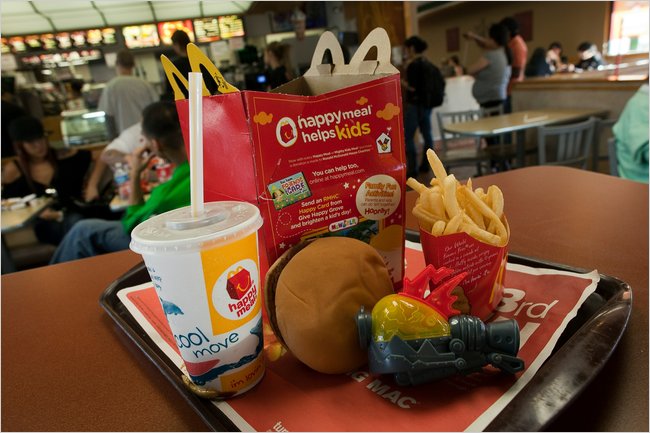
The "New" McDonald's Happy Meals: Apple Slices in the Trash?

This week Michelle Obama proudly stood next to WalMart's executive vice president Leslie Dach as the chain and several others vowed to open stores in USDA designated "food deserts."  Almost all of these stores were already planned when the First Lady inaugurated her campaign against childhood obesity, and the total of 250 to 300 stores WalMart pledged to open within five years weren't mainly in response to a lack of fresh vegetables, but the healthy American desire for profit.  Only now, they'll increase it a lot more, on the backs of taxpayers, who will be subsidizing these new markets to the tune of $35 million this year and--hold onto your hats--$330 million in 2012.  Food Deserts: Helping to increase the urgency of raising the debt ceiling.

Then today, the New York Times featured a story on McDonald's completely altruistic move to cut French fries in Happy Meals by half, substituting three to five apple slices.  The company said it was making the revision "in response to parental and consumer pressure," phasing out Apple Dippers (8-10 slices with caramel dipping sauce) but offering families who eschew fries two smaller apple packs instead.  Parental pressure was not strong enough, however, to inspire the company to cease tucking colorful toys in their Meal boxes, despite some cities' passage of laws restricting their inclusion.

Some consumers scoff at McDonald's efforts to improve the healthfulness of their meals.  They feel their liberty to choose what they want to buy somehow compromised, as if eating high-salt, high-fat, fried-potato fast food is symbolic of freedom from a "nanny state" determined to make decisions for them.  Others suspect McDonald's vow to shave 20% of Happy Meal calories and include less salt and more veggies is simply a clever way to prevent government imposition of even more sweeping, and likely expensive, nutritional requirements for kids' meals.

As it is, there's still plenty unhealthy about those smiling red box lunches youngsters eat under the Golden Arches.  Happy Meals come September will contain a burger or Chicken McNuggets, the smaller pack of fries, apple slices, toy and choice of beverage--which includes sugar-packed, vitamin-free soft drinks as well as 1% milk and lowfat chocolate milk.  By popular demand.

While it could be that McDonald's is modifying its Happy Meals now to prevent legislation forcing their improvement, and despite the change being so minor that New York University nutrition professor Marion Nestle calls it a "sham," the corporation's steps are in the right direction.  It says it will set up advisory boards and phone apps for consumers to get nutrition information, embark on a national "listening tour" for feedback, and involve a third party evaluator (for as-yet-unannounced goals). 

They act despite little evidence that Happy Meals fueled the increase in childhood obesity; after all, they've been offered for 30 years-- since long before childhood obesity rates jumped in the last decade to the present 17%.  Rates for children rose slowly until 2000, peaking in 2003, according to CDC statistics.  Rates of "overweight" in the population have remained constant over time since the 1960s, however--important to note since few health dangers are associated with being "overweight," and articles and alarmists tend to lump together figures for both overweight and obesity.

Also, the literature tends to talk as if Americans have little control over their "poor lifestyle choices," which are the faults of food manufacturers, restaurateurs, cheap school districts that slash P.E. and sports programs, and those eeeeevil inventors of the personal computer, who've parked those kids yearning to be free in front of Hulu, College Humor, Facebook and Stumbleupon. Children have been receiving health education by state mandates for generations; it's not ignorance of the square, pyramid or plate of an ideal diet that has enlarged our citizens against their wills.  And plump is not the desired physique: Hollywood sylphs are still the role models that sell plenty of People and Us Weekly magazines at check-out counters.

Whatever McDonald's motivations for moving toward better nutrition in its offerings, we consumers ought to applaud the result.  After all, these efforts are undertaken for the most noble of reasons--doing well by doing good.  The company seeks to profit, and the way to do it under our free enterprise system is by providing the public something they want enough to pay for.

Does the public want healthier fast food?  Probably not, and if that is born out, McDonald's, like any smart business, will respond.  "McDonald’s has offered apples as a requested choice in Happy Meals since 2004," the company writes in their press release. "And, while recent research found that on average, 88 percent of McDonald’s customers are aware of the option, apples are chosen in only 11 percent of Happy Meal purchases."

At least they're honest--even as they succumb to pressures to health-up their offerings, they can't ignore the primary determinant of their success--the preferences of their customers.  I'd speculate that the trash cans of McDonald's everywhere will contain a lot of apple slices inside those discarded red Happy Meal boxes.  Kids don't clamor for McDonald's to get sliced fruit.

But let the market prevail, and let the nation save the $330 million earmarked next year to make sure apple slices (and other fruits and veggies) can be bought within a mile of all urban residents. That's the definition of a "food desert''--no fresh-food store in walking distance.  Is that the reason so many people are obese, or is it because they choose to buy other types of food at the stores they do patronize?

The do-gooders in government are likely off-track in assuming they know the causes for the rise in obesity between 1980 and 2000, and further assuming that they can manipulate the public back to its formerly svelte proportions with store locations, restaurant menu options, and praise for athletics.  There's much more to understand about the reasons why Americans are fatter (though overall no less healthy), but in the meantime, if McDonald's cuts back the fries and slices up some apples, the kid consumers will decide if that's really a happy meal.

Wednesday, June 15, 2011

Veggies in "Healthy Food Deserts" Won't Cure Obesity

Hand-wringers in universities and government care-for-you offices have rearranged urban geography to stop the obes-ifying of America's children--by deeming certain neighborhoods "healthy food deserts." That's deserts, like the Sahara, not desserts, like what kids are actually eating.

They say that communities lacking large supermarkets, but boasting a plethora of convenience and corner stores, prevent residents from consuming the veggies and fruits that would keep them svelte.  Time and cash-strapped neighbors feed their families the fried chicken, corn dogs, chips and soda these mini-marts sell--but the experts insist that if the same stores featured cucumbers and apples front-and-center instead, parents would opt for the healthy choice.  And they, as well as their children, would be thinner.

This speculative chain of thinking led the "do something" activists--progressively-bent feds, local governments, university researchers and foundations-- to attack the problem the only way they know how: by throwing money at it.  Pres. Obama's stimulus package--our tax dollars at work, through the Centers for Disease Control bureaucracy-- has awarded thirty communities $230 million in grants to prevent childhood obesity.  Local United Way offices have funded "healthy corner store initiatives," like $50,000 to three stores in Franklinville, Ohio, and an unspecified amount in Seattle to upgrade the healthy-food stock and displays in 22 convenience stores in the Delridge neighborhood.  In addition, the W. K. Kellogg Foundation in Battle Creek, Michigan, funded nine sites nationally, including $500,000 to Seattle's King County. In Pennsylvania, $30 million of state grants over three years was triple-matched by $90 million more in grants and loans from The Food Trust, used for 78 grocery outlets in poor neighborhoods.

But the front-page lead article in this week's Sunday Seattle Times paper, combined with its Sunday magazine cover story (funded as a grant project by a California endowment through the University of Southern California) exposes how ineffectual throwing money at fat-causing behaviors really is (even as the feature lamely offers sidebars advising parents on curbing kids' expansion).

The article says that here in my state of Washington, the feds and foundations tossed mega-bucks ($15.5 million from stimulus funds alone) at the "food desert" problem without results. It describes how food-access advocates finally convinced the Delridge "Super 24" corner store to revamp its stock, adding refrigerated cases with an assortment of fruits and veggies. A KOMO TV news story features United Way rep Lauren McGowan pointing to the new cases effusing, "you've got lettuce and limes and lemons and cucumbers, and stuff that families can go home and make a salad, make a fresh meal for their family!"

The news video laments that small convenience stores don't take food stamps, suggesting illogically that this forces homeless customers like Jose Lopez to buy junk food instead: "Oh, I like to have these fruits..." Mr. Lopez, holding a freshly-purchased large coffee says, pointing to a basket of apples, oranges and bananas by the cash register.  He's cut off mid sentence by reporter Elisa Jaffe who finishes, "but they don't take your food stamps."  Lopez shrugs. "They don't."

It's wonderful that kindly community members want their poorer brethren to eat well. But the brethren themselves don't choose to. Bhim Singh, the Delridge store's owner, was lauded in December, 2009 when his new refrigeration units and "healthy choice!" signs touting nutritious items went up. This week's newspaper article, however, provides an update:  "We would spend $200 on vegetables and make only $10," he admits.  He's back to stocking only the longer-shelf life produce he carried before the hoopla, like potatoes and onions.  His clientele, it's clear, keeps him afloat with their fried-food-and soda purchases.

"Officials say they have learned valuable lessons," says the Seattle Times story. "Maybe they didn't spend enough time selling the idea.  In any case, they've budgeted another $1.8 million in hopes of enlisting at least 25 stores."  Don't bore them with facts.

The research considered most definitive on the question of access to healthy food was conducted by the US Department of Agriculture, published in June, 2009.  In it, a national questionnaire (which, when examined, is a pretty poor measure of food access) found that 81 percent of respondents "always had the kinds of food they want to eat."  Sixteen percent had enough, but not "always the kind of food they want to eat." Of that 16%, five percent said they didn't "always have the kinds of food they want to eat" because "it was too hard to get to the store, or the kinds of foods they wanted were not available."  Elderly or infirm people, and those who didn't have the money for food--even if it were easily available--made up more than half of those people--leaving less than 3% of respondents overall who don't "always" have what they want because "the kinds of foods they want are not available."

This calls for another government grant.

Now, nowhere in the study does it ask exactly what are the kinds of foods that respondents wanted.  Might be hallal food, or kosher food.  Might be gluten-free, or sugar-free foods. Might be gourmet cheeses or craft beers.  And of course the questionnaire asked if their desired foods were "always" available. If your market runs out of your brand of cereal or the kind of milk you like, then you aren't "always" able to get what you want.

There's an assumption that people in low-income areas crave fresh fruits and vegetables, but that a nefarious capitalistic force thwarts their innate healthy-food proclivities.

There are indeed market forces at work, and what they do is push shop-keepers to provide their local clientele what that clientele wants--or risk going under.  It's an insult to suggest that poor people don't know the difference between healthy and junk food.  Anyone with a television hears the news stories about Michele Obama's "Let's Move!" program, and watches reports like the video of the Delridge Super 24's new offerings. In 2007 alone, the USDA spent $697 million in classroom education, and every child in school over the last 20 years has, usually by government mandate, learned about good nutrition--but it does no good.  Ask the convenience-store patron buying grease-fried chicken wings about his purchase, and he knows darn well it's less beneficial than the apples he ignored near the cash register.

In fact, that's the exact scenario on the KOMO TV video about the Delridge store.  It opens as heavy-set Joseph Munnerlyn is selecting his purchases. Caught in the act buying junk, he explains, "I'm hungry, I'm trying to get something fast and quick, so I..." A voice-over then interjects that he's "a connoisseur of corner-store meals." Voice up. "Oh, I love it all," Mr. Munnerlyn intones with affection, waving his hand by the fried offerings in a heat-lamp-warmed glass case. "The wings, I mean come on! The breasts, the burritos, the Jo-jos...!" (Jo-jos are breaded and fried potato wedges.)


Bhim Singh owns "Super 24" store
 He gives a sly smile. "I know it's not healthy, but at the same time..." He lifts up an apple from the basket of fruit in front of him at the register. "...It's hard for me to pick up an apple when I've only got two bucks and I've got to feed myself for the rest of the day."  The unchallenged assumption there is that he gets more satisfying food for his money buying Jo-jos than a Jonathan.  It's not his fault.

When it looked at healthy food access by social variables, that Department of Agriculture national study about Americans' access to food found some astonishing conclusions--about supermarkets, typically stocked with a wide assortment of produce-- that the reform-corner-stores crowd might want to consider, such as:

"Overall, median distance to the nearest supermarket is 0.85 miles. Median distance for low-income individuals is about 0.1 of a mile less than for those with higher income, and a greater share of low-income individuals (61.8 percent) have high or medium access to supermarkets than those with higher income (56.1 percent).

"Overall, ethnic and racial minorities have better access to supermarkets than Whites. Median distance to the nearest supermarket for non-White individuals is 0.63 miles, compared with 0.96 miles on average for Whites.

"Similarly, a smaller percentage of non-Whites (26.6 percent) have low access to supermarkets than do Whites (48.2 percent)."

Given failure to influence purchases when corner stores feature fresh fruits and vegetables, and the fact that poor people and minorities have better access nationally to supermarkets than the financially better off and whites, why are anti-obesity experts so gung-ho on watering so-called "healthy food deserts" with tax money and foundation donations?

Because they're desperately searching for do-able solutions to a problem whose cause has still to be defined, and which has foiled all efforts to solve.

It's really not as if gluttony, sloth, inactivity and even childhood obesity are novel foes. According to CDC statistics, the steep increase in childhood obesity began in 1980 and after reaching an alarming peak a few years ago, has leveled off.  Throughout those years, and particularly since 1990, attention at all levels has focused on the issue.  It's just that these problems have proven resistant to even the most expensive and valiant efforts to overcome them.

For decades, millions of dollars have poured into nutritional education.  At the same time that carbonated soft drink consumption declines (every year for the past six!) organic food options burgeon, gaining by 20% every year in the last decade.  Health food stores, once a niche market, have gone mainstream; a case in point--the Whole Foods supermarket chain, begun in 1980 in Austin, now boasts more than 300 outlets.

Still, the mantra throughout professional obesity-world literature is that the problem requires still more investment of public funds. A 2007 book by the Food and Nutrition Board, Progress in Preventing Childhood Obesity: How Do We Measure Up? notes that "Government, industry, communities, schools, and families are responding to the childhood obesity epidemic by implementing a variety of policies, programs, and other interventions," but decides "the current level of investment by the public and private sectors still does not match the extent of the problem."

Of course, its main finding is that we just don't know if all the spending and talking and teaching and fruit-and-veggie-touting is making a difference, phrasing this conclusion in admirably academic terms: "Current data and evidence are inadequate for a comprehensive assessment of the progress that has been made in preventing childhood obesity across the United States."  Ahem.

Obesity in children--and adults--is a far more complex phenomenon than well-meaning agencies and pundits are willing to admit.  And because its causes are not yet understood, creating innumerable boards and bureaucracies to eradicate it (and make food deserts bloom) have failed. To be sure, some money must go toward innovative medical research to tease out the true sources of obesity--and whether the future generation is as doomed by it as alarmists insist.

I suspect that genetics and environmental influences (A virus, like the Adenovirus 36? An "obeso-genic" substance or situation that, like carcinogens, throws cells out of whack?) will prove contributors to the problem, and that unfair stereotypes that suggest all fat people are ignorant, have no self-control and need patronizing interventions will be squashed like the unsold tomatoes at Super 24 in Delridge, Washington.

Wednesday, February 16, 2011

New Dietary Guidelines: Hailed, Hackneyed and--a Cause of Obesity?

Big praise everywhere for the brand-new Dietary Guidelines for Americans, just released by the US Departments of Agriculture and Health. But why?

Apparently, previous guidelines had tip-toed on eggshells so as not to offend well-subsidized farmers and interest groups.  Fast food corporations pay good money in taxes, so the Feds didn't want to suggest that Supersized Fries should feed three, or that the Colonel quit serving chick wings you have to blot with paper towels to eat.

The Guidelines come out every five years by law, and the last one, in 2005, had very similar recommendations, just in less directive language. We've all been hammered with this same nutritional info since the first report in 1980. Every kid who's ever taken Health in junior high school has been tested on it.  Anyone who walks down a supermarket aisle gets a refresher course: "Now, with more fiber!" reads a label.  "And here's a great way to get those five servings of fruits and veggies!" chirps some food guru on a flat-screen TV in the produce section or over the check-out stand.

Let's see, do we want the margarine with the trans-fats or without??  The boastful red ZERO on the tub assures us no grams of that nasty heart-clogger lurk inside.

The problem is that despite redundant emphasis on less sweet and processed food, more fruits and veggies, more fiber and whole grains, less soda and salt--you know the drill--Americans have just gotten fatter.  Frankly, the statistics on obesity are a bit different from what we're led to believe, and I'll discuss them momentarily, but the result of the Feds' urging us to watch our dietary consumption is the opposite of their aim.  Knowledge and ubiquitous publicity about "shoulds" of nutrition have only brought a chunkier population. At the conclusion of this post, I'll tell you why.

In any case, with Michelle Obama adopting obesity-remediation as her personal campaign, we're sure to hear more...and more about it. Let's move!

Obesity stats: First off, a major caveat that the Centers for Disease Control uses the measure of BMI, "body mass index," which is notoriously crude, but all we've got. Every few years, statisticians of the NHANES program of the National Center for Health Statistics go out and take measurements on a sample using consistent methods, and classify subjects into three categories of heft, "overweight," "obese," and "extremely obese."


Now, here's the interesting thing: For adults over age 20, the "overweight," (BMI between 25 and 30) percentage of the population has stayed consistent for 50 years.  It was 31.5% in 1960-62, and 32.3 at the next measurement, 1971-4, compared to the latest figures from 2007-8 when 33.6% were overweight.  In 2005-6, "overweight" subjects were 32.2%, a tenth of a percentage LOWER than the figure for 1971-74.

The situation for the category called "obese," (BMI between 30 and 40) expanded from 13.4% at the 1960-62 first measurement to 15% in 1980. But then--at the next measurement (1988-94), there was a jump to 23.2%. And by the following measure, 1999-2000, the "obese" category swelled to 30.9%. That's a one-hundred-percent increase in just ten years! If people continued ballooning at the same pace, we'd expect to see 60% of the population "obese" by 2010--what a thought!

But there's a different outcome. Let me quote Katherine M. Flegal, et. al, a foremost researcher on obesity trends, in the Journal of the American Medical Association, (January 20, 2010—Vol 303, No. 3, page 235):

"In 2007-2008, the prevalence of obesity was 32.2% among adult men and 35.5% among adult women. The increases in the prevalence of obesity previously observed do not appear to be continuing at the same rate over the past 10 years, particularly for women and possibly for men."

Finally, stats regarding the "extremely obese" (BMI more than 40) are downright scary. In 1962, just .9% of the population--less than one percent--fell into that category. By 1976-80, the percentage was up to 1.4%. At the next measurement, 1988-94, the percentage doubled, to 3.0; by 2000 it was 5.0, and by 2005-6, it was 6.2%. The latest (2008) numbers show a slight drop, to 6.0%. The percentage of "extremely obese" mushroomed five hundred percent from 1962.

Why do I go through all these figures? Because they show that in the 20 years between 1980 and 2000, the rate of obesity skyrocketed. But it varied little before and after that period. Curious.

Do we blame those twenty years of thickening on McDonald's (which already had 1,000 restaurants by 1968) and fast food? On companies that added thousands of products to store shelves to answer working women's demand for convenience? On sloth encouraged by TV and the new lure of computer games? Or...could it be due to a virus (adenovirus 36)?  Hard to tell.

And do you believe it's education that suddenly stopped that steep climb in obesity a decade ago?


The authors of the 112 pages of the current "Dietary Guidelines"  (really only 59 pages of written content before all the appendices) would have us think so. Their recommendations are written in such lofty, vague, sweeping, academic and sometimes, hysterically funny prose as to render them flaccid.  And of course, the document recommends lots more government studies and commissions and interventions and regulations and education efforts as the way to shrink the citizenry. And inflate the budget.

Then, in a final chapter, the Guidelines acknowledge:
Although more consumer education is needed on achieving calorie balance, meeting nutrient needs, and staying physically active, information alone does not lead to behavior change.

Yes, that's right. You can lead a kid to water, but you can't make him drink (if there's soda handy), as the barage of healthy-eating information over the last thirty years has demonstrated.  Additional commissions and partnerships and studies likely won't work to reduce us either, if propping fan mags featuring skinny movie stars right where you buy your food can't inspire purchasers to slim down.  Shoppers ingest the magazine's cheesecake photos as they're loading their Haagen Dazs onto the conveyor belt.

Every market contains vegetables, a far wider variety of them than when I was growing up, including microwave-ready pouches you just nuke for five minutes and fork into.  Just about everyone has access to healthy food as well as the simply satisfying kind, the neck-up tranquilizers that offer rewarding crunches to salve frustration, or creamy smoothness to comfort.  Anybody can put on tennis shoes and go for a jog, or a walk, or climb the stairs in the building--they just don't.  The Guidelines are likely useless, but okay, if they mean there will be less junk in junk food, great.

I believe, however, that the Guidelines and experts telling Americans what they should eat and do are actually causing obesity, because they teach us to not trust our own instincts, to detach from our natural signals of hunger and satiation, and to override the internal mechanism that tells us what it is our bodies need right then.

If we could stop saying that sugar and ice cream are "bad" and celery and apples are "good," we just might clear the way to understand what our naturally thin grandparents did:  you eat when you're hungry, eat what pleases you, and move on to other activities when comfortably sated.  If it were possible to respect our individual likes and dislikes and toss out pyramids that once were squares, perhaps we could be at peace enough to relax about food and get on with actually developing our talents and minds and accomplishments.

One of the most humorous parts of the Dietary Guidelines is a silly diagram (6:1) of all the influences on people's eating and exercise habits.  Using colored ovals and arcs, we get a list of everything a bunch of people could brainstorm, including religion, community design and safety, food service and retail establishments, body image.  The one influence on what we eat that was completely absent from the 24 items packed into 4 sub categories was--body cues.  Hunger.

In other words, the authors of the august Dietary Guidelines for Americans 2010 believe eating choices are completely determined by factors external to the body consuming the food.

Certainly, the choice of particular foods that might satisfy one's body needs is shaped by factors like the cuisine of his family, or what's available.  But what's behind the idea of, say, "I feel like having a hamburger" versus "feeling like" having any other item on the menu?  The Dietary Guidelines would have us disregard the natural messages that tell us what we need nutritionally in favor of chewing some tasteless whole-grain lump, or even a tasty whole-grain lump that wasn't what our bodies needed at that moment.

I realize I'm going against the grain, but the Guidelines' emphasis on distinguishing bad from good foods turns attention from the primary source of food choices, which should be the body's communication of its needs, rather than a Federal Department or even the First Lady.