One of my favorite games is finding connections between seemingly unrelated phenomena. What do "healthy food deserts" have to do with Internet sensation Caine Monroy, the 9-year-old who made a cardboard arcade at his dad's auto parts store in LA?
Aside from the fact they both interest me, they both say something about the free enterprise system.
Lots of my friends sent me last week's New York Times front-page story about "healthy food deserts" because they recalled my post nearly a year ago saying the same thing. New studies now verify that obese people don't lack access to fresh food. The twisted conventional wisdom blames eeeevil fast food chains, with their nefarious advertising campaigns, for expanding the national girth by forcing out sources of healthy veggies: in 2008 a third of the US population was overweight, and an additional third obese.
The assumption is that the obese would choose salads over Big Macs if only they had lettuce, cucumber and tomatoes nearby. Our government has pumped hundreds of millions of dollars directly, and at least another $250 million into tax credits to make food deserts bloom with carrots and broccoli (detailed in my blog). The problem is--all along studies have shown that people in the poorest neighborhoods, with the highest percentages of obese residents, actually have greater choices for food than other areas, including stores with bountiful fresh vegetables.
Yes, I told you so, and I also told you that the real issue isn't availability of food but the fact that our "do something" culture tries to spend its way out of problems, even before understanding their causes. We don't need to throw money at corner stores so that they'll put baskets of fruit by the cash register (to rot). We need to find out the real reasons why obesity rates climbed steeply between 1980 and 2000, and remained steady ever since. Is it a virus (Adeno 36)? A mutant gene (called "FTO"), a hormonal shift (related to ghrelin) or something else? It's not that big corporations, in their greediness, foist gluttony on a hapless public.
And neither is it only that consumers themselves are shoveling sugary calories into their mouths while inert at their computer screens. I was struck viewing an excellent BBC TV series called "Why are Thin People Not Fat?" that followed ten thin people through four weeks of consuming twice the calories they needed, exercise forbidden. Under careful medical supervision that monitored everything--including minute changes in body composition measured inside a strange egg-shaped device that sucks out the air inside--volunteers documented their own fattening processes. It was expected they'd gain about 15% of their body weights in that time, but the "winner," the person gaining the most, added 9%, practically invisible on his frame because it was muscle, not fat. Some added as little as 2% to their body weights. And in every case, after the experiment the extra weight fell off effortlessly, almost immediately.
We learn from this that some people are designed to be thin; others (for a variety of reasons) are going to be fat, and temporary alterations in consumption aren't likely to bring permanent results. Ask anyone who's dieted.
Flash now to an industrious kid in Los Angeles, who instead of spending a lonely summer watching Hulu or playing video games, decided to create something: A place for other people to have fun, from which he would profit. Caine Monroy made discarded cardboard boxes into an old-fashioned arcade, where players could throw a wad-of-tape ball through a net, or dodge rows of scotch-taped toy soldiers, and if successful could trade win tickets Caine pushed through a slot for prizes. The games weren't really impressive, and the ever-hopeful Caine was heart-rending, waiting by his creation with nary a customer, hour after hour.
Until documentary-maker Nirvan Mullick happened by for an auto part, and was captivated by the Rube Goldberg array of cardboard options. His touching 11-minute YouTube about the flash mob he organized to surprise the boy went viral and catapulted Caine and his kindly dad to national fame. Now a scholarship fund for his college education holds $170,000, according to a New York Times article, and Forbes magazine predicts Caine will be a billionaire within 30 years.
I'm not the first to point out how Caine's charming story illustrates that the drive to achieve and improve one's lot still thrives in America, and that the entrepreneurial spirit flourishes even in the face of discouragement (like zero foot traffic near your cardboard arcade). But the same free enterprise system explains why the notion of "food deserts" is a crock.
Business is wonderful; Owners profit by providing people something they want, at a price they're willing to pay. A 9-year-old bases his arcade on the premise that others want to have fun; a grocer in the inner city stocks his shelves in response to the foods his customers want to buy. It turns out that even with vegetables available, more people want to buy packaged food. When the system works, supply responds to demand.
The impressive thing about Caine isn't really his adorable discarded-carton arcade, but his indomitable industry. Before taping together his boxes, Caine tried peddling yard signs, and sold soda and chips door-to-door in his neighborhood. He offered rubber bracelets on eBay and at swap meets. If Nirvan Mullick didn't happen by, Caine would no doubt have invented another get-rich-quick scheme. How come a kid knows something governments don't? Some people do
The bottom line actually refers to the top: social programs from the government down seldom succeed in improving people's values, but the values of tenacity and applied creativity can make a big difference when expressed from the individual up.
For $15, Caine will sell you a self-designed "staff" t-shirt that says "Caine's Arcade" on the back. The Times article describes a shirt purchaser who offered him a $20 bill. Before pulling out his stash,"without a hint of sarcasm," Caine queried his customer: "Do you need any change?" For $2, he'll sell you a "fun pass" good for 500 turns, 20 seconds each, as counted aloud by the young proprietor.
By contrast, handing a corner grocery store $100,000 in tax money to add refrigerated veggie display cases to supply a nonexistent demand makes no business sense. Instead, the purpose is to salve the "do something" conscience of bureaucrats and bleeding-hearts far away, who think they know best how to help fat unfortunates.
Subsidizing stores to carry undesired items shows appalling disregard for a free-market system 9-year-old Caine already understands. Which effort is more likely to succeed--the one to slim down neighbors by stocking more veggies for them to buy, or a kid willing to keep taking entrepreneurial risks until one breaks through?
I'll take the fun pass.
"The world is so full of a number of things, I'm sure we should all be as happy as kings." --Robert Louis Stevenson.
Showing posts with label "healthy food desert". Show all posts
Monday, April 23, 2012
Thursday, July 28, 2011
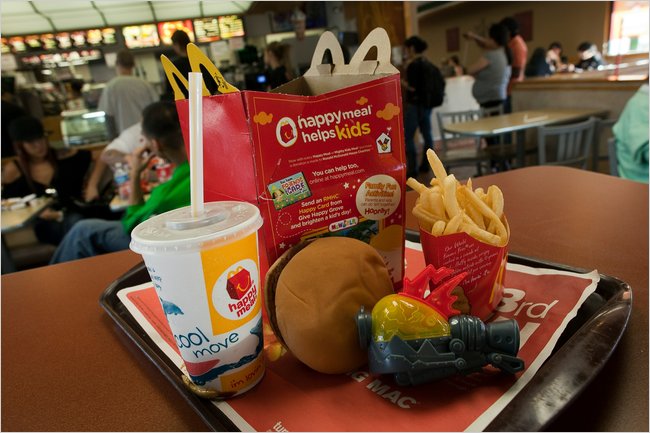
The "New" McDonald's Happy Meals: Apple Slices in the Trash?
This week Michelle Obama proudly stood next to WalMart's executive vice president Leslie Dach as the chain and several others vowed to open stores in USDA designated "food deserts." Almost all of these stores were already planned when the First Lady inaugurated her campaign against childhood obesity, and the total of 250 to 300 stores WalMart pledged to open within five years weren't mainly in response to a lack of fresh vegetables, but the healthy American desire for profit. Only now, they'll increase it a lot more, on the backs of taxpayers, who will be subsidizing these new markets to the tune of $35 million this year and--hold onto your hats--$330 million in 2012. Food Deserts: Helping to increase the urgency of raising the debt ceiling.
Then today, the New York Times featured a story on McDonald's completely altruistic move to cut French fries in Happy Meals by half, substituting three to five apple slices. The company said it was making the revision "in response to parental and consumer pressure," phasing out Apple Dippers (8-10 slices with caramel dipping sauce) but offering families who eschew fries two smaller apple packs instead. Parental pressure was not strong enough, however, to inspire the company to cease tucking colorful toys in their Meal boxes, despite some cities' passage of laws restricting their inclusion.
Some consumers scoff at McDonald's efforts to improve the healthfulness of their meals. They feel their liberty to choose what they want to buy somehow compromised, as if eating high-salt, high-fat, fried-potato fast food is symbolic of freedom from a "nanny state" determined to make decisions for them. Others suspect McDonald's vow to shave 20% of Happy Meal calories and include less salt and more veggies is simply a clever way to prevent government imposition of even more sweeping, and likely expensive, nutritional requirements for kids' meals.
As it is, there's still plenty unhealthy about those smiling red box lunches youngsters eat under the Golden Arches. Happy Meals come September will contain a burger or Chicken McNuggets, the smaller pack of fries, apple slices, toy and choice of beverage--which includes sugar-packed, vitamin-free soft drinks as well as 1% milk and lowfat chocolate milk. By popular demand.
While it could be that McDonald's is modifying its Happy Meals now to prevent legislation forcing their improvement, and despite the change being so minor that New York University nutrition professor Marion Nestle calls it a "sham," the corporation's steps are in the right direction. It says it will set up advisory boards and phone apps for consumers to get nutrition information, embark on a national "listening tour" for feedback, and involve a third party evaluator (for as-yet-unannounced goals).
They act despite little evidence that Happy Meals fueled the increase in childhood obesity; after all, they've been offered for 30 years-- since long before childhood obesity rates jumped in the last decade to the present 17%. Rates for children rose slowly until 2000, peaking in 2003, according to CDC statistics. Rates of "overweight" in the population have remained constant over time since the 1960s, however--important to note since few health dangers are associated with being "overweight," and articles and alarmists tend to lump together figures for both overweight and obesity.
Also, the literature tends to talk as if Americans have little control over their "poor lifestyle choices," which are the faults of food manufacturers, restaurateurs, cheap school districts that slash P.E. and sports programs, and those eeeeevil inventors of the personal computer, who've parked those kids yearning to be free in front of Hulu, College Humor, Facebook and Stumbleupon. Children have been receiving health education by state mandates for generations; it's not ignorance of the square, pyramid or plate of an ideal diet that has enlarged our citizens against their wills. And plump is not the desired physique: Hollywood sylphs are still the role models that sell plenty of People and Us Weekly magazines at check-out counters.
Whatever McDonald's motivations for moving toward better nutrition in its offerings, we consumers ought to applaud the result. After all, these efforts are undertaken for the most noble of reasons--doing well by doing good. The company seeks to profit, and the way to do it under our free enterprise system is by providing the public something they want enough to pay for.
Does the public want healthier fast food? Probably not, and if that is born out, McDonald's, like any smart business, will respond. "McDonald’s has offered apples as a requested choice in Happy Meals since 2004," the company writes in their press release. "And, while recent research found that on average, 88 percent of McDonald’s customers are aware of the option, apples are chosen in only 11 percent of Happy Meal purchases."
At least they're honest--even as they succumb to pressures to health-up their offerings, they can't ignore the primary determinant of their success--the preferences of their customers. I'd speculate that the trash cans of McDonald's everywhere will contain a lot of apple slices inside those discarded red Happy Meal boxes. Kids don't clamor for McDonald's to get sliced fruit.
But let the market prevail, and let the nation save the $330 million earmarked next year to make sure apple slices (and other fruits and veggies) can be bought within a mile of all urban residents. That's the definition of a "food desert''--no fresh-food store in walking distance. Is that the reason so many people are obese, or is it because they choose to buy other types of food at the stores they do patronize?
The do-gooders in government are likely off-track in assuming they know the causes for the rise in obesity between 1980 and 2000, and further assuming that they can manipulate the public back to its formerly svelte proportions with store locations, restaurant menu options, and praise for athletics. There's much more to understand about the reasons why Americans are fatter (though overall no less healthy), but in the meantime, if McDonald's cuts back the fries and slices up some apples, the kid consumers will decide if that's really a happy meal.
Wednesday, June 15, 2011
Veggies in "Healthy Food Deserts" Won't Cure Obesity
Hand-wringers in universities and government care-for-you offices have rearranged urban geography to stop the obes-ifying of America's children--by deeming certain neighborhoods "healthy food deserts." That's deserts, like the Sahara, not desserts, like what kids are actually eating.
They say that communities lacking large supermarkets, but boasting a plethora of convenience and corner stores, prevent residents from consuming the veggies and fruits that would keep them svelte. Time and cash-strapped neighbors feed their families the fried chicken, corn dogs, chips and soda these mini-marts sell--but the experts insist that if the same stores featured cucumbers and apples front-and-center instead, parents would opt for the healthy choice. And they, as well as their children, would be thinner.
This speculative chain of thinking led the "do something" activists--progressively-bent feds, local governments, university researchers and foundations-- to attack the problem the only way they know how: by throwing money at it. Pres. Obama's stimulus package--our tax dollars at work, through the Centers for Disease Control bureaucracy-- has awarded thirty communities $230 million in grants to prevent childhood obesity. Local United Way offices have funded "healthy corner store initiatives," like $50,000 to three stores in Franklinville, Ohio, and an unspecified amount in Seattle to upgrade the healthy-food stock and displays in 22 convenience stores in the Delridge neighborhood. In addition, the W. K. Kellogg Foundation in Battle Creek, Michigan, funded nine sites nationally, including $500,000 to Seattle's King County. In Pennsylvania, $30 million of state grants over three years was triple-matched by $90 million more in grants and loans from The Food Trust, used for 78 grocery outlets in poor neighborhoods.
But the front-page lead article in this week's Sunday Seattle Times paper, combined with its Sunday magazine cover story (funded as a grant project by a California endowment through the University of Southern California) exposes how ineffectual throwing money at fat-causing behaviors really is (even as the feature lamely offers sidebars advising parents on curbing kids' expansion).
The article says that here in my state of Washington, the feds and foundations tossed mega-bucks ($15.5 million from stimulus funds alone) at the "food desert" problem without results. It describes how food-access advocates finally convinced the Delridge "Super 24" corner store to revamp its stock, adding refrigerated cases with an assortment of fruits and veggies. A KOMO TV news story features United Way rep Lauren McGowan pointing to the new cases effusing, "you've got lettuce and limes and lemons and cucumbers, and stuff that families can go home and make a salad, make a fresh meal for their family!"
The news video laments that small convenience stores don't take food stamps, suggesting illogically that this forces homeless customers like Jose Lopez to buy junk food instead: "Oh, I like to have these fruits..." Mr. Lopez, holding a freshly-purchased large coffee says, pointing to a basket of apples, oranges and bananas by the cash register. He's cut off mid sentence by reporter Elisa Jaffe who finishes, "but they don't take your food stamps." Lopez shrugs. "They don't."
It's wonderful that kindly community members want their poorer brethren to eat well. But the brethren themselves don't choose to. Bhim Singh, the Delridge store's owner, was lauded in December, 2009 when his new refrigeration units and "healthy choice!" signs touting nutritious items went up. This week's newspaper article, however, provides an update: "We would spend $200 on vegetables and make only $10," he admits. He's back to stocking only the longer-shelf life produce he carried before the hoopla, like potatoes and onions. His clientele, it's clear, keeps him afloat with their fried-food-and soda purchases.
"Officials say they have learned valuable lessons," says the Seattle Times story. "Maybe they didn't spend enough time selling the idea. In any case, they've budgeted another $1.8 million in hopes of enlisting at least 25 stores." Don't bore them with facts.
The research considered most definitive on the question of access to healthy food was conducted by the US Department of Agriculture, published in June, 2009. In it, a national questionnaire (which, when examined, is a pretty poor measure of food access) found that 81 percent of respondents "always had the kinds of food they want to eat." Sixteen percent had enough, but not "always the kind of food they want to eat." Of that 16%, five percent said they didn't "always have the kinds of food they want to eat" because "it was too hard to get to the store, or the kinds of foods they wanted were not available." Elderly or infirm people, and those who didn't have the money for food--even if it were easily available--made up more than half of those people--leaving less than 3% of respondents overall who don't "always" have what they want because "the kinds of foods they want are not available."
This calls for another government grant.
Now, nowhere in the study does it ask exactly what are the kinds of foods that respondents wanted. Might be hallal food, or kosher food. Might be gluten-free, or sugar-free foods. Might be gourmet cheeses or craft beers. And of course the questionnaire asked if their desired foods were "always" available. If your market runs out of your brand of cereal or the kind of milk you like, then you aren't "always" able to get what you want.
There's an assumption that people in low-income areas crave fresh fruits and vegetables, but that a nefarious capitalistic force thwarts their innate healthy-food proclivities.
There are indeed market forces at work, and what they do is push shop-keepers to provide their local clientele what that clientele wants--or risk going under. It's an insult to suggest that poor people don't know the difference between healthy and junk food. Anyone with a television hears the news stories about Michele Obama's "Let's Move!" program, and watches reports like the video of the Delridge Super 24's new offerings. In 2007 alone, the USDA spent $697 million in classroom education, and every child in school over the last 20 years has, usually by government mandate, learned about good nutrition--but it does no good. Ask the convenience-store patron buying grease-fried chicken wings about his purchase, and he knows darn well it's less beneficial than the apples he ignored near the cash register.
In fact, that's the exact scenario on the KOMO TV video about the Delridge store. It opens as heavy-set Joseph Munnerlyn is selecting his purchases. Caught in the act buying junk, he explains, "I'm hungry, I'm trying to get something fast and quick, so I..." A voice-over then interjects that he's "a connoisseur of corner-store meals." Voice up. "Oh, I love it all," Mr. Munnerlyn intones with affection, waving his hand by the fried offerings in a heat-lamp-warmed glass case. "The wings, I mean come on! The breasts, the burritos, the Jo-jos...!" (Jo-jos are breaded and fried potato wedges.)
When it looked at healthy food access by social variables, that Department of Agriculture national study about Americans' access to food found some astonishing conclusions--about supermarkets, typically stocked with a wide assortment of produce-- that the reform-corner-stores crowd might want to consider, such as:
"Overall, median distance to the nearest supermarket is 0.85 miles. Median distance for low-income individuals is about 0.1 of a mile less than for those with higher income, and a greater share of low-income individuals (61.8 percent) have high or medium access to supermarkets than those with higher income (56.1 percent).
"Overall, ethnic and racial minorities have better access to supermarkets than Whites. Median distance to the nearest supermarket for non-White individuals is 0.63 miles, compared with 0.96 miles on average for Whites.
"Similarly, a smaller percentage of non-Whites (26.6 percent) have low access to supermarkets than do Whites (48.2 percent)."
Given failure to influence purchases when corner stores feature fresh fruits and vegetables, and the fact that poor people and minorities have better access nationally to supermarkets than the financially better off and whites, why are anti-obesity experts so gung-ho on watering so-called "healthy food deserts" with tax money and foundation donations?
Because they're desperately searching for do-able solutions to a problem whose cause has still to be defined, and which has foiled all efforts to solve.
It's really not as if gluttony, sloth, inactivity and even childhood obesity are novel foes. According to CDC statistics, the steep increase in childhood obesity began in 1980 and after reaching an alarming peak a few years ago, has leveled off. Throughout those years, and particularly since 1990, attention at all levels has focused on the issue. It's just that these problems have proven resistant to even the most expensive and valiant efforts to overcome them.
For decades, millions of dollars have poured into nutritional education. At the same time that carbonated soft drink consumption declines (every year for the past six!) organic food options burgeon, gaining by 20% every year in the last decade. Health food stores, once a niche market, have gone mainstream; a case in point--the Whole Foods supermarket chain, begun in 1980 in Austin, now boasts more than 300 outlets.
Still, the mantra throughout professional obesity-world literature is that the problem requires still more investment of public funds. A 2007 book by the Food and Nutrition Board, Progress in Preventing Childhood Obesity: How Do We Measure Up? notes that "Government, industry, communities, schools, and families are responding to the childhood obesity epidemic by implementing a variety of policies, programs, and other interventions," but decides "the current level of investment by the public and private sectors still does not match the extent of the problem."
Of course, its main finding is that we just don't know if all the spending and talking and teaching and fruit-and-veggie-touting is making a difference, phrasing this conclusion in admirably academic terms: "Current data and evidence are inadequate for a comprehensive assessment of the progress that has been made in preventing childhood obesity across the United States." Ahem.
Obesity in children--and adults--is a far more complex phenomenon than well-meaning agencies and pundits are willing to admit. And because its causes are not yet understood, creating innumerable boards and bureaucracies to eradicate it (and make food deserts bloom) have failed. To be sure, some money must go toward innovative medical research to tease out the true sources of obesity--and whether the future generation is as doomed by it as alarmists insist.
I suspect that genetics and environmental influences (A virus, like the Adenovirus 36? An "obeso-genic" substance or situation that, like carcinogens, throws cells out of whack?) will prove contributors to the problem, and that unfair stereotypes that suggest all fat people are ignorant, have no self-control and need patronizing interventions will be squashed like the unsold tomatoes at Super 24 in Delridge, Washington.
They say that communities lacking large supermarkets, but boasting a plethora of convenience and corner stores, prevent residents from consuming the veggies and fruits that would keep them svelte. Time and cash-strapped neighbors feed their families the fried chicken, corn dogs, chips and soda these mini-marts sell--but the experts insist that if the same stores featured cucumbers and apples front-and-center instead, parents would opt for the healthy choice. And they, as well as their children, would be thinner.
This speculative chain of thinking led the "do something" activists--progressively-bent feds, local governments, university researchers and foundations-- to attack the problem the only way they know how: by throwing money at it. Pres. Obama's stimulus package--our tax dollars at work, through the Centers for Disease Control bureaucracy-- has awarded thirty communities $230 million in grants to prevent childhood obesity. Local United Way offices have funded "healthy corner store initiatives," like $50,000 to three stores in Franklinville, Ohio, and an unspecified amount in Seattle to upgrade the healthy-food stock and displays in 22 convenience stores in the Delridge neighborhood. In addition, the W. K. Kellogg Foundation in Battle Creek, Michigan, funded nine sites nationally, including $500,000 to Seattle's King County. In Pennsylvania, $30 million of state grants over three years was triple-matched by $90 million more in grants and loans from The Food Trust, used for 78 grocery outlets in poor neighborhoods.
But the front-page lead article in this week's Sunday Seattle Times paper, combined with its Sunday magazine cover story (funded as a grant project by a California endowment through the University of Southern California) exposes how ineffectual throwing money at fat-causing behaviors really is (even as the feature lamely offers sidebars advising parents on curbing kids' expansion).
The article says that here in my state of Washington, the feds and foundations tossed mega-bucks ($15.5 million from stimulus funds alone) at the "food desert" problem without results. It describes how food-access advocates finally convinced the Delridge "Super 24" corner store to revamp its stock, adding refrigerated cases with an assortment of fruits and veggies. A KOMO TV news story features United Way rep Lauren McGowan pointing to the new cases effusing, "you've got lettuce and limes and lemons and cucumbers, and stuff that families can go home and make a salad, make a fresh meal for their family!"
The news video laments that small convenience stores don't take food stamps, suggesting illogically that this forces homeless customers like Jose Lopez to buy junk food instead: "Oh, I like to have these fruits..." Mr. Lopez, holding a freshly-purchased large coffee says, pointing to a basket of apples, oranges and bananas by the cash register. He's cut off mid sentence by reporter Elisa Jaffe who finishes, "but they don't take your food stamps." Lopez shrugs. "They don't."
It's wonderful that kindly community members want their poorer brethren to eat well. But the brethren themselves don't choose to. Bhim Singh, the Delridge store's owner, was lauded in December, 2009 when his new refrigeration units and "healthy choice!" signs touting nutritious items went up. This week's newspaper article, however, provides an update: "We would spend $200 on vegetables and make only $10," he admits. He's back to stocking only the longer-shelf life produce he carried before the hoopla, like potatoes and onions. His clientele, it's clear, keeps him afloat with their fried-food-and soda purchases.
"Officials say they have learned valuable lessons," says the Seattle Times story. "Maybe they didn't spend enough time selling the idea. In any case, they've budgeted another $1.8 million in hopes of enlisting at least 25 stores." Don't bore them with facts.
The research considered most definitive on the question of access to healthy food was conducted by the US Department of Agriculture, published in June, 2009. In it, a national questionnaire (which, when examined, is a pretty poor measure of food access) found that 81 percent of respondents "always had the kinds of food they want to eat." Sixteen percent had enough, but not "always the kind of food they want to eat." Of that 16%, five percent said they didn't "always have the kinds of food they want to eat" because "it was too hard to get to the store, or the kinds of foods they wanted were not available." Elderly or infirm people, and those who didn't have the money for food--even if it were easily available--made up more than half of those people--leaving less than 3% of respondents overall who don't "always" have what they want because "the kinds of foods they want are not available."
This calls for another government grant.
Now, nowhere in the study does it ask exactly what are the kinds of foods that respondents wanted. Might be hallal food, or kosher food. Might be gluten-free, or sugar-free foods. Might be gourmet cheeses or craft beers. And of course the questionnaire asked if their desired foods were "always" available. If your market runs out of your brand of cereal or the kind of milk you like, then you aren't "always" able to get what you want.
There's an assumption that people in low-income areas crave fresh fruits and vegetables, but that a nefarious capitalistic force thwarts their innate healthy-food proclivities.
There are indeed market forces at work, and what they do is push shop-keepers to provide their local clientele what that clientele wants--or risk going under. It's an insult to suggest that poor people don't know the difference between healthy and junk food. Anyone with a television hears the news stories about Michele Obama's "Let's Move!" program, and watches reports like the video of the Delridge Super 24's new offerings. In 2007 alone, the USDA spent $697 million in classroom education, and every child in school over the last 20 years has, usually by government mandate, learned about good nutrition--but it does no good. Ask the convenience-store patron buying grease-fried chicken wings about his purchase, and he knows darn well it's less beneficial than the apples he ignored near the cash register.
In fact, that's the exact scenario on the KOMO TV video about the Delridge store. It opens as heavy-set Joseph Munnerlyn is selecting his purchases. Caught in the act buying junk, he explains, "I'm hungry, I'm trying to get something fast and quick, so I..." A voice-over then interjects that he's "a connoisseur of corner-store meals." Voice up. "Oh, I love it all," Mr. Munnerlyn intones with affection, waving his hand by the fried offerings in a heat-lamp-warmed glass case. "The wings, I mean come on! The breasts, the burritos, the Jo-jos...!" (Jo-jos are breaded and fried potato wedges.)
He gives a sly smile. "I know it's not healthy, but at the same time..." He lifts up an apple from the basket of fruit in front of him at the register. "...It's hard for me to pick up an apple when I've only got two bucks and I've got to feed myself for the rest of the day." The unchallenged assumption there is that he gets more satisfying food for his money buying Jo-jos than a Jonathan. It's not his fault.
![]() |
| Bhim Singh owns "Super 24" store |
When it looked at healthy food access by social variables, that Department of Agriculture national study about Americans' access to food found some astonishing conclusions--about supermarkets, typically stocked with a wide assortment of produce-- that the reform-corner-stores crowd might want to consider, such as:
"Overall, median distance to the nearest supermarket is 0.85 miles. Median distance for low-income individuals is about 0.1 of a mile less than for those with higher income, and a greater share of low-income individuals (61.8 percent) have high or medium access to supermarkets than those with higher income (56.1 percent).
"Overall, ethnic and racial minorities have better access to supermarkets than Whites. Median distance to the nearest supermarket for non-White individuals is 0.63 miles, compared with 0.96 miles on average for Whites.
"Similarly, a smaller percentage of non-Whites (26.6 percent) have low access to supermarkets than do Whites (48.2 percent)."
Given failure to influence purchases when corner stores feature fresh fruits and vegetables, and the fact that poor people and minorities have better access nationally to supermarkets than the financially better off and whites, why are anti-obesity experts so gung-ho on watering so-called "healthy food deserts" with tax money and foundation donations?
Because they're desperately searching for do-able solutions to a problem whose cause has still to be defined, and which has foiled all efforts to solve.
It's really not as if gluttony, sloth, inactivity and even childhood obesity are novel foes. According to CDC statistics, the steep increase in childhood obesity began in 1980 and after reaching an alarming peak a few years ago, has leveled off. Throughout those years, and particularly since 1990, attention at all levels has focused on the issue. It's just that these problems have proven resistant to even the most expensive and valiant efforts to overcome them.
For decades, millions of dollars have poured into nutritional education. At the same time that carbonated soft drink consumption declines (every year for the past six!) organic food options burgeon, gaining by 20% every year in the last decade. Health food stores, once a niche market, have gone mainstream; a case in point--the Whole Foods supermarket chain, begun in 1980 in Austin, now boasts more than 300 outlets.
Still, the mantra throughout professional obesity-world literature is that the problem requires still more investment of public funds. A 2007 book by the Food and Nutrition Board, Progress in Preventing Childhood Obesity: How Do We Measure Up? notes that "Government, industry, communities, schools, and families are responding to the childhood obesity epidemic by implementing a variety of policies, programs, and other interventions," but decides "the current level of investment by the public and private sectors still does not match the extent of the problem."
Of course, its main finding is that we just don't know if all the spending and talking and teaching and fruit-and-veggie-touting is making a difference, phrasing this conclusion in admirably academic terms: "Current data and evidence are inadequate for a comprehensive assessment of the progress that has been made in preventing childhood obesity across the United States." Ahem.
Obesity in children--and adults--is a far more complex phenomenon than well-meaning agencies and pundits are willing to admit. And because its causes are not yet understood, creating innumerable boards and bureaucracies to eradicate it (and make food deserts bloom) have failed. To be sure, some money must go toward innovative medical research to tease out the true sources of obesity--and whether the future generation is as doomed by it as alarmists insist.
I suspect that genetics and environmental influences (A virus, like the Adenovirus 36? An "obeso-genic" substance or situation that, like carcinogens, throws cells out of whack?) will prove contributors to the problem, and that unfair stereotypes that suggest all fat people are ignorant, have no self-control and need patronizing interventions will be squashed like the unsold tomatoes at Super 24 in Delridge, Washington.
Subscribe to:
Posts (Atom)