Tuesday, August 24, 2010

"Velcro Parents" or Anticipating Loss: Why Parents Hate When Kids Leave Home

Could it be coincidence that my husband and I tearfully watched our youngest child pass through the airport metal detector heading off for a year's post-high school study abroad yesterday, and today the New York Times has a front-page story about parents letting go of their college freshman children?

Apparently, we aren't the only moms and dads ruing the separation, as the article snidely chides "Velcro parents" and quotes the Grinnell College VP of Student Affairs deriding "the evolution of overinvolvement in our students' lives."  This know-it-all, Houston Dougharty, adds, "These are the baby-on-board parents...they do a lot of living vicariously..."

Well, Mr. Dougherty, those yellow "Baby on Board" suction car-window signs were way passe when today's freshmen, born in 1992, came along.  And Boomer parents didn't need to live vicariously, having been-there, done-that, with free love, drugs, women's lib, protest marches and minority pride.  Maybe you could say that we were used to being in the limelight, and hate to give it up; maybe you could say we never grew up ourselves.  But you'd be only part-right.

Parents today are no different from other generations, caring so much about their kids they want to be sure they're safe and secure.  Selecting colleges from a national field is a fairly recent phenomenon, and competition has ramped up significantly over the last few years, forcing many more kids to attend distant second and third choices.

In previous generations, fewer high school grads went to college, fewer went away for school; and far fewer of the parents of children going off to college had been through it themselves.  With Boomers the first cohort programmed for universities, they become the largest parental cohort to anticipate potential issues in their kids' college acclimations.

A July report from the College Board laments that the US has slipped from being the world's leader in college graduates--but a NYTimes piece on it notes that 70% of high school grads enroll in college, and nearly 60% of the ones who attend a four-year school graduate within 6 years.  While Pres. Obama and the Bill and Melinda Gates Foundations think that's abysmal enough to commit tax and Foundation money to increasing those figures, to my mind, our nation of many immigrants and non-college grad success stories (Bill Gates comes to mind), is perhaps too obsessed with perpetuating formal academics as the standard for achievement.

Until American parents concur with me, they'll be there with stuffed minivans, moving desk lamps, cube-shaped fridges and printers into their kids' dorm rooms.  They'll phone and text and worry and yes, shed lots of tears.

My husband and I dreaded the departure of our son, and after he was gone, we sat together on our living room sofa, masochistically listening to William Walton's "Touch her Soft Lips and Part," blubbering.  Earlier, Dionne Warwick's "One less bell to answer, one less egg to fry" was in my husband's mind; I kept singing the Beatles' "She's leaving home, bye bye..."  Then, while dumping my son's strewn clothes into the laundry, and returning his pile of Archie comics to his bookshelf, I realized the floor and family room would stay that way--uncomfortably clean.  My car will now be available to me 24/7; I won't have to buy two gallons of milk every week, or cook pounds of pasta.

Nor will I hear him playing his ukulele and singing, watch him bounding in the front door with an energetic "hi, Mom, I'm hungry!" or encounter him lying on the couch, laptop balanced on his belly, laughing at some College Humor video.

Why do parents hate to separate from their kids?  And why have colleges created ceremonies to signal parents to leave?  Because parents hurt emotionally from the loss of their kids' physical presence in their homes--a presence that for 18 years has brought joy, connection and the confidence that the offspring in whom they've invested their very hearts, are safe and well.  They don't want the era of parenthood to end, or the completeness and dynamic of their family to be torn asunder.  Parents' identities and schedules and sense of balance are all related to the cohesiveness of their families, and when one integral component of that, the new college freshman, departs, the world is askew.

My son is across the globe, now crowded with five never-met-before guys in a tiny dorm room, sharing a bathroom described as "horrible."  He's in a distant country that's surrounded by hostile forces, under the supervision of adults we assume are competent and caring.

Me?  I've got one less man to pick up after. And enough peace and quiet to remind me what I'm missing.

Tuesday, August 17, 2010

Vacationing Scientists Discover Ancient Jewish Secret: A Break from Tech-life is Rejuvenating

The "most popular" article listed for the New York Times this week was a front-page story about a group of professors who thought they'd study technology-withdrawal by spending four days on vacation.

The neuroscientists took their respite at Utah's Glen Canyon National Recreation area, and noted their reactions to having no computers, email and cell phones.  Not a newsworthy event, except they invited a reporter along.
 
These erudite intellectuals came up with the insight that they're more relaxed when they don't have the temptation of instant communication.  They marveled a lot about their lack of technology at the beginning of their time off, then gradually settled into a happy, less-pressured state of being.

They didn't measure anything, but finally pronounced vacations restorative.

Excuse me:  Jews have taken a day off every week since the year 1312 before the common era--Because God told them long ago what these professors discovered from drinking Tecate beer and river rafting from a home base at Recapture Lodge.

Those quickly-mellowed educators reluctantly left their gadgets, but observant Jews dutifully turn off cell phones and shut down computers every Friday afternoon.  We eschew all types of creativity, including starting or stopping anything electric (or the internal combustion engine of cars).  We go only as far as we can walk, noticing growth in neighbors' gardens, birds' changing songs and the friends we meet on the sidewalk, on our way to the synagogue. If a phone rings when seated enjoying lunch with guests discussing the messages of that week's Torah portion, we don't lurch to pick it up, but rather resent its jarring intrusion.  We loll all afternoon in freedom from pressures; chatting, playing games with the family, talking politics, catching up on reading, studying Jewish topics and even napping.  And when the sky darkens and time to resume the regular week approaches on Saturday night, we are loath to close this sanctified time.

That's why the wild popularity of a story about a few professors noticing how great it is to quit technology seems almost silly to me. These guys know a University of Michigan study where 38 college students could repeat a series of numbers better in nature than a busy street, but they seem not to have heard of the Fourth Commandment.  Their experience of liberation led to all sorts of experiment ideas, but no one mentioned quitting his own electronics on a regular basis.

Doesn't it stand to reason that if a one-shot withdrawal from instant access improves focus, such a shut-off on a regular basis could bring ongoing benefits?  Actually, personalizing Sabbath observance was the subject of a New York Times piece a couple weeks ago about young professionals who craved respite from daily tech-overload.  It doesn't take neuroscience to confirm that constant availability creates responsibility and stress.

So please, dear academicians, don't take any more tax money from the National Institutes of Health to see if 12 students remember numbers better after viewing nature pictures (that was part two of the famed U of Michigan study).  I know that a professor's main task is to guarantee that his job continues, but instead of enduring that stress, just listen to Moses' advice and drop out of the race on Saturdays (or Sundays, if that's your tradition).  It's a self-renewing reminder that the world continues without your constant attention, putting your microcosm in perspective.  It's also a lot easier than nervously awaiting word on your grant, and an impressive n of subjects report that it works.

Friday, August 13, 2010

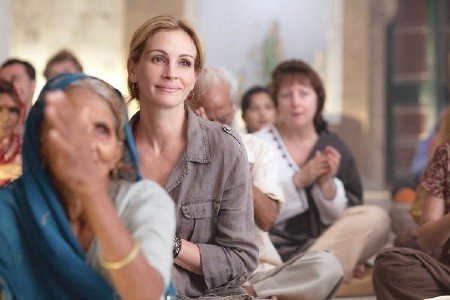
"Eat Pray Love:" My word is...Disappointing.

I caught an early screening of "Eat Pray Love," the highly-hyped Julia Roberts movie based on the Liz Gilbert book.  I have no interest in reading it, actually, but am eager for any flick that might be an antidote to this summer's Seattle overcast.

In one early scene, while Julia and friends are scarfing Italian food, each chooses "her" word, a singularly capsulizing descriptor.  London was "stuffy," Rome was "sex" and the Liz Gilbert character was stumped.  After the screening, I turned to my husband:  "MY word is...disappointing."

I wanted to go out of the theater feeling uplifted; instead I came out confused.  Here's the movie I saw:

The protagonist throws away marriage to an adoring husband and the city life because she's vaguely unsatisfied, and attempts to regain sensuality, spirituality and personal connection by escaping for a year to three locales, one specializing in each.  The Rome segment is filled with closeups of squirting melted cheese, mounds of spaghetti, and Roberts' cheerily munching maw.  The segment at an Indian ashram shows her sitting--in a garden, in a group mumbling prayers to the photo of their female guru, under the gruff mentoring of an older guy whose previous work-focus caused his family to decamp. And the final segment, in Bali, has her the scribe of a local palm-reader and patient of a folk-medicine woman--where  Gilbert ultimately hooks up with a Brazilian (turned Australian) ex-pat (Javier Bardem, Oscar winner for "No Country for Old Men").

The scenery and cinematography are outstanding, but I'd hoped for more than a travelogue. In fact, it's really not even that; just some scenic interspersed shots.  We hear Liz is a writer, but we really don't see her writing.  None of the significant others ever seem to spend time making money, either.  We learn nothing of her blood-family, but somehow within four months, the people she meets in each stop coalesce into her new "families."

As a psychologist who's spent years working with marriages in trouble, one of the most frustrating situations is when a spouse "cuts and runs," usually to somebody new.  Here, Liz Gilbert rebuffs her husband, who loves her and is willing to breach any rift.  During the course of the film, flashbacks to her wedding, as well as her own statements, confirm that the marriage was as much her choice as her partner's, and began sincerely only a few years before.

Yes, it would have been far worse if Liz Gilbert had taken flight on a spouse and children.  But under any circumstances, "unhappy" (fixable!) ennui is just not a good reason for a divorce. It's made even worse because in the only emotional prayer we see, pre-exit, Gilbert asks God to tell her what to do! The Gilbert character then leaps into an affair with a younger man; she quickly connects with guys in Italy, at the Ashram and finally in Bali.  One gets the impression that if the protagonist were not Julia Roberts, but instead a very plain-looking woman, the title might have instead been "Eat Pray...Pray."

Then again, even the prayer is hard to understand; for little reason we can see, Gilbert becomes Hindu, even buying a metal icon of the Elephant-god Ganesha at an idol-store.  We don't know why she chooses Rome as food-central, either.  And though there's mention that she'd connected with the Balinese palm-reader years before, her quick integration there into the local ex-patriot party-scene, where she meets her lover, doesn't follow, given her new ashram-spawned serenity.

Maybe it's assumed I've read the book, and all these disjointed segments and unanswered questions were covered there.  But a film must be judged on its own merits, and this one has some--serviceable but not stellar acting, a few lovely settings, a handful of well-done moments--as well as yawning flaws.

Monday, August 9, 2010

Never a Fashion "Formerly," Only a "Presently"

This post starts off with the insignificant--whether clothes represent status as "formerly hot"--and morphs into the important, the call to see beyond daily pettiness to our roles in God's universe.

I spent the afternoon clothes shopping in a store called "Forever 21."
I accompanied my really 21-year-old daughter, perusing the stock of cheapo tops (lots of dolman sleeves out there!), "jeggings" and dysfunctionally flimsy sweaters. No need to buy, because my closet is amply stocked with what I call "hand me ups."  Clothes my daughters begged me to buy--now rejected as passe.  "Here, Mom. You take them."

Some might say that the only thing more pathetic than a mom in Forever 21 clothes is a mom in Forever 21 clothes that are five years old.

But they're perfectly good.  My husband and I paid for them--I can't just give them away.  That wouldn't be frugal.

I don't wear micro-minis, cleavage-down-to-there, or high-waisted wisp-blouses that make one look in her second trimester.  Just sweaters, t-shirts and solid-color jeans--okay, I also rescue the girls' quickly-junked trend purchases.   Trouble is, my thriftiness is extreme:  Just as the buck stopped at the desk of Harry Truman, the out-of-style bucks we've spent stop in my closet, in the form of short-length sweaters, loose-knit tie-front shirts, long jersey skirts and western wear.

It's all there, waiting to be worn again by me. Can't I somehow incorporate that  three-quarter-sleeved snap-front orange crop that barely reaches my belly-button?  It's only been worn twice!  How about that poufy-hem layered skirt?  I can't bring myself to throw out perfectly useable, nearly new garments.

Clothes as Merely Wrapping:
On the other hand, what is a boomer-mom to do?  Not at all ready for the non-waisted look at Chicos (and their stuff's way to large for me) perhaps I should follow the lead of Stephanie Dolgoff, who got a a book, 30,000 monthly blog visitors, and a big write-up in the New York Times yesterday, by grousing that, at 40, she's "formerly hot" and has no fashion station?

On the one hand, I scoff at her making much of a non-problem; on the other, it's great she used her entrepreneurial skills to make money from this superficial idea. Nearly all of the 62 comments Dolgoff's Times article generated included the words "vapid," "inane," "offensive," or "trivial."  It should be noted that the author coined the term "formerly hot" as a joke to cope with her shifting interests.

She suggests that at 40, one must mature, and attempts to define her new phase. Here's how it's expressed in garb: "Trends are for little kids," she declares.  Animal Prints? "OK at 20 or 60," says her NYT article, "but for 40-somethings, they raise all kinds of unseemly 'cougar' questions." Retro styles? "If you were alive during the time the look was first in vogue," Dolgoff admonishes, "it can look as if you've saved your outfit for all these years."

Well, um, I have.

Which is why sartorially, I've never been, and intend never to be a "Formerly."  I'm a "Presently," which means that I try to look good, frugally. Might be funky, might be hand-me-up, might be something I got at Ohrbach's on Wilshire Blvd in 1969. It won't be anything with a tag seen on a runway.

You'd think that wearing clothes stashed since their last fashion pass would be lauded as green.  Recycling, as in style cycles, is at least as in-vogue as Vogue.  And putting on that kilt I wore in high school revives in me a frozen time, as much as flight through the night skies retains the youth of Peter Pan's Lost Boys.

Perhaps some of us are too far out of the chic-race to even lag behind.  That's why my stroll through Forever 21 today was more anthropological research than serious shopping.  My daughter found a few things to wear in her new job. (And I began planning which cranny in my closet they'll eventually occupy.)

Why bother? To reach the Bigger Picture:
The value in the "Formerly hot" term is as motivation to reject it (I suspect Dolgoff would agree), particularly valuable to me now, as my youngest child leaves home.  I spent a lot of time on parenting, but I won't be a "former mom." Yet I do look forward to leaving behind the less developed person I am, by improving my knowledge, accomplishments and attachment to things that really matter--becoming, with each day, a "new me."  Change is not only inevitable, but desirable.

Tonight begins the Jewish month of Elul, a time of repentance and introspection in preparation for God's judgment on Rosh Hashana, the beginning of the year 5771 of the Jewish calendar.  Each day during this month, the shofar, a ram's horn, is sounded, its tones awakening listeners from petty concerns, like how trendy we look, which bars we frequent, and how well we earn attention from strangers of the opposite sex.

I never had a "formerly hot," party-hearty life, but I've previously had a less spiritually-connected one, and my level of godly focus constantly moves and approaches and sometimes, withdraws.  This time of year is specially endowed with a cosmic magnet pulling us beyond the mundane, the clothes and paint chips and accessories, to seriousness.  We lose daylight and realize the imminence of darkness; we hear the shofar and are called to self-evaluation, just as music affects the soul though we cannot see or touch it.

So perhaps, in a sense, I am a "formerly." Formerly I had learned less; formerly I was more self-absorbed. Presently, though, is the opportunity to increase and to grow, and in this month of Elul, to prepare.

Monday, August 2, 2010

Writing Avoidance and "Social Media"

The New York Times' business section is something I usually scan and toss--until today. I kept reading articles--one on Tumblr, touted as a cross between Facebook and Twitter. Another on author Buzz Bissinger's conversion from Twitter con to Twitter pro, as in he used to despise it, now lives by it.  As psychological release during writer's angst.

Reading the first piece, my visceral reaction was: "Both Facebook and Twitter are such colossal time-wasters, and they're turning everyone narcissistic. Now there's another tiresome 'social network' to soak up the day for suckers." Simultaneously, my other brain is thinking, "hmm, better join Tumblr."

Because unlike Buzz Bissinger (right), who wrote the sports classic "Friday Night Lights" 22 years ago and, while yet to duplicate that success, keeps churning out product, I use any number of procrastination, distraction and obfuscation techniques to keep from completing projects I could be whipping out.
Do I need Twitter to jump-start my industrious spirit?  Do I need to emulate Buzz Bissinger, who Tweets, "When people call me over-the-hill I react with profane defensiveness. But maybe it is true. It crawls into my head every minute, every day" and then, unburdened, returns to his keyboard?

Um, maybe. Writing is lonely, but if there's something to say--and someone waiting for it--you really can't dither around much.  But now there's Facebook and its tempting voyeuristic sense of skulking around people's lives.  Email, the old standby, provides an hour of diversion.  Web links, another hour, and then it's time to pick up a kid, or listen to the can't-miss radio show, or start cooking, or get to the market lest we're out of milk.  I wonder if Buzz buys the milk in his family?

On the other hand, Twitter and Facebook and now Tumblr and any number of their competitors can be seen as promotion.  Authors need audiences; even more, they need purchasers.  You don't make money on Twitter, and probably not on Facebook or Tumblr, but supposedly they're required to promote the author "brand."

Truth is, for many of us, the psychological bugaboo is probably low self esteem; fear of failure; the same fear Buzz Tweets about--being told you're no good, over the hill, unworthy.

The over-the-hill idea fits because anyone who grew up with My Space and Facebook and YouTube doesn't have that fear.  Used to being "right out there," casually insulted, and publicly teased--and even more often, praised and "friended," kids just don't care about others' judgements.  Their self-esteem is so secure, so lauded, so intact, they'll easily put up a video of themselves singing off-key the 3,000th "cover" of a song, just because the world can see it. Once you can click onto a website and see yourself singing, you're famous; you feel good.  Now, just get other people to subscribe to your channel and "follow" you. No need for any authorities to validate your worth.  These are the seeds of the out-of-control egos and "look at me" mentality that are everywhere.  America's got talent, and YouTube's got everybody.

Note to self: get over it and learn some bravado from your son, who just had his 18th birthday Friday and has many, many followers of his YouTube channel.

What? Counting followers?  The world's laughing--maybe. Better check Facebook.

Friday, July 30, 2010

Are we all "Picky Eaters"?

My son qualifies as a picky eater. He'll eat anything as long as it's pasta, cheese pizza, French Fries, (sometimes called "chips," if in "Fish 'n") and maybe a bagel with marinara and mozzarella.

According to a recent piece in the Wall Street Journal, he's got a handicap that may just qualify for its own entry ("selective eating disorder") in the next DSM, the Diagnostic and Statistical Manual that psych clinicians use to put a label on the weird and disabling behaviors of clients.  For now, he can log into a new registry created by Duke University to study the quirky eating habits of those whose palates enjoy the whole range of options from A to...B.

"Picky eaters tend to gravitate to certain foods, including blander products that are often white or pale colored, like plain pasta or cheese pizza," writes Shirley S. Wang. "For reasons that aren't clear, almost all adult picky eaters like French fries and often chicken fingers, health experts say."

(Should chicken be eaten with the fingers?  No, the fingers should be eaten separately.)

Bob Krause has made a bit of a career out of his pickiness.  His first and last names were the two opening words of a January, 2007 Psychology Today article about the condition that heretofore was considered a passing phase of toddlers, like diapers.  His idiosyncratic diet earned its own sidebar in the Wall Street Journal piece of a couple of days ago.  And he pops right up if you google "picky eaters," with his "picky eating adult support" website, on which he admits his aversion to normal meals has caused such angst in "Social Settings" (sic) that "On some occasions, I have become so depressed the thought of ending it all has gone through my mind."  He even blames his eating habits for his two divorces.

Thankfully, Bob doesn't let his affliction hold him back, heading a business with 35 employees and, naturally, planning to make his "hard to imagine" adventures coping with restricted appetite into a Movie (sic).  He suggests tactics to help the similarly-burdened handle dreaded food-centric Social Settings, most involving deception, though the last one, presumably for ladies only, employs what is likely an effective distraction: "13. Offer sex to a man who wants to take you to dinner."

While picky eaters  like Jill Bloomfield, (who does picky-eating consulting and went on to write a kids' cookbook) can enlarge their menus with deliberate effort, they may never appreciate the range of tastes most folk enjoy.  An August, 2007 study by Cooke, Haworth and Wadle teased out the amount of pickiness caused by environment and training, versus what's inbred.  Turns out three-quarters (77% to be exact) of pickiness is inherited; parents who self-blame for a child's unbalanced diet are likely saddled with their own quirky food repertoires.

Pickiness isn't just a casual choice, either.  Unacceptable foods are downright repulsive, either due to texture, taste, smell or a combination thereof.  "You wouldn't put a handful of grass in your mouth and chew it up," says Amber Scott, 29, in the WSJ article. Yearning to acquire a new taste, she ventured to try an apricot last summer, but it made her stomach churn: "I really wanted to like it, but my body wouldn't let me."

Readers of this blog might recall two posts in which I excoriate cilantro.  Its odor is repugnant, its taste so abhorrent that even a smidgen is immediately detectable and expectorated.  Just about everyone, even folks who blithely claim to "like everything," have at least a few foods they avoid.  Cooked liver? (barfable!) Oysters? (no aphrodisiac for me!)  If you really want to taunt nausea, read the Olive Magazine list of top ten hated foods in Britain, a nation whose gastronomy adds insult to injury.  It begins with tripe ("edible offal made from the stomach of cow, sheep or pig"), heads south through jellied eels to Marmite ("a dark brown yeast spread, by-product of the brewing industry") and concludes with beetroot in vinegar.

Just last night while waiting out my husband's screening of a violent movie, I stumbled upon the grand opening of Seafood City, a huge Filipino supermarket in Seattle's Westfield Southcenter mall. Its Asian fast-food joints had lines down the block, swaying to the unintelligible words of a rock band, but the real attractions were inside, where the produce department exploded with weird prickly, bumpy, nasty-looking vegetables, the shelves were filled with mushy, spherical and often brown items with no English on their labels, and a full third of the store held ice-lined tables with whole, colorful fish, their dull eyes shimmering.  A long queue formed at a counter called something like "kill and cook" where purchasers could wait for their selections, if from tanks, to be murdered, and if from the ice tables, to be prepared to their specifications.

All I could think was, "eeewwww!"

Meanwhile, those eager customers were thinking, "yum!"

Admittedly, the difference here was cultural.  But within families, even, some members crave certain flavors that others just plain eschew.  I've always wondered how individual food preferences are shaped.  I don't like the taste of mango, but everyone else in my clan loves it.  Onions give me, sorry, stomach repercussions, but the others in my home gobble them down to no reprisal.  Two of the five of us adore spiciness, daring the other to consume ghost peppers and bottled hot sauce; the remaining three like flavor, but dishes even slightly inflamed send us to the fire hydrant.

Which brings me back to pickiness.  Something internal, independent of will or environment, determines what comestibles we devour or detest.  Similarly, another internal mechanism tells us at any given time what appeals, and what's yukky.  Is pickiness really a disorder?  As a psychologist, I'd say that when it interferes with normal life--like Bob Krause's devious means to avoid shared meals--something's wrong.  Otherwise, I'd consider a limited array of desires as simply the tail of a normal distribution along the continuum of food preferences.  The true omnivore who equally enjoys every edible would occupy the other tail, and everyone else fits somewhere in the middle.

One's niche on the consumables continuum would be a snapshot frequently shifting, from meal to meal, moment to moment--and I believe it reflects one's nutritional status at any given time.  Your body is talking to you, by those strangely non-verbal cues it sends, telling you that you're hungry, and what would be most satisfying.  If, for example, your body is short on certain amino acids when sitting down to a dignified restaurant dinner, you might order a steak.  If, instead, your body wants the vitamins found in greens, you might go for a big salad.  Think about it:  With a large, tempting menu in front of you, how do you know what you "feel" like eating?

Unfortunately, American society and family life overlays all sorts of messages on the cues our bodies send, and too often, those externals override internal signals.  We're bored, so grab something munchy from the candy machine.  Mom made that special dish, and we eat it to reassure her we love her.  We read magazine articles insisting our diets look like pyramids, and so construct them and imbibe them, brick by brick.  There are many external "authorities" and reasons we ignore those quiet but correct messages from our bodies, but when we do, well, we end up with a "national epidemic of obesity."

It's only an epidemic in that we "catch" it by listening to external sources, not from being true to our bodies' natural, but subtle messages.

So, despite sounding a bit snide in describing my son's narrow food preferences, actually I honor them.  I don't understand where they come from; I don't know if it's good or bad that they're there, but ultimately, listening to them determines whether he has a positive or negative relationship with the food he eats.  And I see that his limited set of delicacies is merely a shortened form of my own picky-list (which, btw, includes papayas, black coffee, lite beers, toffee and at least a hundred other disdainables).

Bottom line? Respect your palate.  If only buttered noodles earns your salivation, that's the entree for you. Instead of merely denoting a new disorder, researchers could more profitably trace the causes of everyone's food love-hates, and find out how these can address the "national epidemic" in a way Michelle Obama's "Let's Move!" campaign can't touch.

 Erasing the stigma of "picky" eating to enhance respect for individual food preferences might be an excellent preliminary step toward fixing the Fat Heads in our country.  Eat what you want, and at the same time empower yourself.

Sunday, July 18, 2010

Wedding Announcemet as Immigration Editorial

Is a wedding announcement the right place for a political statement?

With the feature about Perla Farias and David Portugal, Jr.'s nuptials last week, the New York Times certainly thought so.  The couple, 21 and 22 years old, lamented that the undocumented immigrant members of their extended family of 400 were too skittish to attend their Goodyear, Arizona wedding.  It wasn't travel, expense or illness preventing their attendance--but fear of deportation occasioned by the recently-adopted state law empowering law enforcement to verify immigration status.

The bride and groom sound like great, idealistic kids.  They're both in college and met through their Catholic church.  They bonded in their youth group, soon spending Sunday afternoons "taking long walks, discussing the book they were reading--or immigration raids."  His early gift to her was a portrait he painted from a photo in which she's wearing a t-shirt emblazoned, "Think: It isn't illegal yet."

Their relationship matured as they became "partners in community activism."  The new Mrs. Portugal's family came to the US illegally, but received "amnesty under a 1986 federal immigration reform bill."  (That would have been two years into the second term of Pres. Reagan, about three years before she was born.)  Mr. Portugal is a fourth-generation Mexican-American from Los Angeles.

Not only do I congratulate the young couple and wish them well, but I have no problem with The Times highlighting their interest in pro-immigrant activism.  What I found surprising, however, was the article's unrelenting slant--opening with "The marriage of Perla Farias and David Portugal Jr. in Goodyear, Ariz, was marked as much by those who didn't attend as it was by the more than 250 guests who did." It leaps from there into a lament about the two dozen undocumented-immigrant relations of Ms. Farias too nervous about the not-yet-enacted Arizona clamp-down to show their faces at the celebration.

Personally, I don't think the new Arizona law was a good idea, for a variety of reasons, and I sympathize with the hard-workers who risk everything coming to the US for a better life. (I also think the federal lawsuit against the Arizona bill is a waste of taxpayer money, since the law's sure to be challenged anyway.)

Illegal immigrants would gladly come legally if they could--but receiving documentation for average people to emigrate from Mexico to the US is nearly impossible, given Mexico's corruption greased by bribery at each step of the process.  The people who leave family behind, take our least-desirable jobs (and are even willing to live in the shadows) are not unlike those in generations past who boarded crowded ships with similar hopes--they share the American spirit of self-determination founded on willingness to take chances and put in effort.

The mothers of "anchor babies" want those children to live where they have the best chance for success and the most opportunity.  Is America the greatest nation on God's green earth? Ask them.

Still, I blanched seeing the blatantly political message featured on the wedding announcements page.  Just another reminder that the press has become as openly biased as anyone else, and doesn't mind inserting its editorial content everywhere it can.