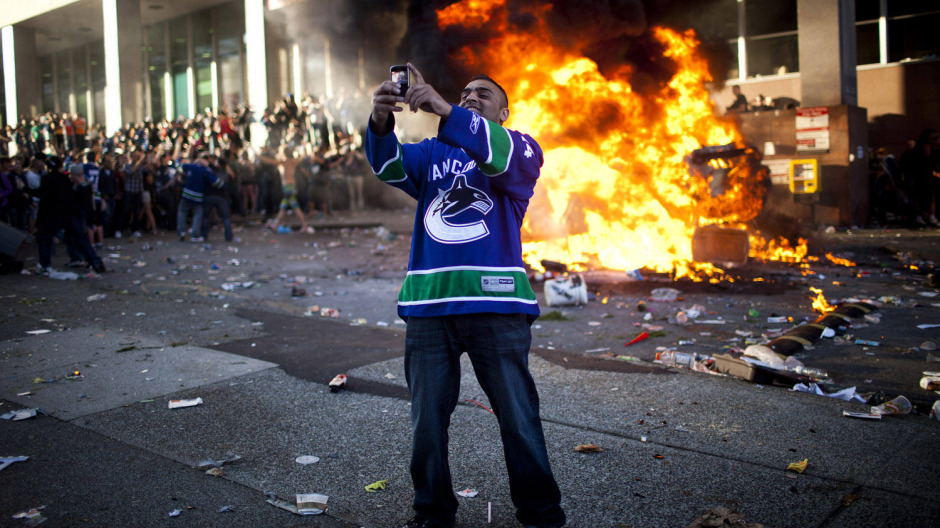
The devastation last week when the Vancouver, BC hockey team, the Canucks, caused a riot by losing the Stanley Cup Final to the Boston Bruins, was shocking--and not just because sports fans can turn so mean.
Though it was appalling: A downtown destroyed, a hundred people arrested, nine policemen injured, 15 cars burned...because of a game?
To my feminine brain, the idea that team supporters could get so worked up that they go on a burning, looting, stampeding, violent rampage en masse--abandoning all morals!--is incomprehensible. But when you start watching the YouTube videos, you're transported to the thick of it, and the outrageous mob mentality fomenting evil becomes real.
What was different about this monstrous reaction to something inherently minor in the scheme of life? Canucks fans probably don't think their team loss was minor--after all, Vancouver has no other major sports team, and viewing the Finals' Game 7 was organized to be a city experience, with bleachers and seven huge screens set up on Georgia Street downtown. But sports, while a major business and industry, is merely peripheral to life's necessities, such as food, shelter, a source of income, family connections, and health.
When you look at the YouTube videos posted, you realize that the mere fact of their availability means somebody was abetting the havoc and mayhem by standing there recording it. Observers posting their videos undoubtedly felt they witnessed something significant--but failed to join with the overwhelmed police or lone citizens trying to quell the throngs to stop it. In fact, their actions added to the difficulties.
What that does, again visible on the posted videos, is encourage criminals' bravado. You can see the thugs standing on overturned, burning cars, making muscles posing for a friend. You see them running in front of burning stores for the snapshot, then running back into the mob. You see guys grabbing wooden planks, shoving them through glass into window displays, then raising their fists triumphantly, proclaiming their macho act, posing for the semi-circle of cell phone-holding spectators, heard cheering their subject.
And the hoodlums have no fear that their performances will bring reprisal, even as they show off for the phone-wielding hordes. Instead of encouraging restraint, since they can be identified and more easily prosecuted, the cell phones seem to make every thug a star, every evening's anarchist a hero.
Rather a famous bad guy on this "reality TV" than a decent person with what used to be considered "normal" values. Could it be that all the sluts-as-celebs and jerks-as-leading men on cable shows fascinate the public so much their despicable behavior is now seen as compellingly benign? What is it about a dozen cell phone cameras trained on him that makes a guy completely negate his upbringing?
It's true that religion in BC is in retreat, and latest census data shows "no religion" as the most popular option, selected by 35% of the population. But don't even atheists have a concept of being a "good person"? Wouldn't that include refraining from bashing in store windows with posts--and then when a singular man protests "What is this? Are you guys insane?" attacking him, kicking him and bashing him until he's a crumpled heap in the gutter?
I gasped when I watched that, a burly guy who'd answered the hooligans, beaten down by six or seven creeps, until he lay motionless in the street.
I was also agog to read the coverage of the riot in the press. All written in the passive voice--so that nobody's actually responsible. By using that grammatical structure, the perpetrators aren't criminals or thugs or hoodlums or looters but rather, neutral forces: "Windows were broken..." "A large two-by-four was jammed..." "A Honda was overturned..." "It started with a couple dozen plastic bottles being thrown...then fireworks were ignited...a gray SUV was set on fire..." All this from a single Seattle Times report of the mayhem. What usually might say "A young man in a Canucks jersey stomped on a mailbox..." reads instead "A mailbox was stomped." The subjects causing the verbs are missing. Can't imply these are bad guys breaking the law.
To be sure, many Vancouver residents are ashamed of their neighbors. Volunteers assembled to clean up the mess. But the chutzpah of rioters to brag about their criminal acts on their Facebook pages, and post shots of themselves in the midst of burning mayhem shows the devolved character of too many people in chaotic circumstances.
My husband thinks the Canucks' loss was just the excuse for pent up anger, perhaps a "spring fever" delayed by bad weather, like what used to appear as annual college campus protests. That suggests that the riots would have happened whether the Vancouver team won or lost. Certainly the setting was right--crowds compressed into a tight downtown area, loosened by alcohol, anxious over their athletes' success. But these were not downtrodden societal underdogs rebelling against broader injustices--rather, they were a mix of ordinary Canadian sports fans, more of whom should have stood up to blatant criminality occurring before their eyes.

Now, however, eyes are electronic, removing their owners from responsibility and direct connection to what they view. At this point, the Vancouver riots are another form of entertainment; something else to raise our eyebrows for a moment, before we upload other scraps of life into the ether.


