Tuesday, December 10, 2013

Animals Too Weird for Evolution

Copulating hermaphrodite sea slugs soon to get violent
Sometimes the headline grabs you: "Sea Slug Sex and Violence," for example. Or, "Clever crocs, gators balance sticks on snouts to lure prey." Both are real, and both made me ask, "how in the world would these evolve?"

First, the violent sex of sea slugs. An item in the Science section of the New York Times reports, "Researchers have identified a new kind of hermaphroditic sea slug living on the Great Barrier Reef that uses its phallus to stab its partner in the forehead after copulating..." This certainly caught my attention, and I found a Scientific American article with the lead: "Everyone remember not to have sex with hermaphrodite sea slugs, because they’ll want to inject prostate gland fluid into your forehead."

Turns out biologists led by Rolanda Lange of Monash University in Australia captured 32 of the 2-4 millimeter-long Siphopteron sp. 1 sea slugs off Queensland, and videotaped sixteen couplings of their several-times-daily antics. The slugs enjoy quite a mating ritual: 2.5 minutes of twirling embrace, with a few romantic neck-bites, and some organ "everting," (the phallus turns outward or inside out). Then the sex act, and since both have male and female openings, well, one of them behaves as the male and the other, female. After that, the "penile stylus" gropes the "female", until whap! It's injecting glandular fluid deep into "her" forehead!

The experts witnessing this were flummoxed. No other animal has been observed stabbing its paramour in the forehead after coitus. They had no idea why one hermaphrodite would inject prostate fluid into the head of another one. Their speculation is that this neurologically manipulates the partner to absorb more of the sperm just received, but they honestly have no evidence for that.

Given that this weird behavior appears unique among all animals, I just wonder how and why this would confer evolutionary advantage. Apparently, the "penile stylus" is flexible enough to reach any part of the recipient; lots of other creatures poke and prod, but not the forehead. How could this fit the workings of Darwinian theory? It's possible that with enough research, we'll eventually discover why this one species of sea slug developed a behavior so different from any other creature--but for now, its habit seems illogical and amazing.

Equally astounding are the crocodiles and alligators who, only during the spring mating season of nearby-nesting birds, balance twigs on their snouts and lie motionless in the water for hours until a mama-bird, seeking nest-building material, plucks the twig and...SNAP! She's lunch!
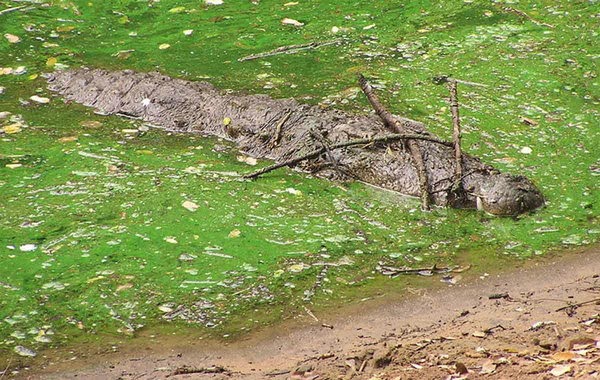
Alligator (that's no log!) with twigs awaits lunch

Researchers observed crocodiles in Tamil Nadu, India, and alligators in four sites in Louisiana laying twigs on their barely-submerged snouts, as "tools" to snare prey. "Use of objects as hunting lures is very rare among animals," writes a team of authors led by Vladimir Dinets of the University of Tennessee. The only animals ever found with that ability are "captive capuchin monkeys, a few bird species and one insect." The big question is how the reptiles know to try their trick only in the weeks birds compete for twigs. Are they looking up and saying, "gee, I see birds swooping around, so I'm gonna camouflage myself like a log and balance some twigs on my snout"?

OK, I can't resist one more strange animal story, this one from a splashy piece in the New York Times Sunday Magazine. Rasberry Crazy Ants, named after Tom Rasberry, the exterminator who brought them to the attention of authorities in 2002, are swarming over Texas and several more Southern states. The weird part is that they congregate in electrical appliances by the thousands, and blacken dirt and pavement by their sheer density and number. When they cozy up inside a radio or TV, their little bodies complete electrical circuits, shorting out the appliance, zapping the critters, who send out a pheromone smell calling for reinforcements. By the time the owner opens the appliance, thousands of bodies, dead and alive, jam its inside.

Crazy Ants: Just 1/8 inch long, but overpowering
A June NBC News report noted, "In one case, the ants quickly spread to 90 out of 150 air-conditioning units in an apartment building in Waco, Texas," and their swarms in industrial sheds are a "problem for industries in Texas and elsewhere along the Gulf Coast." They often overtake local fire ants who bite, but at least perish with regular ant bait, which crazy ants ignore. Also called tawny ants, the crazy Nylanderia fulva drive off the much-larger fire ants; see them in a two-minute YouTube video that's had more than 91,000 views.

How did all these bizarre and mind-boggling species manage to exist and survive today? My personal reaction is found in Psalm 104, expressing the awesomeness of nature, "...How abundant are Your works, God, all of them you made with wisdom; full is the earth with Your possessions."

Tuesday, December 3, 2013

Disney's "Frozen": Scary with Bad Messages for Children

Princesses Elsa and Anna, in Disney's "Frozen"
The new Disney seasonal animated movie, Frozen, kicked off big. According to the Hollywood Reporter, the film broke the all-time record in its Thanksgiving debut, and earned $93 million over the long weekend (second only to Hunger Games' sequel, Catching Fire, $110 million). The reviews are glowing as brightly as the ice castle Queen Elsa waves into existence with her mysteriously-endowed power to freeze whatever she touches.

Though generating profit is great for the economy, Frozen is too scary for kids, proffers bad messages, and follows a nonsensical, convoluted plot. I went to a preview screening of the film, and afterward, saw kids more dazed than excited.

Adults fuel the success of Frozen--Mom and Dad hear there's a new Disney movie with princesses and a loveable, joking snowman, and, looking for something to share, grab the kids and go.

But parents, beware. In fact, anyone who doesn't care for fright, beware.
That would include me, a mother whose youngest is 21, who covered my eyes and hummed as an amorphous abominable snowman-monster attempted to kill the sweet, if unwise younger princess, Anna.

That's the hook for boys: scary monster and dumb-joking snowman. Upside for girls are the two personality-infused princesses. Then, there are significant downsides. Girls will recoil in fear as their heroic Princess Anna faces destruction (by an agent of her own sister, no less!), and boys will disdain the sisterly lovey-dovey/distancing-rejection theme, not to mention the musical number portraying Anna falling in love. I'm surprised no reviewer has mentioned the royal deaths that make the young princesses sudden orphans--after which the girls' grief is oh-so-brief, the closing of a curtain on a portrait of their drowned parents. Wouldn't watching this event distress any child who understands what transpired?

For parents, Frozen presents the challenge of resisting smart phones for 108 minutes; no adult would pay to see this movie if it weren't for his kids. Sure, the Disney Animation visuals, especially in 3-D, are excellent, but while grown-ups may appreciate the artistry, that's not enough to lure anyone over middle school to the theater.

Most importantly, parents should note the deleterious messages for kids embedded in the story. After the parents' demise, Elsa, noticing her freezing effect increasing, locks herself in an empty room so she won't harm anyone. The younger Anna is perplexed that her once-loving sister has, well, frozen her out, and won't even answer her musical pleas for contact from behind her closed door. The lack of any other individuals in the girls' world--to educate, play with, amuse or even feed them--receives its own musical number, "Do You Want to Build a Snowman," in which a spurned Anna begs her sister for a response: "...I think some company is overdue, I've started talking to the pictures on the walls. It gets a little lonely, all these empty rooms, just watching the hours tick by..." And indeed, we see Anna doing absolutely nothing beside watching the clock, and the visuals accompanying the song imply her vacuous existence lasts about a decade.

Even Beauty and the Beast's Belle, who had her aging father to tend, found time to read. We tell our kids not to waste time. We tell our kids to express themselves, sharing their feelings and discussing issues that separate them from others. These princesses model exactly the behavior we work to discourage in youngsters: withdrawing and sitting around, bored.

Aside from that, Frozen doesn't hold together logically, but a cogent plot may be an unreasonable expectation for a princess movie. Certainly fantastical characters get a pass, even if the main one is a snowman Elsa unknowingly created and abandoned, but who remains unrelentingly upbeat and loquacious, even when his body is disassembled.

Elsa's quick decision to renounce the crown she'd just accepted in a public coronation doesn't make sense given her slavish devotion to duty expressed in the song "Let it Go:" "Don't let them in, don't let them see, be the good girl you always had to be." When her freezing power becomes revealed, she dumps her kingdom--which incidentally she'd just turned from summer to perpetual winter--and runs off, finding fulfillment as the self-centered scion of her private ice palace.

With her empire facing hypothermia, the remaining sister Anna, now in control by default, makes a nonsensical executive decision to head into the snowy wilderness alone, sans supplies or escort, on the unfounded belief her sister can reset the season. She leaves the kingdom in the hands of a foreign prince she's known for 24 hours, a poor choice.

In fact, she'd be toast, er, popsicle, if she didn't coincidentally come across a trading post among the snow-drifts, and there bump into Kristof, a goofy reindeer-whisperer who sells ice and was raised by a family of rock-trolls. And, happy news: the trolls' "Grand Pabbie" happens to know the antidote to Elsa's freeze-inducing condition. While in search of Elsa, wolves attack Anna and Kristof in another too-scary-for-small-kids scene, but they luckily run into the snowman, out just chillin', who directs them to the palace.

Am I a curmudgeon for noticing the difficulties in such plot points?

Also irritating are the final scenes with a reversal I won't spoil, and an interminably trite running-breathlessly-to-make-it finale.  Oh, and the music is pleasant but forgettable, even with the rash of charming articles about their husband-wife songwriting team, the Lopezes. You're not going to leave the theater remembering, much less humming, a tune, because these sound too much like most other musicals. A case in point is Elsa's anthem, "Let it Go," which celebrates casting off restriction and unfettering her harmful proclivity: "no right or wrong, no rules for me...I'm never going back; the past is in the past."
Princess Elsa, happily ensconced in her ice castle

My objections about the film don't blunt the lavish effort promoting Frozen. "...Disney fired up its vaunted cross-marketing engines," notes the NY Times, calling on its Disney TV Channel, its several theme parks and resorts, and even a tie-in give-away of hash-browns, despite absence of potatoes in the story.

Resist the hype. If you're the parent of little kids--any kids!--looking for some holiday entertainment, I suggest you ice skate, view lights displays, make cookies and play in the snow; don't spend your precious time together in the Frozen dark, implanting scary images and dubious messages.

Saturday, November 23, 2013

(Most) Girls Don't Want to be Engineers

My son with his plastic tools
Who said this, and when: "Ad agencies are predominantly men, and the men in ads are generally heroic and funny, while women are sidekicks or home-makers."
Was that...Gloria Steinem, 1970?
Was that...Betty Friedan, 1969?

How about this gripe: "I thought back to my childhood with the princesses and the ponies and wondered why construction toys and math and science kits are for boys."

Was that...Sheryl Sandberg, on why she leans in? Was this Tina Fey in "30 Rock"?

No, this is the anachronistic grouse of the makers of the currently viral YouTube commercial for GoldieBlox building toy, kits for girls to build things. The ad shows three gleeful girls watching their elaborate Rube Goldberg contraption knock over stuff, turn on water and generally make a mess rivaling the classic "Cat in the Hat." Their ad is destined for even greater fame, as the result of a New York Times business section front-page story today.

All the feminists are posting the link to their Facebook pages. They're tweeting how innovative this ad is, with its girls wearing hardhats and cool new lyrics to the Beastie Boys' song "Girls." Hey, I'm a feminist, and I think girls should be encouraged in math and sciences; I want girls with the proclivity to become engineers.  And I have no problem with GoldieBlox.

But I doubt girls will play with them.  Parents will definitely purchase and push the toy, and since sales is the goal of any entrepreneurial endeavor, GoldieBlox will make some money. That's great; I want every start-up to succeed.

But in five years, lots of dusty GoldieBlox will lay in thrift shops, barely used.

Modern feminism, the one that sent many more women back to the workforce, is forty
years old. Since that first feminist wave, toy makers have marketed chemistry sets and tool kits to girls. Aisles in toy stores were re-named from "Boys'" and "Girls'" toys to generic "dolls" and "sports." But...take a stroll down any Toys R Us, and you won't find lots of boys dawdling among the toy kitchens, or girls ogling the trucks.

Serious boy with toy gun that has an orange tip
I've got a raft of books on my shelf--more than a dozen--describing the difference between boys' and girls' brain hard-wiring. No matter what idealists would desire, male and female are created differently. Little girls want to play with dollies and set up dining-room vignettes (like my daughters did, without my coaching); little boys, like my son, want to push toy lawnmowers, "shoot" with anything handy, and wrap ropes around furniture. Arriving as he did as the third child after two sisters, our Danny's first gun was a Barbie doll, held by the head with a barrel of a pair of legs. Our first, Sarah, made her "Shabbat table" tableaux using erasers and other "food" scavenged from my desk drawer.

Makers of GoldieBlox, yours may be a noble sentiment, but it's not just because girls don't have their own build-it kits that they stay away from engineering. Note that in 1985, women earned 37% of computer science degrees, and now they earn half that, according to the NY Times piece. Girls just want to have fun; can't we just laud their natural preferences, and stop implying their choices' inferiority by insisting they really want something else?

Wednesday, November 20, 2013

Government as Savior: Feed the Hungry, Slim the Obese

Pic from a 1949 'Life Magazine' article on obesity
It's ironic: the poorest Americans, the ones on government food stamps, tend to be the fattest. Which calls for another government program to get them slim.

Reading a fascinating series of articles in the Washington Post by Eli Saslow about poverty and obesity, I was struck by the underlying assumptions fueling many expensive, publicly-funded efforts to "save" the obese poor.

Everyone wants to spare people illness and pain. Everyone wants to enhance longevity and add to quality of life. No one wants to pay for medical services for poor people if their illnesses can be avoided. In fact, with the laughable state of Obamacare in its first roll-out weeks, it appears no one wants to pay for governmentally-required health plans.

But we're paying for a lot of health-oriented programs, anyway. One Post article describes ignorance and incapacity in nutritious food preparation of residents in Hidalgo County, Texas, near the Mexican border. Forty percent of the population there relies on federal programs to pay for comestibles, a percentage nearly the same as the area's 38% obesity rate. Local food stores don't offer many vegetables, but do a brisk business in Cheetos smothered in melted cheese. Is it greedy grocers who are pumping pounds onto hapless neighbors, or, could it be that if these outlets offered veggies, neighbors would still opt for Cheetos?

slide show with the Washington Post series offers a rather disheartening, though honest answer. One photo shows a portly woman guffawing in a nutrition class when the teacher suggests serving smaller portions. "Yeah, well, try telling that to my husband!" she retorts.

In Chicago, where Mayor Rahm Emanuel boasts city efforts brought a 21% decline in "healthy food deserts" in the last two years, obesity remains high. Childhood obesity rates are notably higher than the national average; overall, 27% of Chicagoans are obese, 34% overweight, and 38% of "normal" BMI. Reporting on a study that made national projections, the Chicago ABC affiliate last year headlined, "Half of Illinoisans to be Obese by 2030."

A conundrum that health experts ponder is that food stamp recipients--whose need for sustenance is great enough for the government to step in--are disproportionately obese. As I frequently note, more and more non-gluttony causes of obesity are surfacing. Offering vegetables to the poor obese, even with education explaining how and why to cook them, can't affect most causes being discovered. It's condescending and silly to think that government-programs for classes, gyms and markets with produce can have much effect on the poor's collective girth.

That relates to the "government will provide" mentality inculcated in the public by Obama's Supplemental Nutrition Assistance Program (SNAP), the values-free new moniker for Food Stamps.

Under Obama-administration direction, taxpayer-funded "outreach" workers infiltrate low-income pockets to sign-up as many candidates as possible. One illuminating Washington Post article follows a recruiter as she approaches residents of a shabby central Florida trailer park, pursuing her quota of 150 seniors per month. Her method is to bring piles of free food to attract a crowd, and then lure them to enroll, using a set of SNAP-provided talking points crafted to silence listener's doubts.

If a prospect hesitates because of welfare stigma, the recruiter responds, "You worked hard and the taxes you paid helped create SNAP."

If a candidate's embarrassed, the recruiter soothes, "Everyone needs help now and then." If accepting denotes failure, the recruiter just normalizes the experience: "Lots of people, young and old, are having financial difficulties." The recruiter might add that with the step-up in loading people to the dole, fellow recipients likely live next door. In Florida, the setting for the story, food stamp enrollment soared in just the last 5 years from 1.45 million to 3.35 million beneficiaries.

The whole effort riles me, not only because of the increase in federal tax burden, but because stifling moral objections scoots a vulnerable population down the chute to permanent dependence. Of course, the presently-empowered political party gains supporters when more voters rely on them rather than on family, church or self-starting entrepreneurship. It's a smart move for Democrats to ease in as many new SNAP dependents as possible, because they form the voting bloc guaranteeing support for politicians who guard their entitlements. Challengers who would rein in government largess become the bad guys grabbing food away from the hungry.

Clever strategies cajole low-income elders with salesmanship and persuasion. The stigma of ripping stamps or paper slips from a coupon book is gone. Now, recipients swipe a cute little card called an EBT, for Electronic Benefits Transfer. Looks just like a credit card, but you never get the bill.

In an astonishing reversal of right and wrong, recruiters claim that taking federal assistance is actually altruistic, because it brings money into the local economy and thereby creates jobs. Despite the appeal to civic responsibility, seniors are reticent to sign up, and only 38% of eligible Floridians have, a rate half that of other age groups. "That means about 300,000 people over 60 are not getting their benefits, and at least $381 million in available federal money isn’t coming into the state," spins the Post article. Mr. Low-Income Senior, it's your duty  to, well, snap it up.

The article describes the moral dilemma of one older Florida resident who prided himself throughout his life in being one of society's "makers" rather than "takers." He resists shifting to a new demoralizing status that confirms his failure, but the implication is that sooner or later, he will succumb.

While certainly some assistance to people in need is important, the search-and-SNAP effort brings two kinds of harm. First is replacing initiative with entitlement. And the second is the intrusion of public agencies' tentacles into the crevices of families' lives, all the way to their dinner plates. Cheetos smothered in melted cheese are awful as daily fare, but the issue isn't lack of broccoli, but the desire and energy to create vegetable-laden dishes--that children eschew anyway. Poor single parents, especially, are exhausted, and they'll never pay six dollars for salad when the Cheetos their kids crave cost just two. And once again, obesity can be driven by chemical, genetic or environmental causes that fruit and veggies can't cure.

 Government-as-savior's response is to do something. Subsidize greens for poor people. Install basketball hoops in every cul-de-sac. Send nutrition educators to every low-income home. Help these poor people!

Concerned legislators began throwing money at obesity ten, fifteen, twenty years ago, and even with Mrs. Obama's "Let's Move!" campaign, it seems obesity outruns it all. Mrs. Obama seems to see the futility in her efforts; last week she officially turned her focus from pummeling childhood obesity to encouraging college. Her new cause is a more constructive direction, because the college message says "you can make something of yourself." Much better than "we can make less of you."

Wednesday, October 30, 2013

"I Swerve for Trash," Litter-ally. Or, "My Husband Uses a Grabber"

Man and grabber in action
In this season when leaf-blowers blare, scooting piles of ocher maple leaves out of driveways, my anti-litter husband is ever-more vigilant in his quest for man-made debris marring our tidy town. And now the police have caught him.

He can be seen every Sabbath, walking the nearly 3 miles to our synagogue, seeking bottle-necks poking out from the thick, crisp foliage on the sidewalk. He'll trudge into a damp ditch next to the street to retrieve a carelessly-tossed Kleenex. He'll triumphantly display the shiny beer can he's clutched in his "gopher" grabber, scooped from the grassy parkway.

And, while driving in our community, he's also on the look-out for obnoxious cardboard, and fast-food wrappers tossed along the roadway. So compulsive is he about removing wayward garbage that I really must make the bumper-sticker that I've been threatening to paste on his car: "I swerve for trash."

Perhaps if the law-keeper had seen it, he might not have pounced, lights flashing, when he pulled over yesterday in a muddy narrow strip next to a tight two-lane passage. I was in the passenger seat, rolling my eyes perhaps, since my husband's many detours for toppled garage sale signs, runaway hubcaps and the like delay us whenever we go. After my husband stopped in this peculiarly-cramped spot, he leaped out of the car exclaiming, "A bottle! And a cup!"

I thought he'd said "A bottle! And a cop!" And I was right. The officer slammed his car behind us, hemming us in, because there would be no reason for anyone to pull over there--unless for nefarious purpose. When I saw the him grilling my husband, all I could do was guffaw.

After the policeman pulled away, and my husband retrieved not only the bottle and the Starbucks cup but several cigarette butts and a candy wrapper, he wryly climbed into the car...laughing.

Because after the officer ascertained that my husband was not in trouble nor planning vandalism, and he understood that the objects he was removing from his trunk were merely a plastic (recycled) supermarket bag and his gopher grabber, the response was: "Thank you."

My brilliant husband has taught me many, many things. One of them is litter awareness. I shall never walk by a discarded energy bar wrapper. While on foot, I examine my surroundings, detecting detritus partially obscured by fauna: The sparkle of aluminum foil. The glint of white notebook paper peeking from the gutter. If, while driving, I note an egregious Styrofoam carton or flyaway paper napkin, I make mental note but do not stop, since I know that after work, my husband will pass here on his way home. And swerve.

I tell you all this to ask for your help. If you're walking your dog, pick up not just his droppings but any litter you come across. If you're a jogger and see refuse in your path, take a plastic bag in your pocket, circle around and get the exercise benefit of swooping down to grab it.

Also, don't overlook the beauty in your world. Enjoy your neighborhood; enjoy the seasons, and while doing that, develop a determination that anything that detracts is an opportunity to make an improvement. Carry a plastic shopping bag you can un-wad and pop offensive litter into. Talk about litter to your kids; let them know that they can improve the environment--not by un-doing Global Warming, but by leaving the places they walk and see a bit cleaner.

This is what my husband calls "do it yourself conservatism," but I don't think that cleaning up visible garbage is "conservative" except that it conserves nature, and conserves a sense of order and calm.

One birthday, I made my husband a special present: a fluorescent orange safety vest with letters I cut out of reflective tape. Over the front chest pocket was his name. On the back, I glued, "Help me pick up litter."  I wish he'd wear it, for safety's sake, but also because perhaps it would let the people watching him with his plastic bag and grabber at the side of the road know they're empowered, too.

Friday, October 25, 2013

Halloween...it's not just for Kids and Martha Stewart Anymore

Martha Stewart as 'Queen of the Wild Things'
Am I the only one noticing a proliferation of Halloweeniana in my neighborhood? More houses than ever before shine with strings of orange "Christmas" lights. Cottony white blobs drip from bushes; rubber spiders hang over the street from crimson maples. Plastic tombstones sprout from lawns, set off by foam cuffed arms with clutching hands reaching desperately upward.  The real arachnids of autumn are outdone by super-sized, LED-illuminated webs pasted on front doors.

The other night, I accompanied my husband as he lectured at the fund-raiser for a local politician at a lakeside mansion. The lane to the home flickered with eerie illuminaria; a large 3-D ghoul welcomed us, chalky face, long white hair and arms with skeletal bony fingers that caught the clothes of those passing within. The entry danced with the light from blinking vignettes of haunted houses, replete with flying bats, fluttering ghosts, and sound effects of screaming and slamming doors. Piles of pumpkins graced tables, some gilded, others warty, some sparkling with sequins. A metal cut-out of an arched-spined, hissing black cat stared, frozen on the fireplace mantel.

Free party invitation from Crate and Barrel

Martha Stewart has for years embraced Halloween as her opportunity for expression, and scores of other purveyors recently joined the party. Pottery Barn tells you how to throw a Halloween soiree, with a recipe for "ghoul-a-tinis," while Crate and Barrel has embraced the Day of the Dead (actually November 1) with black skull candles ($4.95 for three) and free party invitations. Annual special issues of Martha Stewart's magazine offer pumpkin-carving designs, table-scaping ideas and costume-making innovations. Pop-up stores dot malls as summer ends, offering costumes for all, from the adorable to the skanky.

Every year, my husband and I enjoy "the Great Halloween Debate" on his radio show. I'm "for" and he's "against," saying it teaches kids to beg, inspires vandalism, and turns focus to death. I counter that it's all voluntary and great fun; that costumes bring imagination and creativity, and holiday purchases fire our economy. We'll once again enter our friendly on-air spar next Thursday. Every year I win.

Martha Stewart in her cat costume
The National Retail Federation projects a slightly smaller turnout this year--158 million participants, down from last year's all-time high of 170 million, due to "cooler weather." But the organization expects "far from a bust" as consumers will happily part with $6.9 billion for costumes, candy and accoutrements.

I think retailers will be pleasantly surprised, judging from the way my neighborhood looked even weeks before the spooky night. Ghoulish Scrooges will simply turn off their porch lights, while the rest of us smile as children fill our doorways with their excited one-word exclamations: "Trickertreeeet!"

Friday, October 11, 2013

Rain in Seattle--Is it a Blessing?

Photo I took of downtown Seattle, from the I-90 floating bridge
They say there are two seasons in Seattle: August and the Rainy Season. Every outdoor scene in the 1993 film "Sleepless in Seattle" showed torrential rain.

Well, it's not like that. We're London-esque, usually living under a blanket of gray punctuated by drizzles. By spring, lichen has turned the sidewalks green and four kinds of moss drip off the trees in my backyard.

Just this week I used the kids' magnetic letters on my refrigerator to spell out "stop raining!" a wasted command, for sure. This September broke the record for most rain, 6.1 inches, compared to the usual average for that month of 1.5 inches. We bounced almost half a wet inch off our umbrellas in just the last 24 hours.

I'm a sun person; my mood is in direct proportion to the amount of bright sunshine I see. Sun is universally equated with happiness--You are my Sunshine; you're never my downpour.

But according to Jewish tradition, rain is not only a blessing, but a reward for doing what God wants. The seminal Jewish prayer, "The Shema" ("Hear O Israel...our Lord God is the One and Only") describes three types of rain as the result of diligently following the rules; those who flout them will see the heavens "restrained" and no rain will fall. Hebrew actually has at least four words for rain--geshem, which shares the same root as "gashmiut," worldly material; matar, rain, the basis for the word for umbrella; and for precipitation at different times of year, yoreh (the early rain) and malkosh (the late rain).

The more words a culture has for something, the more important it is. We in Seattle deal with quite a bit of moisture, so you'd think we'd have a plethora of rain words. Our newspapers have two: Showers (light rain) and Rain (steady to pelting rain). You will not see the word "drizzles" in our print media. No, "drizzles," in Seattle parlance, is "chance of showers." Nimbus clouds with spaces creating stops and starts of showers or rain, is called "Sunbreaks."  When the sky is a low blanket of misty drizzle that might evolve into recognizable clouds, you'll read "Chance of sunbreaks." Clouds that do not produce water are called "Sun."

Those who read the weather forecast here, a small and masochistic crew since the forecast is irrelevant to the actual weather, look for the bright side. They'll peruse the weekly lineup, see "chance of sunbreaks" four days on, and chirp, "We're supposed to get good weather on Thursday!"

There's no need to answer. These are the same folk who thought Barack Obama was going to bring Hope and Change.

This is not to complain. We do get some interesting clouds. My draperies do not fade. The

Mt. Rainier is right there. Really. (btw, I took this photo)
skin cancer rate is low. Vitamin D sales are brisk. Gray goes with everything.

And we have great fun playing a cruel game with visitors, insisting there's a 14,400-foot mountain right there, that they just can't see because of the clouds. Mount Rainier is almost a religious experience: you can't see it, but you know it exists.

I should add that we just ended a most beautiful summer. July had zero rain.

I have joined the Cloud Appreciation Society, and highly recommend their gorgeous gallery of photos as a pleasurable way to spend several hours. I've learned a lot about the clouds that fill our view: Our altocumulus undulatus bring...rain.

But rain makes our lush Northwestern environment so green. How about this deal: rain at night, sun during daytime. That would please everyone.