Wednesday, January 29, 2014

President Obama and Rep. Cathy McMorris Rodgers: Puttin' on a Happy Face

I watched the POTUS' State of the Union Address from Honolulu. It was 4 pm, stormy and windy outside, and my husband was taking notes on the back of a discarded print-out of a dated news story. I leafed through a coffee table photo book of Hawaiian surf icons and made wisecracks at the well-delivered platitudes of our president during the applause that more than 80 times erupted from admirers in the House chambers.

I was impressed at the obviously well-rehearsed delivery. And wasn't it nice to hear unrelenting good news? He said the deficit was reduced by $2.5 trillion dollars! How wonderful, and how did that happen? The sequester...oh wait, our president says everyone agrees the sequester was "a really bad idea."

Pres. Obama says "the biggest driver of our long-term debt is the rising cost of health care for an aging population." And of course Obamacare adds to that coverage for stuff people don't necessarily want or need, while spending millions of tax dollars to cajole reluctant, healthy younger people to sign up. Advertising doesn't affect the debt much, I guess. But perhaps his never-mentioned $787 billion Stimulus Package might have?

Our president had a long wish-list of items to accomplish. "High Quality" preschool for all. "Redesigning America's high schools." Incentives for companies to hire the long-term unemployed. "A chance for every responsible homeowner in America to save $3,000 by refinancing at today's rates." A national minimum wage of $10.10."Tax credits, grants and better loans" for college students. Rewarding colleges for offering programs that lead to jobs. Why do I doubt whether any of these things should be a national responsibility rather than a state or local concern?

Teasers from the White House before the speech suggested bold moves by the President with a "telephone and a pen." No phone or pen earned mention in his speech, and his only pledge was to use his executive powers to work around the legislative process. That sounds pretty ominous, dodging the people's representatives.

Didn't our Founders limit the federal government to activities only an overarching power can accomplish, like defending our country, crushing terrorists, maintaining interstate highways and regulating immigration? Instead, I hear our President has a plan for every corner of life, and seemingly a commission, strategy or executive order to enact it. Just as the iconic character "Julia" benefited from government largesse from birth to death, if the State of the Union can be believed, no phase of our lives will escape the warm butter of Obama's soothing protection.

Unless we become successful and earn a lot of money, and then we face closed loopholes and more expensive prescriptions. I was relieved that Pres. Obama omitted the term "income inequality" from his speech. "Income Inequality" is the new code for last year's reviled "1%," the new bon mot of the politics of envy. Thankfully, we were spared the redistribution of wealth; could that be related to the president's reported $20 million advance for his memoirs?

Pres. Obama sure sounded polished. He paused expectantly for applause. He lilted in a perfect, practiced cadence with occasional 'hood inflection. He acknowledged the camera and nodded to his imported "example people." He seemed confident, with only a minor flub with "My IRA." I still don't know if it's pronounced "Myra" or separately, "My IRA."

Cathy McMorris Rodgers, getting to know you
Cathy McMorris Rodgers, who I've met several times, is as sweet as she seemed, though not nearly as syrupy. She had a tough job as Republican "responder" to the POTUS' pronouncements. Without knowing the content of his speech, she needed to appear on top of things in words written in advance. Instead of labeling her talk as "response," it should have been called "Alternative view," because her real charge wasn't answering the Pres, but offering the GOP as the viable and welcoming alternative to Obama's Democratic advertisement. Rep. McMorris Rogers successfully showed  Republicans as salt of the earth, hard-working and earnest. And not much more, because the positions she offered were vague enough to sound compatible with the president's.

Both Obama and McMorris Rodgers want immigration reform and closed borders. They both want more jobs and economic responsibility without debt. They both want health care, but Republicans disdain Obamacare restrictions. Hers was not a response to Obama's content but rather an introduction--a youthful, feminine face for a party many identify with wealthy, out-of-touch, old white guys. If you wanted a response to the President, you had to go to post-event commentary by Paul Ryan and Ted Cruz (who seemed to me surprisingly on target).

Truth be known, the whole thing was a yawn unless you're already a politico. How many viewers watched the entire State of the Union Speech without interruption? Don't know but ratings show the 2014 event with the lowest number of viewers since 2000, 33.3 million people. Second lowest was last year's speech, with 33.5 million. Clearly, folks are losing interest, which parallels the President's favorability ratings. By contrast, the Super Bowl this Sunday is expected to break all records, including last year's high of 111.3 million viewers.

Admittedly, during the State of the Union, I took a phone call and missed a bit. Someone with me had his eyes closed at one point. Was there anything new or shocking or worth tweeting other than the sheer predictability of the event?

Pundits manufactured their comments, as expected, and until elections later this year, we can look forward to the same old, same old. In the meantime, I'm heading to the beach..

Wednesday, January 15, 2014

Placenta...with some Fava Beans and a Nice Chianti...

"She lived in Portland, and ate her placenta, with some fava beans and a nice Chianti...szz-szz-szz-szz!"

Sounds even more disgusting than eating her liver with the same accompaniments. But wait, this is not cannibalism, it's...reality! The State of Oregon has actually passed a law that explicitly approves mothers' taking their fresh placentas with them when they leave the hospital.  Oregon Rep. Alissa Keny-Guyer introduced the notion in HB 2612, which passed 56-0 and took effect January 1.

Now you can do what you want with your placenta, and Portland doula Raeben Nolan's company, Tree of Life Placenta Services, will happily transform the meaty organ into tortilla soup, lasagna or, when dried and ground, little placenta pills. An article from the Los Angeles Times shows Amanda Englund, "who prepares women's placentas for consumption" and also makes them into wall art.


Raeben Nolan at work on a placenta
Beth Plymale, who paid Tree of Life $250 for a package of services including supplements made in her kitchen from her son's placenta, appears in a Portland news video swallowing a capsule with a healthy swig of water from a mason jar. For her money she also got some Tincture of Placenta for use "later in life, maybe menopause, when she feels the need for a hormone boost." As an $80 option, Nolan will make you some Miyeok Guk Soup, traditional Korean post-partum fare, though usually made with seaweed.


Only one study, in anthropology from the University of Nevada, Las Vegas in 2013, researched benefits, side-effects or drawbacks from "placentophagy," the term for consuming placenta. Most of the study's 189 "overwhelmingly white, married, college-educated" mothers had their steamed placentas made into pills, after home-births. Seventy-six percent of the survey respondents had a "very positive" experience, though 57% reported negative side-effects, mainly lack of appeal, unpleasant burping and headaches. The researchers now hope to document placenta nutritional contents and their effects.

Placentophagy is fast becoming cool. Las Vegas reality star Holly Madison blogged that she
planned to encapsulate her placenta so she might optimize her recovery. Mad Men's January Jones gobbled her own placenta pills, saying, "it's not witch-crafty or anything! I suggest it to all moms!" Kim Kardashian, before the arrival of little North West, considered whether to consume her placenta to gasps and cheers at a family dinner with the Jenners (on ETOnline video).  Raeben Nolan thinks eating her own placenta after her daughter's birth prevented the post-partum depression that followed her previous delivery, but New York Times blogger Nancy Redd found her placenta capsules caused "tabloid-worthy meltdown" that disappeared when she quit eating them.


Placentas have a rich history in folklore. Cambodians bury them to protect the child's soul. The Navajo and Maori of New Zealand also bury them, while The Kwakiutyl tribe of the Northwest would put a girl's placenta near the tide line so she'll be good at digging clams. Boys' placentas were left out to be eaten by crows, which they thought brought foresight and wisdom.


Amanda Englund with a placenta print suitable for framing
I will confess: I was a placental explorer. Giving birth to my third child in 1992 in Los Angeles, I requested that my placenta be available, and my obstetrician gave me a tour of it, if you will. While my son was being weighed and all the other stuff hospitals do, she explained its wondrous functions as we examined it. That's how I know that its inside is magically pearlescent, offering an unseen rainbow of metallic colors to the developing baby. The side facing the mother's body is a dark-red color, plain and steak-like. My husband grimaced at my interest and wouldn't watch, but when seeing it I was filled with awe and gratitude, already overcome by the miracle of my child's entry into the world and now doubly amazed at the astounding home that sheltered him. I declined the obstetrician's offer to take it home.

I had no inclination to eat, bury or plant my son's placenta, and I'm skeptical of a state law that explicitly authorizes hospitals to send mothers off with them. Given absence of data supporting ingesting placenta, and the circumstances of its removal and then subsequent transport, I doubt the wisdom of encouraging placentophagy. Certainly this is something that might be addressed on a case-by-case basis; there's enough controversy about the benefits of supplements of all sorts to warrant screening of vulnerable new moms who would blithely seethe their placentas for soup in expectation of health benefits.

But now in Oregon, as one blogger noted, your doula might well ask, "And would you like placenta with that?"

Monday, January 13, 2014

Mazel tov! Wedding Show Fun (Just add 50%)

Well, my son proposed to his girlfriend after four years together. He's 21 and she's 24, so I suppose it's to be expected, and his bride is wonderful...but that my youngest child should be the first of my three to wed is as bizarre to me as the fact that I can no longer claim to be 25.

So today my son and I went to our first Wedding Show.

If you believe the entrepreneurial spirit is clipped by this slow economy, you're wrong; economic malaise heightens competition. And in our state of Washington, same-sex marriage has been legal for a year, bringing a new market of locals and customers from out of state to a burgeoning crop of vendors seeking their share.

In addition, weddings entice families to splurge, with the justification that it's a once-in-a-lifetime occasion. Two studies found that vendors charge significantly more when the same event is called a "wedding" versus a "family party." Photographers, party gear rental companies, caterers and musicians all add a surreptitious surcharge just because they can. Potential profit drew all sorts of businesses to rent booths at the Seattle Convention Center, and their presence spurred brides and their emotional moms to shell out $17 each to enter.


Which my son and I did today. What did we find? Long rows of colorfully-decorated booths with brochure-thrusting attendants. Tables of samples of cakes. Performers plucking harps or repeating soppy standards on violins. A fashion show of wedding gowns and tuxedos, punctuated by choreographed jazzy interludes of groomsmen cavorting with brides in matching black fedoras. A section filled with wedding dresses to try on. None of the gowns I saw, in the entire showroom floor and hundreds of feet of racks, had any type of sleeve, and the vast majority were low cut and strapless.

The chaos was oppressive, like sitting in traffic while everyone's honking. The cacophony of musicians and boom boxes blaring from booths, the voices of hustling vendors, the squeals of delight and disgust melded to a headache-inducing mélange, visually amplified by ubiquitous bouquets of orange, magenta and lime. Each product played into the romantic ideal with its own twist. One invitation company imbued its papers with seeds so its recycling would flower. One decorator created an arch of old books, rentable for about $900. A party goods company offered rustic cedar tables, mismatched tableware and mason jar glasses. Travel agents peddled Eco-honeymoons and photo-booth purveyors snapped freebie samples of passersby borrowing feather boas.

I discovered my son likes purple and white floral arrangements. That he doesn't want a
photo booth, and he'd like a friend to take pictures. Being kosher, all the caterers with their fake hors d'oeurve platters couldn't lure us, and venues like an old castle, an inn on Hood Canal and a barn won't be replacing our synagogue. What we learned is that too many unnecessary options distort the focus of weddings from the spiritual toward the material, and that false requirements can cause couples to spend on accoutrements ultimately forgotten except when paying off credit cards.

One's definition of a "perfect wedding" can be elastic. I recall my own wedding planning, so entranced by my future husband that I didn't assert any preferences, borrowing a dress I'd never seen and letting him choose our wedding rings, simply because nothing really mattered at the time, except that I marry him. In about two weeks, we will celebrate our 29th wedding anniversary. I remember many aspects of our wedding, but not the menu, not the table decorations (generously executed entirely by friends) and certainly not the honeymoon, which we skipped in favor of the Jewish tradition of "sheva bruchos," seven nights of celebrations hosted by friends and family. The most costly wedding expenses were the most forgettable, and the most important were irreplaceable and come without price.

The Wedding Show was fun and informative, but my son and I agree we've been there,
done that, and his gentle-spirited bride has been spared its chaos. My son and his fiancee have plenty of decisions to make, but religious precedence removes much of that pressure, and keeps them focused on the centerpiece of their life together.

Tuesday, December 17, 2013

Wife Keeps her Name at Marriage--and Other Ways to Get Respect

An article last week in in the New York Times argued every-which-way about changing or retaining names at marriage. It provoked a huge response, because the central issue isn't really about keeping a name, but retaining respect as an individual.

The piece mainly described women's dilemmas and choices, noting that men haven't rushed to claim their wives' names. A Lesbian couple made their own mashup: Ms. Rothman and Ms. Gerkin became the Gerkmans. (Seems odd; classmates of any future children could taunt "Jerk-Man!" and their choice includes "man" when neither partner is one.)

"Third wave" feminists, the now-marrying generation, often take their husbands' names, even though their own mothers kept their original names out of conviction. The older moms seem disappointed when daughters don't follow their examples, but one youth suggested, “Your generation did all the work, now we can go back to having our husbands’ names.”

One hundred twenty comments, almost all by women, reveal the passion this issue still evokes. The majority of writers insisted that keeping their names preserved their identities, and posed no difficulties. But awkward stories threaded through the rest, bemoaning confused contexts, hyphenated horrors and attacks for choosing the traditional path.

One couple avoided the entire his/hers issue by making up a euphonious Tolkein-esque name and both changing to it in court.

Now that marriage is optional, divorce ubiquitous and unmarried parenthood acceptable, what's the big deal? The crux of the passion is a need for respect as an individual. For many nowadays, taking another person's name feels like a surrender of one's persona, a loss of the unique individuality established and nurtured throughout life.

I think people should be called by whatever they prefer. More crucial for engendering respect than a name, however, is title. "Dr.," "Ms.," "Mr.," and even "Miss" or "Mrs.," if desired, should precede whatever name someone uses, because titles confer respect.

Graffiti, foul language in public (and in media), and pushy drivers all reflect the same decrease in respect for others that dropping titles demonstrates. It's a societal malaise--haven't you noticed it?

Lack of respect begins when a youngster's allowed to address adults casually, by their first names, teaching him there's no difference between children and elders. When a well-meaning teacher tries to "get close" to his charges by going by his first name, students learn that they and the teacher share similar status; children become elevated and the teacher loses ground. The snot-nosed kid gets snotty because nobody's ever superior to him; no one else's position or needs trump his own. Self-esteem's great until it destroys deference to anyone else.

When a store salesperson calls me by my first name, I'm unpleasantly surprised, because the context dictates that he cater to me. A doctor should address her patient as Mr. or Ms., and a child should use those titles for neighbors, because of something becoming startlingly rare: common courtesy. Courtesy is at root respect for others.

Respect is the entire point, the nexus of name-passion.

Feminists want acclaim for their own accomplishments, not as extensions of someone else. They'll get it no matter the last name if we insist upon courtesy and respect for every individual in every circumstance. Titles are one small and perhaps superficial means to remind all present to recognize and honor others. The secondary results might be less inclination to vandalize others' property, cut in when in traffic, and dull sensitivity to politeness with public swearing.

As one of those earlier-wave feminists, I thought it dumb that tradition saw wives as
husband-extensions--and then I fell in love with someone I was proud to extend. More precisely, I was honored that this particular man wanted me to share his future, and delighted we could create our own family united under a single moniker. Suddenly it didn't bother me anymore that I would "lose" my name, because in marrying, I was entering a new phase, as a partner in a new enterprise, the adventure combining my husband and me.

This is the key to what I believe is the value of marriage, and a couple sharing a single last name simply symbolizes it: the whole of the two individuals creates something that is different from, and better than, what each person can be alone.

Each individual deserves respect. But so does the entity of a family, the commitment of two people to each other. If that universal respect was restored, perhaps more people would guard and protect their marriages. And if problems arose, they might work to overcome them, rather than divorce, hurting so many others, and destroying the history and combination they've built.

Tuesday, December 10, 2013

Animals Too Weird for Evolution

Copulating hermaphrodite sea slugs soon to get violent
Sometimes the headline grabs you: "Sea Slug Sex and Violence," for example. Or, "Clever crocs, gators balance sticks on snouts to lure prey." Both are real, and both made me ask, "how in the world would these evolve?"

First, the violent sex of sea slugs. An item in the Science section of the New York Times reports, "Researchers have identified a new kind of hermaphroditic sea slug living on the Great Barrier Reef that uses its phallus to stab its partner in the forehead after copulating..." This certainly caught my attention, and I found a Scientific American article with the lead: "Everyone remember not to have sex with hermaphrodite sea slugs, because they’ll want to inject prostate gland fluid into your forehead."

Turns out biologists led by Rolanda Lange of Monash University in Australia captured 32 of the 2-4 millimeter-long Siphopteron sp. 1 sea slugs off Queensland, and videotaped sixteen couplings of their several-times-daily antics. The slugs enjoy quite a mating ritual: 2.5 minutes of twirling embrace, with a few romantic neck-bites, and some organ "everting," (the phallus turns outward or inside out). Then the sex act, and since both have male and female openings, well, one of them behaves as the male and the other, female. After that, the "penile stylus" gropes the "female", until whap! It's injecting glandular fluid deep into "her" forehead!

The experts witnessing this were flummoxed. No other animal has been observed stabbing its paramour in the forehead after coitus. They had no idea why one hermaphrodite would inject prostate fluid into the head of another one. Their speculation is that this neurologically manipulates the partner to absorb more of the sperm just received, but they honestly have no evidence for that.

Given that this weird behavior appears unique among all animals, I just wonder how and why this would confer evolutionary advantage. Apparently, the "penile stylus" is flexible enough to reach any part of the recipient; lots of other creatures poke and prod, but not the forehead. How could this fit the workings of Darwinian theory? It's possible that with enough research, we'll eventually discover why this one species of sea slug developed a behavior so different from any other creature--but for now, its habit seems illogical and amazing.

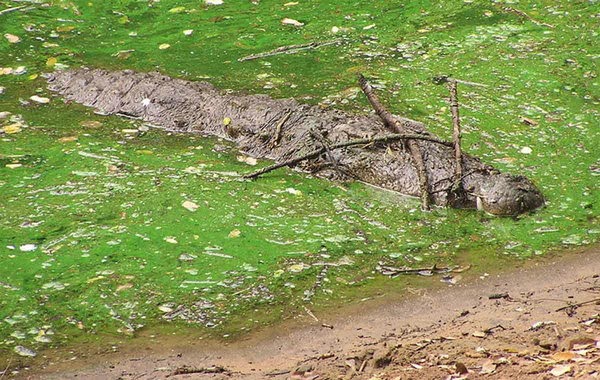
Equally astounding are the crocodiles and alligators who, only during the spring mating season of nearby-nesting birds, balance twigs on their snouts and lie motionless in the water for hours until a mama-bird, seeking nest-building material, plucks the twig and...SNAP! She's lunch!
Alligator (that's no log!) with twigs awaits lunch

Researchers observed crocodiles in Tamil Nadu, India, and alligators in four sites in Louisiana laying twigs on their barely-submerged snouts, as "tools" to snare prey. "Use of objects as hunting lures is very rare among animals," writes a team of authors led by Vladimir Dinets of the University of Tennessee. The only animals ever found with that ability are "captive capuchin monkeys, a few bird species and one insect." The big question is how the reptiles know to try their trick only in the weeks birds compete for twigs. Are they looking up and saying, "gee, I see birds swooping around, so I'm gonna camouflage myself like a log and balance some twigs on my snout"?

OK, I can't resist one more strange animal story, this one from a splashy piece in the New York Times Sunday Magazine. Rasberry Crazy Ants, named after Tom Rasberry, the exterminator who brought them to the attention of authorities in 2002, are swarming over Texas and several more Southern states. The weird part is that they congregate in electrical appliances by the thousands, and blacken dirt and pavement by their sheer density and number. When they cozy up inside a radio or TV, their little bodies complete electrical circuits, shorting out the appliance, zapping the critters, who send out a pheromone smell calling for reinforcements. By the time the owner opens the appliance, thousands of bodies, dead and alive, jam its inside.

Crazy Ants: Just 1/8 inch long, but overpowering
A June NBC News report noted, "In one case, the ants quickly spread to 90 out of 150 air-conditioning units in an apartment building in Waco, Texas," and their swarms in industrial sheds are a "problem for industries in Texas and elsewhere along the Gulf Coast." They often overtake local fire ants who bite, but at least perish with regular ant bait, which crazy ants ignore. Also called tawny ants, the crazy Nylanderia fulva drive off the much-larger fire ants; see them in a two-minute YouTube video that's had more than 91,000 views.

How did all these bizarre and mind-boggling species manage to exist and survive today? My personal reaction is found in Psalm 104, expressing the awesomeness of nature, "...How abundant are Your works, God, all of them you made with wisdom; full is the earth with Your possessions."

Tuesday, December 3, 2013

Disney's "Frozen": Scary with Bad Messages for Children

Princesses Elsa and Anna, in Disney's "Frozen"
The new Disney seasonal animated movie, Frozen, kicked off big. According to the Hollywood Reporter, the film broke the all-time record in its Thanksgiving debut, and earned $93 million over the long weekend (second only to Hunger Games' sequel, Catching Fire, $110 million). The reviews are glowing as brightly as the ice castle Queen Elsa waves into existence with her mysteriously-endowed power to freeze whatever she touches.

Though generating profit is great for the economy, Frozen is too scary for kids, proffers bad messages, and follows a nonsensical, convoluted plot. I went to a preview screening of the film, and afterward, saw kids more dazed than excited.

Adults fuel the success of Frozen--Mom and Dad hear there's a new Disney movie with princesses and a loveable, joking snowman, and, looking for something to share, grab the kids and go.

But parents, beware. In fact, anyone who doesn't care for fright, beware.
That would include me, a mother whose youngest is 21, who covered my eyes and hummed as an amorphous abominable snowman-monster attempted to kill the sweet, if unwise younger princess, Anna.

That's the hook for boys: scary monster and dumb-joking snowman. Upside for girls are the two personality-infused princesses. Then, there are significant downsides. Girls will recoil in fear as their heroic Princess Anna faces destruction (by an agent of her own sister, no less!), and boys will disdain the sisterly lovey-dovey/distancing-rejection theme, not to mention the musical number portraying Anna falling in love. I'm surprised no reviewer has mentioned the royal deaths that make the young princesses sudden orphans--after which the girls' grief is oh-so-brief, the closing of a curtain on a portrait of their drowned parents. Wouldn't watching this event distress any child who understands what transpired?

For parents, Frozen presents the challenge of resisting smart phones for 108 minutes; no adult would pay to see this movie if it weren't for his kids. Sure, the Disney Animation visuals, especially in 3-D, are excellent, but while grown-ups may appreciate the artistry, that's not enough to lure anyone over middle school to the theater.

Most importantly, parents should note the deleterious messages for kids embedded in the story. After the parents' demise, Elsa, noticing her freezing effect increasing, locks herself in an empty room so she won't harm anyone. The younger Anna is perplexed that her once-loving sister has, well, frozen her out, and won't even answer her musical pleas for contact from behind her closed door. The lack of any other individuals in the girls' world--to educate, play with, amuse or even feed them--receives its own musical number, "Do You Want to Build a Snowman," in which a spurned Anna begs her sister for a response: "...I think some company is overdue, I've started talking to the pictures on the walls. It gets a little lonely, all these empty rooms, just watching the hours tick by..." And indeed, we see Anna doing absolutely nothing beside watching the clock, and the visuals accompanying the song imply her vacuous existence lasts about a decade.

Even Beauty and the Beast's Belle, who had her aging father to tend, found time to read. We tell our kids not to waste time. We tell our kids to express themselves, sharing their feelings and discussing issues that separate them from others. These princesses model exactly the behavior we work to discourage in youngsters: withdrawing and sitting around, bored.

Aside from that, Frozen doesn't hold together logically, but a cogent plot may be an unreasonable expectation for a princess movie. Certainly fantastical characters get a pass, even if the main one is a snowman Elsa unknowingly created and abandoned, but who remains unrelentingly upbeat and loquacious, even when his body is disassembled.

Elsa's quick decision to renounce the crown she'd just accepted in a public coronation doesn't make sense given her slavish devotion to duty expressed in the song "Let it Go:" "Don't let them in, don't let them see, be the good girl you always had to be." When her freezing power becomes revealed, she dumps her kingdom--which incidentally she'd just turned from summer to perpetual winter--and runs off, finding fulfillment as the self-centered scion of her private ice palace.

With her empire facing hypothermia, the remaining sister Anna, now in control by default, makes a nonsensical executive decision to head into the snowy wilderness alone, sans supplies or escort, on the unfounded belief her sister can reset the season. She leaves the kingdom in the hands of a foreign prince she's known for 24 hours, a poor choice.

In fact, she'd be toast, er, popsicle, if she didn't coincidentally come across a trading post among the snow-drifts, and there bump into Kristof, a goofy reindeer-whisperer who sells ice and was raised by a family of rock-trolls. And, happy news: the trolls' "Grand Pabbie" happens to know the antidote to Elsa's freeze-inducing condition. While in search of Elsa, wolves attack Anna and Kristof in another too-scary-for-small-kids scene, but they luckily run into the snowman, out just chillin', who directs them to the palace.

Am I a curmudgeon for noticing the difficulties in such plot points?

Also irritating are the final scenes with a reversal I won't spoil, and an interminably trite running-breathlessly-to-make-it finale.  Oh, and the music is pleasant but forgettable, even with the rash of charming articles about their husband-wife songwriting team, the Lopezes. You're not going to leave the theater remembering, much less humming, a tune, because these sound too much like most other musicals. A case in point is Elsa's anthem, "Let it Go," which celebrates casting off restriction and unfettering her harmful proclivity: "no right or wrong, no rules for me...I'm never going back; the past is in the past."
Princess Elsa, happily ensconced in her ice castle

My objections about the film don't blunt the lavish effort promoting Frozen. "...Disney fired up its vaunted cross-marketing engines," notes the NY Times, calling on its Disney TV Channel, its several theme parks and resorts, and even a tie-in give-away of hash-browns, despite absence of potatoes in the story.

Resist the hype. If you're the parent of little kids--any kids!--looking for some holiday entertainment, I suggest you ice skate, view lights displays, make cookies and play in the snow; don't spend your precious time together in the Frozen dark, implanting scary images and dubious messages.

Saturday, November 23, 2013

(Most) Girls Don't Want to be Engineers

My son with his plastic tools
Who said this, and when: "Ad agencies are predominantly men, and the men in ads are generally heroic and funny, while women are sidekicks or home-makers."
Was that...Gloria Steinem, 1970?
Was that...Betty Friedan, 1969?

How about this gripe: "I thought back to my childhood with the princesses and the ponies and wondered why construction toys and math and science kits are for boys."

Was that...Sheryl Sandberg, on why she leans in? Was this Tina Fey in "30 Rock"?

No, this is the anachronistic grouse of the makers of the currently viral YouTube commercial for GoldieBlox building toy, kits for girls to build things. The ad shows three gleeful girls watching their elaborate Rube Goldberg contraption knock over stuff, turn on water and generally make a mess rivaling the classic "Cat in the Hat." Their ad is destined for even greater fame, as the result of a New York Times business section front-page story today.

All the feminists are posting the link to their Facebook pages. They're tweeting how innovative this ad is, with its girls wearing hardhats and cool new lyrics to the Beastie Boys' song "Girls." Hey, I'm a feminist, and I think girls should be encouraged in math and sciences; I want girls with the proclivity to become engineers.  And I have no problem with GoldieBlox.

But I doubt girls will play with them.  Parents will definitely purchase and push the toy, and since sales is the goal of any entrepreneurial endeavor, GoldieBlox will make some money. That's great; I want every start-up to succeed.

But in five years, lots of dusty GoldieBlox will lay in thrift shops, barely used.

Modern feminism, the one that sent many more women back to the workforce, is forty
years old. Since that first feminist wave, toy makers have marketed chemistry sets and tool kits to girls. Aisles in toy stores were re-named from "Boys'" and "Girls'" toys to generic "dolls" and "sports." But...take a stroll down any Toys R Us, and you won't find lots of boys dawdling among the toy kitchens, or girls ogling the trucks.

Serious boy with toy gun that has an orange tip
I've got a raft of books on my shelf--more than a dozen--describing the difference between boys' and girls' brain hard-wiring. No matter what idealists would desire, male and female are created differently. Little girls want to play with dollies and set up dining-room vignettes (like my daughters did, without my coaching); little boys, like my son, want to push toy lawnmowers, "shoot" with anything handy, and wrap ropes around furniture. Arriving as he did as the third child after two sisters, our Danny's first gun was a Barbie doll, held by the head with a barrel of a pair of legs. Our first, Sarah, made her "Shabbat table" tableaux using erasers and other "food" scavenged from my desk drawer.

Makers of GoldieBlox, yours may be a noble sentiment, but it's not just because girls don't have their own build-it kits that they stay away from engineering. Note that in 1985, women earned 37% of computer science degrees, and now they earn half that, according to the NY Times piece. Girls just want to have fun; can't we just laud their natural preferences, and stop implying their choices' inferiority by insisting they really want something else?