Friday, April 5, 2013

Challah Bread, Tiny Houses, and Appreciating "Stuff"

Jews like me just completed the annual holiday of Passover, when we avoid anything leavened, like--especially--bread. One explanation is that at the commemoration of the creation of Jewish people-hood, we shouldn't get "puffed up," like risen dough, with our own sense of self-importance. We shouldn't be arrogant because God decided we were His people, or because individually, it's too easy, with Facebook posts and Instagram and Twitter, to think the world revolves around us. Not us: Me.

So with that recent reminder, it seems we ought to laud the folk who are smiling from the front pages of our newspapers and magazines because they've divested all their personal effects and decided to live in a 250-square-foot box. Downsizing to the ridiculous is now a fad, the "Tiny House Movement," perfect for anyone on the no-carbon-footprint bandwagon. Still, I respect those with small aspirations. In an engrossing documentary by Kirsten Dirksen on tiny homes, Stephen Marshall, who builds wee buildings in California, (quoting Michael Janzen, from the Tiny House Design blog) repeats the trendsetters' slogan: "Tiny houses are not a fad; it's McMansions that are the fad."

Not that people choosing small spaces are selfless. But generally, they are passionate that a life with minimal material goods is not just good; it's better for the planet and the soul.

I beg to differ. While certainly there's plenty of waste, plenty of hoarding and plenty of consumerism that unfortunately trumps kindness and spirituality, it doesn't have to be that way.  A Jewish approach holds that wealth is a positive, worth pursuing, as long as it's attached to the proper attitude. More money means you can help more people. Beautiful things are a blessing if they're appreciated and cherished.

How do I come upon this topic? I'm often heard saying, "I have more of (fill in the blank) than any human should be allowed to have." I have a collection of lovely paper napkins, each pack with a print that thrills me. They're too good to use, my "save it for the best occasion" self says, and then my smarter self takes over: "But what could be a better occasion? Who better than my friends and family to save it for? How many packs of heart-thrilling printed paper do I really need? There are more exciting napkin designs to be had!"

So I use them, and enjoy them, and frequently re-organize them. A simple pack of paper napkins (always bought at bargain price at Tuesday Morning or Ikea) enriches my day. Do I need 20 packs of paper napkins? No. But just having them reminds me how privileged I am to be able to collect them.

Same with napkin rings. I host Sabbath meals--fancy, formal, religious occasions--for 12 every week. And over 28 years of marriage, I've amassed a large collection of tableware. Table cloths. Cloth napkins. Vases. Drinking glasses. Table runners. If I can use it on a Shabbat table, I have "more than any human should be allowed to have." Occasionally I cull my possessions. Often, I enjoy and admire what I have (since every week, I'm designing another completely new tablescape).

I also have a drawer-ful of socks. More socks than I could wear every day for three months.
These are not my socks, but could be.
In fact, choosing my socks today spurred writing this post. I'm wearing a lavender top (a hand-me-up from a daughter) and could choose from many patterned socks. I recalled when I was in college and scraping by on my part-time minimum-wage earnings that I owned just two pairs of jeans, four tops, and four pair of socks. I owned two very cheap necklaces. It never occurred to me to spend time shopping, or that I needed more.

Now I have dozens of necklaces, selected at craft fairs because I enjoyed them, or gifts from people I love. Am I living an inferior life? No, I'm simply surrounded by more beauty, memories and joy. If I had to live in one of those eensie shoe-boxes, I could, but I'd feel loss when I gave up the necklace my son made in kindergarten or the one my friend bought, the same for each of us.

But as I get older and keep pushing aside the idea that there are only so many days left to use up all those napkins, wear all those pairs of socks or colorful necklaces, I view them all with increased appreciation and urgency. Yes, it's good to purge and even downsize, but it's also good to see something beautiful or useful and enjoy it. I don't have to own everything I appreciate; I certainly don't buy all the clever and gorgeous items I see or even want. But I don't think that people in spacious homes with lots of stuff are necessarily any less responsible than the tiny housers, and I don't think that embracing the bounty of our material world is inferior to eschewing it.

And now, post-Passover, it's once again the eve of Shabbat, the busiest day of the week for me, as I prepare to welcome my brother-in-law from Israel along with two tables-ful of guests, and must immediately make my challah bread dough, so it has enough time to rise.

                                                  Diane Medved's Challah

2 1/2 teaspoons yeast
2 cups warm water
8 1/2 cups King Arthur bread flour
1 tablespoon salt
3/4 cup sugar
3 eggs
2/3 to 3/4 cup vegetable oil
1 beaten egg for glaze

Sprinkle yeast on warm water in measuring cup; set aside for about 10 minutes. In large food processor with dough blade, combine flour, salt and sugar. Add oil and eggs but don't mix. Return to yeast/water and gently make sure all yeast is combined in water and starting to bubble. Flash blend while slowly adding yeast mixture, then process until dough moves as one lump around processor bowl. Remove the clump to a trash bag-sized plastic bag; knead a little and then seal the bag with a twist-tie. Place in a warm place several hours until risen. Line 2 large baking sheets with foil and spray with nonstick spray. Punch down and divide dough into four large pieces. Divide one of the large pieces into three strands and braid onto the baking sheet; repeat so there are two long loaves per baking sheet. Set aside in a warm place to rise until doubled. When ready to bake, preheat oven to 350 degrees. Brush beaten egg on loaves and bake for 16 minutes, til golden. Say a blessing, and enjoy.

Monday, March 4, 2013

Michelle Obama "Mom Dances" but Can't Really Shrink the Nation

The story on the front page of the New York Times heralds that "Children in US Are Eating Fewer Calories, Study Finds," quickly noting "the findings offered an encouraging sign that the epidemic of obesity might be easing." This arises out of a new Centers for Disease Control and Prevention analysis of 2010 results from the enormous, ongoing National Health and Nutrition Examination Survey. That's the main source of most data on obesity you see.

Funny, though, that the CDC report, in its "Key Findings" summary, right at the top, says "Between 1999–2000 and 2009–2010, the prevalence of obesity increased among boys, but not among girls. There was no change however, in the prevalence of obesity between 2007–2008 and 2009–2010 for either boys or girls. It is unclear if the changes in the prevalence of obesity were associated with corresponding changes in energy and macronutrient intakes in children and adolescents during this time frame."

In other words, decreases of just 150 daily calories for boys, and 76 calories for girls over a decade haven't really made a difference in the numbers of kids who are fat. (Are those losses in calories offset by more sedentary time in front of a computer?) Interestingly, intake by boys ten years ago was 1,258 calories on average per day. Now, with an average of 2,100 calories as the mean consumed, teen boys are actually taking in less than the American Heart Association says is ideal for health.

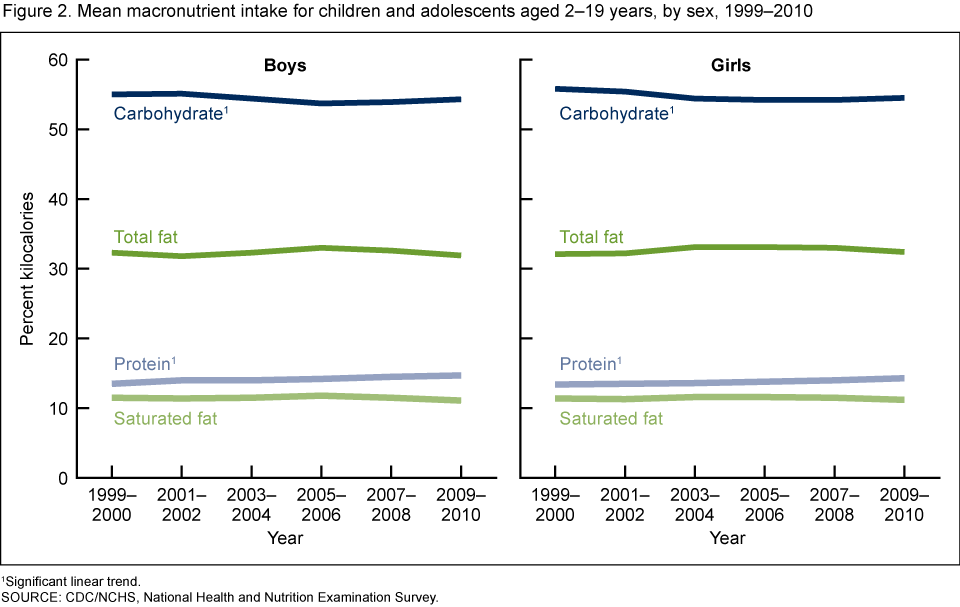
Then you look at the new study's chart about changes in what kids eat over the last decade, and, well, looks pretty consistent to me:

Figure 2. Mean macronutrient intake for children and adolescents aged 2–19 years, by sex, 1999–2010
Figure 2 is a line graph showing the mean percentage of kilocalories from carbohydrate, protein, total, and saturated fat for every 2 years between 1999 through 2010 for children and adolescents aged 2-19, by sex.
1Significant linear trend.  SOURCE: CDC/NCHS, National Health and Nutrition Examination Survey.
 
Perhaps the headline should have been "Hype and Expense Countering Obesity Bring Few Results."
 
But our culture's enmity toward fat demands a war on "the epidemic of obesity" and continued revulsion toward those of size. A new book, What's Wrong with Fat? details all the negative implications of terms for larger people--terms of disdain rather than simply judgement-neutral descriptions. New York Times reviewer Abagail Zugler, MD. notes, "'fat' often implies the coexistence of sloth, gluttony and self-indulgence. 'Obesity' equals disease to medical professionals, while in the world of public health, it is a raging epidemic with substantial global mortality."
 
Except when it isn't. An impressive meta-analysis of thousands of studies recently found that overweight folks have the highest life expectancy, and those considered "grade 1" obese have the same mortality as people of normal BMI.
 
So why do we despise fat so much? Why is it worth millions of taxpayer dollars to combat this "epidemic"? The Stimulus alone dedicated $230 million just to anti-obesity ads. Could it have something to do with ease and grace? I'm just speculating here--Hollywood perpetrates the thin-as-beautiful model, obviously, and last week's Academy Awards highlighted to the nation the impossible standards placed before the public (with the refreshing exception of singer Adele). But it's more than that--our culture honors sports stars, ballerinas, and CEOs so accomplished they appear not to have time to eat.

Why? In our visual milieu, with TV and YouTube and HD movies from our own cameras, we're more exposed to images that contrast dynamic action with sluggishness. Thin people move easily. They gracefully alight from chairs, and energetically take on what's in their way.
 

Jered Fogel with his old pants at Subway
Rolls of fat generally slow people down. Moving large girth requires greater strength and at times, difficult maneuvers. Communicating while out of breath detracts from content. Gov. Chris Christie, while brilliant and effective, has to deal with his weight publicly, a factor and distraction unconfronted by politicians who are more averagely shaped. Gov. Mike Huckabee, with a kindly heart, hopeful message and insightful mind, demonstrated his competence when he lost more than 100 pounds, writing about it in his book, Quit Digging Your Grave with a Knife and Fork. Some suspect that regaining part of the weight was a factor in his choice not to reprise his 2008 presidential bid in 2012.
 

Obese people face problems beyond the usual challenges of life simply because they present a large form. A Feb. 13 New York Times story "Two-Thirds the Man He Used to Be, and Proud of It," describes England's Paul Mason, who actually lost two-thirds of his 980-lb. body weight via gastric bypass surgery, diet and exercise (though he remains limited by excess skin). (The online version of the Times story corrects the headline error, to "One-third the Man...") Meanwhile, a USA Today story details how Jared Fogel's life now centers around his new career as symbol for fast food giant Subway, after his self-styled sandwich diet whittled him from 425 to 190 lbs. Now the company and Jered have a symbiotic relationship, and its marketing chief credits him with a third to a half of the chain's growth over 15 years.
 
In other words, media shows us that obesity isn't a matter of health, it's a matter of gliding with effort versus ease. Of looking good, not just staying well.
 
"Let's Move!" barks first lady Michelle Obama, who took her healthy-eating campaign to Mississippi this week. She took a cue from her husband's tendency to sound preacherly when she lauded that state's improvement in elementary-age obesity: "Your schools did hard work, replaced their fryers with steamers, hallelujah, and started serving more fruits and vegetables and whole grains!"

As the champion of svelte form, known for her muscular arms, the First Lady adds to the assumption that agility and litheness are superior to ample girth, no matter the amount of strength and stamina the larger person commands. Fat implies gluttony and sloth nowadays, rather than an upper-class, pampered life. Perhaps thinness, a la Les Miserables, was once considered a sign of poverty and hopelessness, but in America, to the contrary, lower socio-economic-classes experience higher levels of obesity. Now it's the stylish, well-to-do who have time for gym regimens and preparing cuisine-du-jour featuring quinoa, macadamia nuts and acai. The poor, data show, spend more time sedentary in front of televisions and computers, munching "lower quality" diets of calorie-dense prepared foods.
 
To combat this trend, Mrs. Obama and television cook Rachael Ray joined in a healthy food cooking duet in Mississippi, and Michelle's "The Evolution of the Mom Dance" with TV host Jimmy Fallon garnered more than 14 million YouTube views. Her moves with Serena Williams and a gym full of kids in Chicago was another occasion to put down fat and boost people whose bodies can make easy gyrations.

I don't condemn the First Lady's campaign, or even her grinding in a circle, hands clasped over her head. Exercise is beneficial and moving freely, important. I don't think it unseemly for Mrs. Obama to demonstrate that no one is above striving for fitness, and to show that dancing can be fun, rewarding exercise (I'm a Zumba fan, myself). I also understand why gazelle-like movement is seen as more beautiful and desirable than the same actions by someone generously endowed (e.g. ballet is seldom performed by overweight dancers).

My issue is with the idea that obesity can be cured by a happy afternoon bopping in the gym, revising school lunch menus and putting fresh fruit stands on inner city corners. These things do no harm, but it's a waste to invest enormous amounts of tax money in them when there's scant evidence they'll improve public health or longevity.

Obesity is far too complex a problem to insist that choosing tangerines over Tootsie Rolls  will make a major difference. All the hopeful praise of (to me imperceptible) declines in childhood BMI in a few locales negates the truth of the issue, and disheartens the many people who struggle earnestly to "make healthy choices" and include exercise in their lives but find they're still not dropping pounds permanently. We need honesty about the real extent of the "problem," and less panic and hysteria about an "epidemic" whose means of transmission is just not known.

Tuesday, February 19, 2013

My Husband Shaved off his Mustache! (or, "I Kissed a Stranger")

Throughout the thirty years I've known my husband, he's had a mustache. It was his trademark, in fact, crawling across his face as he hosted a long-running television show, and gave thousands of speeches to huge groups across the country. He was one of those people known for his 'stache, almost his defining characteristic, because he clung to it, or it to him, way past the time even the least fashionable media icons decorated with lip fuzz.


Mustachio'd on the Jewish holiday of Purim
We moved on, and he didn't, until yesterday. He called me downstairs to the bathroom and looked me in the face, grinning. Who is this person?


I should've seen it coming. I'd sweetly suggested the clean sweep to eliminate his chore of plucking out invading gray hairs. A few weeks earlier, our fashion-conscious daughter pointed out that his facial adornment had become...slightly crooked. Our son confirmed it was definitely lopsided. No, my man protested, the color of the balancing side had just turned less visible.

The fact my husband's mustache was turning gray was a big factor in his decision. Though he's staked his career on transmitting values and messages, the truth is that in our visual culture, appearance is the first factor on which people are judged. For a long time, he felt quirky or idiosyncratic by having an out-of-style facial signature. And au courant or no, he rationalized, it fit well above his thinnish lips.

He's not one for change, and that hairy strip was a reassuring constant in a dizzy world. Years ago, he reluctantly exchanged his thick eye glasses for contact lenses, at the insistence of his TV producer, who said their reflection interfered with his presentation. But his mustache? That was him.

More than once, for the Jewish holiday of Purim, when celebrants wear costumes, groups had impersonated my husband, mainly by each adding great facial swaths.  The holiday is coming again this weekend, and anyone seeking to emulate him will have to rely on a toothbrush, an accessory for cleaning he often keeps neatly in his cheek.

Or maybe his clothes, known to be less than trendy. His concession to acceptability was buying a couple shirts and jeans at Costco; our daughter's expedition to Nordstrom Rack had yielded some wardrobe candidates, but he wouldn't even try them on. After all, with a closet-ful of ancient outfits (faded and threadbare makes them more comfortable), he didn't "need" any more. This is the man who went for a meeting with the President of the United States in the White House, wearing a pair of black jeans, albeit with a shirt, tie and (well-aged) sport coat. A colleague had to take him aside afterward and gently explain the proper attire for the Oval Office.

The man with a naked lip


However, there's no one more up-to-date on ideas. Ask the man anything about current events, politics, film, or, for that matter, history of anyplace or anyone, and his encyclopedic mind kicks in instantly. How could he stubbornly defend a ridicule-inspiring symbol that is so, well, in-your-face?

At last he caved. And when he called me downstairs to proudly show it off, I was stunned. Between his nose and admittedly thinnish lips was...a football-field of skin. After a few moments of awe, I kissed a stranger. A very different experience, unimpeded by stray coarse hairs and a stiff fringe. With my eyes closed, it was still him. With them open, well, it sounded like him.

I'm still not used to seeing my husband's new countenance. He tends to look in the mirror and smile, frequently, assessing the image. I do think the absence of a gray slug parked over his mouth makes him look younger. Change of this type is a good thing--reminding us that physical appearance is ever-morphing, even if we don't take a scissors and Norelco to the fronts of our faces. My mom used to tell me that "beauty is only skin deep," and in this case, growing from it.

I hope my husband retains his new, sleek look. There's no need to advertise one's maturity with a mustache both wildly-unfashionable and graying. And he's got such important and worthwhile content coming out of his mouth that it hardly matters what facial decor surrounds it.

Monday, January 28, 2013

Punishing Smokers and the Obese--what?

Heidi Klum: Role model for the obese?
I just read an Associated Press story in my local paper with the headline, "Do penalties for smokers and the obese make sense?" It proposes either punishing folks whose conditions are likely to require greater health care expenditures or letting "these health sinners die prematurely."
In other words, there are only two options for smokers, whose annual health-care costs are "about $96 billion," and the obese, ($147 billion): Death before they otherwise would go--perhaps saving the system old-age-related health care costs--or taxes and restrictions designed to curb smoking or eating, to offset the extra services they'll likely need while alive the usual length of time.

Does this sound crazy to you?

The most glaring and offensive assumption is that smoking is a choice that is equivalent to a choice to be obese.

The big argument in the article is whether penalties are unfair to the poor, who tend to be both smokers and obese. A secondary argument is about whether it's fair that other people sharing a health carrier should be forced to absorb the expenses of your smoking or obesity. Sorry, those are not the relevant questions, and certainly shouldn't be posed as if these two divergent health problems are comparable.


Daniel Callahan: shame fatties
Quoted is bioethicist Daniel Callahan, senior research scholar at The Hastings Center, New York. He got in trouble last week for a paper in which he suggests that the obese, already "lost," aren't going to be helped, but overweight folk don't really realize how badly-off they are, and need "nudging" by policy and practice toward eating less and having some self-control. His paper got press under the term "fat-shaming," though that isn't exactly what he advocates. He describes how social pressure got him to quit smoking, and thinks that when the brains of the bulging understand how they're harming their bods with excess weight, they'll gain motivation to slim.

Does he have any evidence that fat people are unaware they're chunking up? Does he think our society, that confronts everyone purchasing food in a check-out line with magazine covers of impossibly thin movie stars, offers little pressure to be healthy, fit and slender?

Here we have an individual who truly has little understanding of the complexities of the obesity issue, yet suggests we ask the portly, "Fair or not, do you know that many people look down upon those excessively overweight or obese, often in fact discriminating against them and making fun of them or calling them lazy and lacking in self-control?"

The central mistake in both Dr. Callahan's paper and the Associated Press piece is the belief that the smoking and obesity problems are parallel, subject to the same causes and cures. The causes of both, implicitly, are exactly the taunts Dr. Callahan points out to those of size: laziness, lack of will-power and self-control.

That such a paper could be called scholarly and get published is astonishing; that newspapers would carry such assertions and suggestions is appalling.

You can teach a smoker to completely stop smoking--but never an eater to completely stop eating. Smokers have a range of physical and emotional reasons for smoking; science is constantly revealing new causes for overweight and obesity, many of them out of individuals' control.

A few days ago, Nicholas D. Kristof wrote in the New York Times about the impact of en-utero and at-birth influences on offsprings' obesity. He described research in which genetically identical mice fed and exercised the same were of greatly differing sizes--depending on whether they were exposed to an endocrine-disrupting chemical at birth. A single exposure determined whether they spent life obese or normal-sized. Kristof used the information to argue against endocrine-disruptors, such as the plastic additive BPA, in the environment.


'Flabby' and normal mouse differ only by at-birth endocrine disruptors
I wonder how he feels about dieting, then. If the "flabby" mouse ate and exercised the same as his thin brother, yet was programmed to be obese in a way he could never change, why ever argue for eating less and exercising more? For these mice, is a calorie a calorie, or does the calorie do something different depending on warped or healthy chromosomes?

Could you shame an endocrine-disruptor-exposed obese person into losing weight? How about someone with obesity as a souvenir of the Adeno 36 virus, also shown to change both people and animals from svelte to swollen after exposure? Can you "nudge" into skinniness someone whose hormones have gone wacky? Or those experiencing obesity as a side-effect of needed medication for another condition?

The Associated Press story talks about the success of rules limiting smoking in public places, and cites NY Mayor Bloomberg's ban of sugary drinks in 16-ounce or larger cups as another policy to address a health problem. I've never seen anyone harmed by second-hand soda, and there's scant evidence that selling16 versus 20-ounce fountain drinks makes for smaller bodies. New York government is meddling in restaurant commerce with a kindly intent but with the erroneous assumption that like smoking, obesity can be extinguished through laws better able to help people than they, themselves, can.

Another striking and shockingly erroneous parallel appearing in news media, by the way, is between smoking and gun ownership, seen as similarly dangerous. If we can legislate limitation of smoking, and thereby save lives, we can legislate limitation of gun ownership, again saving lives. The comparison fails, however, in that the vast majority of gun owners are responsible, law-abiding citizens whose weapons could stop a crazy person's rampage, thus saving, rather than taking, lives. Current campaigning to eliminate gun ownership (gift cards for guns turned in; creating hurdles to gun ownership; limiting size of ammunition clips), especially as portrayed by the New York Times' "expose" this weekend on what the paper considers the gun industry's efforts to capture children as future customers, contains the same misguided underpinning: Big businesses want profit despite causing harm, and government needs to step in to protect people from their own deleterious decisions in patronizing them.

The Associated Press story does acknowledge a difference between second-hand smoke and first-hand-to-mouth imbibing: "When you eat yourself to death, you're pretty much just harming yourself," University of Illinois professor Jay Olshansky concedes. The Affordable Care Act allows a surcharge for smokers, but none for the overweight or obese, however. New studies showing that overweight and mild obesity correlate with greatest longevity don't do much for the argument that smoking and obesity are equal evils.

And that's my point: The thickening of America is a unique issue, and, if these longevity studies are correct, doesn't have to be, in all cases, a problem. I think our culture has thoroughly shamed people whose bodies are wider than ideal, and the number of diet books and slimming industries, feeding $20 billion annually into our economy, testifies to the extent Americans care about their weight, health and appearance. Don't tell me our nation needs "nudging" or penalties or restrictions to motivate us toward healthy size. Don't even suggest that people are unaware of their shapes or even the healthfulness of their diets. They know, and a plethora of forces acts on their food decisions and ultimately, whether they are fat or thin.

Wednesday, January 16, 2013

New Year Brings (Ridiculous) Barrage on Weight Loss

Did you resolve to lose weight in 2013? According to an endless media parade, you have, or should have vowed to get in shape, or otherwise deal with your weight, eating or fitness.

I've been catching up on all the newspaper I've skipped while away several weeks, and notice that in every issue of the four different papers I peruse, there are at least two items about obesity, eating or dieting that I feel compelled to clip, given my work on a book in that area.  I find something objectionable about them all, because appearance/eating journalism features guilt, shame and failure as themes. No wonder newspapers are sunk.

Here's a piece in USA Today, "Critics pounce on Coca-Cola obesity campaign" from Tuesday, January 15. The Coca-Cola company makes a video trying to define its role in making people fat--after all, consumers pay to guzzle their products--and the anti-obesity establishment jumps all over it. The article's headline nods to the disdainful Michael Jacobson, executive director of Washington's Center for Science in the Public Interest, who says Coke's video "is a page out of Damage Control 101, which is try to pretend you're part of the solution rather than part of the problem."

If nobody bought Coke, the company would go under. Enough people are willing to pay for it to generate profits instead. Banning soda whether in Mayor Bloomberg's favorite 16-oz. cups or any other form, or shaming its imbibers is no solution for obesity, but nobody wants to hear it. At the end of the article, a Coca-Cola spokesman offers, "Obesity is complex, and it requires partnership and collaboration to help solve it. We have an important role to play in the effort to find solutions that work for everybody."

Barry Popkin of the University of North Carolina won't buy it, responding, "The Coca-Cola Company still remains one of the major causes of obesity in the USA and globally." So there.

On the very same page of that day's newspaper was an interview with "Manhattan socialite" Dara-Lynn Weiss, 41, whose new book explains why she put her obese 7-year-old on a diet. She wrote about it in the April issue of Vogue, to subsequent viral web vilification.  Now she's hyping her story further, and says little Bea, now 9, is a "healthy" weight. Bea bulked up by age 6, despite living in a home of thin people who shared healthy meals together, because she "was a child with an enormous appetite."


Dara-Lynn Weiss and Bea
What do I take from this? Just what the Coca-Cola spokesman says: Obesity is complex. Here was a little girl with skinny parents and a little brother "who doesn't want to eat sweets," whose natural physiological makeup gave her more appetite. Should she restrict her diet her whole life? Should her mom have enforced her weight loss? I don't know, but can you blame Bea's obesity on the Coca-Cola Company?

I can understand how difficult it is for a fat child. No mother wants to see her daughter suffer with something that can be addressed. On the other hand, few mothers would describe their efforts to slim their 7-year-old in Vogue Magazine.

That aside, the message remains: Fat, shape, obesity and dieting are enormous problems in America. Perhaps as much for their psychological impact as their physical manifestations. They're also huge sources of wealth for businesses large and small who deal with them.

Yet, being fat could be good for you. I found a slew of articles reporting on a new US government meta-review of 97 studies on longevity that found that overweight people had a 6%, and "Grade 1" obese a 5% lower risk of early death, than either higher-level obese or normal-weight people. The study's release was followed by a New York Times Op-Ed piece by Paul Campos, one of my favorite writers on the subject, who's made the same point repeatedly since his 2004 book, The Obesity Myth.

I'm also a fan of the lead author of the massive new study, Katherine M. Flegal of the CDC and National Institutes of Health, who discusses her process and findings in a three-and-a-half-minute video. Her team looked at 7,000 studies, eventually selecting 97 that met their criteria: body-mass index as the measure of girth, and broadly representative populations (not subsets, such as those suffering from a disease). Their many analyses yielded "strikingly consistent findings," across age, sex, smoking, gender and parts of the world (most studies were from North America). Being somewhat obese or overweight was simply not a hazard for dying; being overweight was a statistically significant advantage to longevity.

The obesity police? Watch out!
This is not a message that the obesity police want to hear. They immediately set to work tearing apart this unassailable, respectable analysis. Walter Willett of the Harvard School of Public Health erroneously said the study's flaw was "because the overweight and obese groups were compared to this mix of healthy and ill persons who have a very high risk of death, this led to the false conclusions that being overweight is beneficial and that grade 1 (moderate) obesity carries no extra risk." I wonder if he actually read the research, but he was emphatic in his review: "The paper is a pile of rubbish." With three million subjects studied, that's an awfully high pile.

Perhaps you can grouse that BMI isn't an accurate measure of overweight since it doesn't account for percentages of muscle, or location of fat, but when you talk about 97 high-quality studies of three million people, you've got enough information to say something important. The health establishment is so invested in its anti-obesity campaigns that it can't even acknowledge a bit of good news.

And the reason that establishment is so dismissive is the same cultural bias that prompted Dara-Lynn Weiss to print in a fashion magazine the dragon-mother tactics she used to whittle her 7-year-old ("I stopped letting her enjoy Pizza Fridays when she admitted to adding a corn salad as a side dish one week. I dressed down a Starbucks barista when he professed ignorance of the calorie content of the kids' hot chocolate...").

And that reason is our hatred of body fat. We associate a bulbous appearance with negative personality characteristics. Here's another article I clipped today, from the Wall Street Journal: "Want to be CEO? What's Your BMI?" "Executives with larger waistlines and higher body-mass-index readings tend to be perceived as less effective, both in performance and interpersonal relationships," according to a study by the Center for Creative Leadership, a non-profit group. "Excess weight can convey weakness or 'lack of control,'" adds New York image consultant Amanda Sanders.

A 2010 Australian study found that "obese people were rated less favorably, and as more disgusting, than all other social groups." Yale University researchers (2005) tried to improve anti-fat bias by combatting the perception that obesity is within an individual's control, and that "people get what they deserve and are responsible for their life situation." Interestingly, prejudice against the rotund has grown to a global phenomenon, with Arizona State University researchers reporting cross-cultural agreement with the statement, "fat people are lazy."

A generation ago, we might have considered it impolite to comment on others' sizes. I remember my mother admonishing that one's inner soul, or "the content of his character" is what counts, not how he looks on the outside. At the very least, we judge by behavior, right? No longer.

We despise fatness, and now in the guise of ending an epidemic, the obesity police have free rein to butt into our most personal decisions ("what size beverage do I want?"). It doesn't matter that health and BMI are for most people unlinked. Paul Campos can wisely repeat that "baselessly categorizing at least 130 million Americans--and hundreds of millions in the rest of the world--as people in need of 'treatment' for their 'conditon'" merely feeds big pharma and weight-loss industry coffers. He can insist that there's no health reason to push present ideals--but he won't change anything, because in our culture, fat is abhorrent.

I've spent a lot of  time researching causes of obesity, and they are many. Certainly not soft drinks, though glugging full-sugar sodas throughout the day adds calories, just as enjoying a morning latte does. Pure fruit juices count as "sugary drinks" equally, despite their enrichment with extra vitamins, since their calorie-counts are similar to Coke's (for example, 8 oz. of Florida's Natural orange juice is 110 calories; regular Coca-Cola has 96 for the same amount). What few people mention is that "normal" eaters, the ones in touch with their body's cues of hunger and satiation, feel full when they consume food or drink, and the more they consume, the less additional they want.

And that's my answer to the obesity issue, though certainly not a complete or perfect solution. Rather than listening to the prattle of pundits or exortations of experts, all of us can relax and strive to trust our bodies' messages. Even doing that, many people will be fat. I think of poor little Bea Weiss, whose mother watched in horror as she responded to her inner call for food. Dara-Lynn Weiss only wants the best for her daughter; she only wants her to grow up healthy and happy, and the only means she knows to facilitate that is to teach Bea very young to deny her desires and place a major emphasis on staying thin. "It's absolutely a problem every day that we are attentive to," Dara-Lynn Weiss tells Fox and Friends in an interview about her new book, The Heavy.

My hope is that medical science can learn more about the causes of obesity, and means to regulate them--and there's a lot to learn. Some obesity is caused by a cold virus. Some is the result of imbalanced hormones. Some is a medication side-effect. Some obesity is inherited, and some is the result of genetic changes caused by environmental factors. Stomach acids play a role; the amount of calories expended in breath impacts metabolism, too. If you ever watched the excellent BBC series "Why are Thin People Not Fat?" you know that a range of influences determines how calories are burned.

Exercise is not necessarily central among them. Some sedentary people eat whatever they want in any amount they choose and remain thin. They may not have finely-toned muscles, but they stay slender. What determines one person's desire for soft drinks versus another's preference for black coffee? Is the black coffee drinker more likely to be thin? Is a Cheetos-eater more likely to be fat? Not necessarily. We just don't know enough.

This is never the message of the articles I cull from the newspaper daily. I have folders on all sorts of interesting fat-related themes, including psychological influences on weight, what crusaders are doing to shrink the populace, and various substances certain loud voices dub deleterious (think sugar). I have files on childhood obesity (Bea!) and exercise and the food industry.

But aside from awaiting research, what can Americans do? Learn to turn inward. To thine own body sensations be true. Separate psychological, media and presence-of-food influences from real hunger, and when eating, focus on physical reactions. This is a learnable way to live, natural and effortless for a swath of the population. It's just too bad all this publicity about obesity and sloth has everyone so unfairly and wrongly uptight.

Friday, December 28, 2012

Just Fix the Fiscal Cliff, already! Notes from Paradise

It's a big contrast between my idyllic surroundings in Hawaii and the stress my husband is feeling, and sharing (or foisting) with me about the impending fiscal cliff.

I think our President wants us to tumble, because he's in the position of power and revels in it. He wants Republicans to look bad, and after Speaker Boehner's failure with Plan B, you know we do. By so doing, he looks good, of course, his favorite way to look.

Even better for him is feeling powerful, and now's his moment. He wouldn't dare linger one more day in Kailua (on the other side of Oahu from Waikiki) with the fam, when he can watch the nation plunge off the precipice and gloat.

"Suffer, you poor stubborn Republicans!" And incidentally, everyone else, who very quickly will pile on his side and yell for the selfish, stinky, eeeeevil Republicans who want to protect their rich 1% cronies, to cave. Truth is, they--we--are stuck at the mercy of the grinning Potus once paychecks shrink and inheritances crumble--and stocks plummet and jobs disappear and we're all screaming--pleading!--for relief.

"Help us! Oh, help us, dear President!" And with his magnanimousness, our Nobel Laureate, who obviously knows a thing or two about keeping the peace, will accept the bow of those who once were too stiff-necked to see his truth.

There is no reason for our president to want to "cobble out" a compromise; no need for him to do more than stand parentally watching the bad boys and girls who want to protect the filthy rich realize their folly. He wants to save us. It frosts me, which takes a lot when the night-time low temperature is 75, that he gets to feel so superior and so right.

He thinks what he wants is best for the country. Going over the cliff, even to win his point, will hurt a lot of people. But in the end, he'll remind us, we'll be better off.  When that doesn't happen, possibly because people smart enough to earn more than $250,000 annually are also smart enough to figure out how to avoid taxes, he'll still blame Republicans.

It's a beautiful view here in Hawaii, with the aqua surf, stark Pali mountains, lush tropical flowers. Our president can certainly tell you that. But from his vantage, the view is even better in Washington, because he'll watch his opponents tumble into place like the white cascade of the waterfalls in paradise.

And the rest of us, no matter our surroundings, are left with stress...

Monday, December 17, 2012

Sad, but sick of pondering Connecticut shootings

Newtown, CT memorial for victims of shooting rampage
I'm sorry not to be politically correct, but I don't want any more emails or alerts about whether my children are safe in school. I can't read any more pronouncements for banning handguns so that kids emerge alive from their classrooms. Don't replay presidential assurances that "something will be done" to prevent tragedies like the Connecticut mass shootings.

There is nothing to be said; nothing to be done (but, perhaps, weep for the children and the families involved). Seeing flags flying at half-mast everywhere I go makes me wonder what the signal of such gestures is, or can be. When I was young, upon the death of a statesman, president or unusually significant leader, flags would ascend only half their usual heights in recognition of the accomplishments of the deceased. The diminished loftiness of the flag acknowledged the loss of someone particularly influential and great. Now, it seems, if we have reason to be sad, even if it's because someone went berserk, the national symbol is lowered.

That a human being could murder in such a shockingly heartless and cruel manner--in a place we consider innocent and pure--so many blameless and even exemplary people is, of course, horrifying. It is fitting that those lost should be memorialized properly, and mourned.

But that's where the response should stop. Instead of generalizing and sermonizing; instead of attacking second-amendment freedoms or insisting that some policy or safeguard might have prevented this tragedy, we should simply grieve. Quietly and sincerely.

There is no sense to be made of this. There is no action needed or blame to be placed. There is no rule or safeguard that should have been enforced. This was unpredictable and nonsensical. The motivations of the individual who committed this unspeakable series of murders is incomprehensible. We do not want to accept that, but we should, and in the end, we will.

In the interim, we magnify the sorrow by endlessly succumbing to what my husband has dubbed "the do-something disease." In our powerlessness, we crave solutions. We want to address the problem to gain control.

But we have none, and this kind of wrenchingly awful crime cannot be addressed. There is comfort to be shared but no resolution.

What causes mental illness to manifest itself? What causes a person to "snap" or experience "melt down" or, in shooter Adam Lanza's case, endure "an episode"? What spurs any compulsion? Medications can influence the brain and thus behavior, but are they automatically appropriate for socially inept, quiet people? Are we to look at anyone with idiosyncrasies or even Asperger's Syndrome as a threat requiring treatment and "normalizing"?

Sorry. I seem to be indulging in the same mind games I eschew. Let's deal with this in our personal feelings and stop groping for answers to imponderable questions. Sometimes the message is to realize our vulnerabilities and our dependence on God, and become more humble. There's research to be done on how the brain functions, but that is ongoing and hasn't yielded what we want to hear now. Let's accept our inadequacies and our lack of control, and then, please, just be quiet.