Thursday, June 30, 2011

Jumping through Hoops: Why go to College?

In the new flick "Larry Crowne," which I viewed a couple nights ago, the lead character (Tom Hanks) gets downsized from his do-everything clerk job at a big box store--despite multiple "employee of the month" honors and pride in his work--simply because he never went to college.  Later in the film, we see his colleague dismissed because he only completed three years post-high school education.

Besides the development of a sparkless connection with a speech teacher (Julia Roberts) when he enrolls at a community college, the take-away from "Larry Crowne" is that being enthusiastic and competent counts far less for advancement than some arguably meaningless hours in a classroom.

Coincidentally, my fave radio host just spent an hour interviewing John Stossel about whether or not college is worthwhile.  Stossel, on the show to promote a TV special on the topic, emphatically championed "not."

But "worthwhile" was only defined as college's import or impact on the careers of its graduates.  Are most jobs that require a college degree really performed better because their holders possess a sheepskin?  Probably not, if the employee has enough smarts to otherwise pick up the skill set.  Are graduate degrees worth the thousands of dollars of debt they usually incur?  That's getting to be a tossup, with many occupations now overloaded with applicants.  Get a juris doctor from a good though not top school, and you're no longer guaranteed a position in a law firm when you finish.

Vocational schools do an admirable job preparing students for real-world wage-earning.  I hired a young woman to baby sit my children partially because she had a certificate from a "nanny school."  Years ago, when earning my counseling credentials in Los Angeles (yes, at a university--more on that later), I toured and admired a regional vocational center, where high school students took courses on real-life skills, like how to plate meals at restaurants, how to repair a Ford carburetor, how to manage a hotel, and how to organize an office.  The graduates of these programs were immediately employable--if they'd been subsidized by Obama's stimulus, they'd be called "shovel-ready," though these folk won't need to wield a shovel to earn a paycheck.

There are plenty of very clever entrepreneurs who didn't need college classes to put their creativity and industriousness to lucrative work.  Everyone points to Harvard dropout Bill Gates as a premier example.  But lots of dot-com and smartphone app-designers learn how to write code and instantly launch businesses that answer a need or desire, with no need for pre-requisities.  If you're smart, you'll succeed with--or without--a college degree.

If you're not at the IQ or achievement apex, though, college has some benefits--for you and your future employer.  Possessing a four-year degree shows tenacity, the ability to play by the rules successfully to conclusion of task.  Dropping out suggests failure, no way around it; extenuating circumstances must be explained.  Nowadays, those who don't even attempt college are assumed unintelligent or incapable or disadvantaged.  None of those terms describe highly-desired employees.  College completion is a gate-keeper, a screening device simplifying the employee selection process.  Earning a professional degree is similarly the red rope allowing the plucky few through to highest-paid echelons.

So it's true that education is the key to success.  The more educated, the more income and less unemployment.  Here are the latest data from the Bureau of Labor Statistics:


Earning a degree is an achievement. Admittedly it's a very narrow type of achievement, showing short-term mastery of material, compliance with requirements, and the ability to show up at lectures or share notes with someone who has.  With "distance learning" the new trend, now even face-time on campus is optional.

Higher education is also an industry.  Confession: I have a master's degree in...believe it or not, Higher Education. It's an actual major in the Graduate School of Education at UCLA, and I earned an MA in it.  In fact, I was a happy customer for the industry of college for eleven years.  Because what one is prepared for when one completes high school is...to go to school.  For me, and many others, college is an extension of high school where you get to decide when to come to class.

Throughout my college years, I was self-supporting through a variety of lower-paying jobs, and had no help from parents.  And I finally did have to decide what I wanted to do, and it did require the ultimate degree I earned.  But being in college gave me lots of time to figure that out, as my professors urged me to go on to higher levels, to stick around sitting in the front row taking copious notes and memorizing the words that came from their mouths.

College has plenty of perquisites, including fun. Not just in the getting drunk kind of way (wasn't my thing) but in the pleasure of learning stuff and then spewing it back, with the reward of credits, and ultimately, a degree.  And respect.  I didn't really understand why simply continuing to be a subordinate, an older child, earned such kudos, but I also didn't care. The process was excellent.  The campus was beautiful, with exotic botanics punctuating every season, lunchtimes on broad expanses of lawn eating unreasonably cheap meals, a built-in friendship network and exciting events publicized in a free daily newspaper.

Tip to youth: When you don't really want to grow up, collect graduate degrees.

The infrastructure supports it.  Professors want to keep their jobs and, as I implied before, enjoy the ego boost from attentive and interested students. To support their administration and auxiliary services, as well as the faculty, colleges want to attract and matriculate good students. The counselors want clientele; the cafeteria staff wants to keep making delicious soups with free crackers and selling them for two dollars a bowl.  The point is that higher education is an enormous industry that exists to perpetuate itself.  It's invested in its own prestige, and a gullible society buys in.
 
Because of its historical importance, and the fact that decision makers went there and passed through its gate, and mainly because of higher education's own survival mechanisms, politicians like our president seek to expand the market for colleges and funnel more tax funds their way.  Speaking at the University of Texas, Austin, last August, the President said, "I'm absolutely committed to making sure that here in America, nobody is denied a college education, nobody is denied a chance to pursue their dreams, nobody is denied a chance to make the most of their lives just because they can’t afford it. We are a better country than that, and we need to act like we’re a better country than that."

So, in his view, a "better" country channels everyone into college, in stark denial of the realities of the marketplace.  The new workforce can now design websites from home. It can telecommute and use flat-screen TVs for group meetings.  It can outsource manual manufacturing to China from computers by the pool.  Did Bill Gates need college?

Does America?  If, as Pres. Obama envisions, ours becomes a country where everyone is college educated, who will serve your Starbucks?  Who will deliver the replacement windows that are energy-efficient?  Who will staff the restaurant where you have your raw food salad?  (Answer: the barista, delivery truck driver and waiter with BAs in sociology, psychology and history.)  Truth is, not everyone is academically inclined, and our country would be in trouble if everyone were.

I have three children, two with bachelor's degrees, but my third child is poised to start college this fall.  Would I advise him not to--rather to create another iPhone app? He's computer capable but not code-savvy, not mathematical, not even really academically enthused.  But he knows without my saying it that he will attend and graduate a 4-year college, because in present cultured society it's the minimum acceptable, the first rung on the success ladder.

A college degree is what a high school diploma was perhaps forty years ago.  Adolescence has expanded, and my son knows, having grown up in this overly-diploma'd family, what's honored and expected.  But were he to start his own company, and were it to grow and succeed, and, were he to then come to me and say he wanted to drop out of college to pursue his business...I'm not sure what I'd say.  Probably something like, "Keep working on your enterprise, but you ought to finish what you start."

That's the hoop of college, the jump that requires a smooth execution, not a stumble.  Completion.  I think we ought to drop the stigma for the working person who didn't attend college, but at the same time recognize that we're not returning to the old days when a high school diploma was sufficient.  Success is sufficient. Nobody cares that Bill Gates dropped out of Harvard, in fact to the contrary, there's something humanizing about it. I think the big box store unfairly axed the Larry Crowne character, because he showed not only competence but superiority in his work; he was successful in his position.

But when you're 21 and heading out to the world, it's still nice to have enjoyed the perks of college at a time of life when you're unencumbered.  And a diploma is still a symbol to the world that you finish what you start.

There are other issues at play--the left-leaning political bias among college professors that gets transmitted to impressionable students eager to please, the social milieu that promotes drinking and fraternizing, the blossoming of "disciplines" (e.g. Women's studies, "Queer" studies, Environmental Studies) that used to be subsumed under standard departments like history and biology, and plenty more--that complicate college's assessment.  Also, not all colleges are equal.  The benefits of attending an elite college are tangible while those for a non-selective institution may be minimal, especially when the financial toll is figured in.

Perhaps the best solution would be to eliminate federal tax subsidies for students, and for states to restructure.  Some of the least financially viable schools would close; those that attract a clientele would remain.  The remainder would become even more selective, allowing the most academic applicants access, and the rest a reason to explore vocational training or entrepreneurial outlets.  In the end, no matter how urgently the administration presses for universal college attendance, the reality of individual differences will prevail.  And because of that, the broader goal should be to honor honest, dedicated effort--hard work, self-sufficiency--rather than a certain number of hours in a lecture hall or a passing score on a final exam.

Tuesday, June 21, 2011

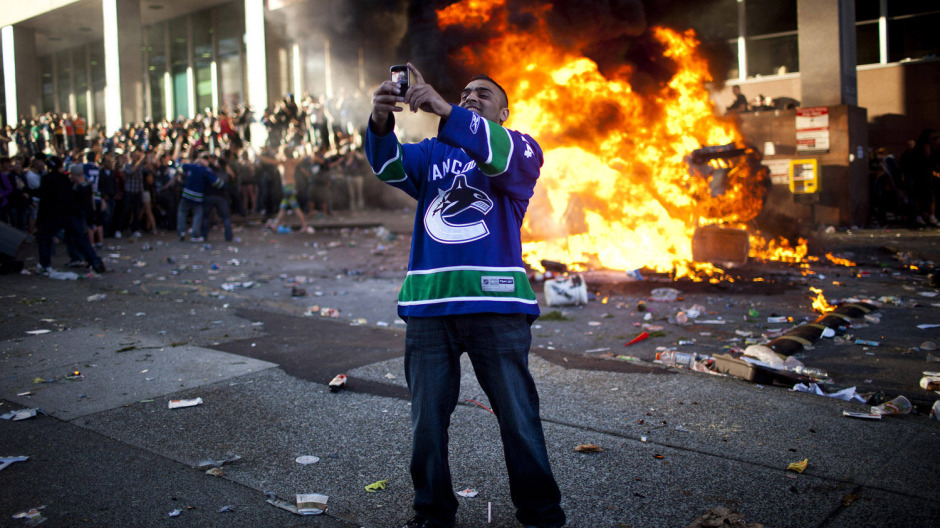
Every Thug A Star: Vancouver Riot Fueled by YouTube Wanna-Bes

The devastation last week when the Vancouver, BC hockey team, the Canucks, caused a riot by losing the Stanley Cup Final to the Boston Bruins, was shocking--and not just because sports fans can turn so mean.

Though it was appalling: A downtown destroyed, a hundred people arrested, nine policemen injured, 15 cars burned...because of a game?

To my feminine brain, the idea that team supporters could get so worked up that they go on a burning, looting, stampeding, violent rampage en masse--abandoning all morals!--is incomprehensible.  But when you start watching the YouTube videos, you're transported to the thick of it, and the outrageous mob mentality fomenting evil becomes real.

What was different about this monstrous reaction to something inherently minor in the scheme of life?  Canucks fans probably don't think their team loss was minor--after all, Vancouver has no other major sports team, and viewing the Finals' Game 7 was organized to be a city experience, with bleachers and seven huge screens set up on Georgia Street downtown. But sports, while a major business and industry, is merely peripheral to life's necessities, such as food, shelter, a source of income, family connections, and health.

The thing that made this urban outburst unique was that something new, beyond masculine idiocy and selfish thievery exacerbated the destructive mentality:  ubiquitous cell phones.

When you look at the YouTube videos posted, you realize that the mere fact of their availability means somebody was abetting the havoc and mayhem by standing there recording it.  Observers posting their videos undoubtedly felt they witnessed something significant--but failed to join with the overwhelmed police or lone citizens trying to quell the throngs to stop it.  In fact, their actions added to the difficulties.

The second thing you notice when watching is that nearly everyone else on screen not actively bashing or kicking or crashing something is also taking a video or a photo. No longer are news events "covered" by reporters sent belatedly to the scene. Now, when something unusual happens, individuals become device-holders; recording one's surroundings becomes integral to participants' experiences.

What that does, again visible on the posted videos, is encourage criminals' bravado.  You can see the thugs standing on overturned, burning cars, making muscles posing for a friend. You see them running in front of burning stores for the snapshot, then running back into the mob.  You see guys grabbing wooden planks, shoving them through glass into window displays, then raising their fists triumphantly, proclaiming their macho act, posing for the semi-circle of cell phone-holding spectators, heard cheering their subject.

And the hoodlums have no fear that their performances will bring reprisal, even as they show off for the phone-wielding hordes.  Instead of encouraging restraint, since they can be identified and more easily prosecuted, the cell phones seem to make every thug a star, every evening's anarchist a hero.

Rather a famous bad guy on this "reality TV" than a decent person with what used to be considered "normal" values.  Could it be that all the sluts-as-celebs and jerks-as-leading men on cable shows fascinate the public so much their despicable behavior is now seen as compellingly benign? What is it about a dozen cell phone cameras trained on him that makes a guy completely negate his upbringing?

It's true that religion in BC is in retreat, and latest census data shows "no religion" as the most popular option, selected by 35% of the population.  But don't even atheists have a concept of being a "good person"?  Wouldn't that include refraining from bashing in store windows with posts--and then when a singular man protests "What is this? Are you guys insane?" attacking him, kicking him and bashing him until he's a crumpled heap in the gutter?

I gasped when I watched that, a burly guy who'd answered the hooligans, beaten down by six or seven creeps, until he lay motionless in the street.

I was also agog to read the coverage of the riot in the press.  All written in the passive voice--so that nobody's actually responsible. By using that grammatical structure, the perpetrators aren't criminals or thugs or hoodlums or looters but rather, neutral forces:  "Windows were broken..." "A large two-by-four was jammed..." "A Honda was overturned..."  "It started with a couple dozen plastic bottles being thrown...then fireworks were ignited...a gray SUV was set on fire..."  All this from a single Seattle Times report of the mayhem.  What usually might say "A young man in a Canucks jersey stomped on a mailbox..." reads instead "A mailbox was stomped." The subjects causing the verbs are missing.  Can't imply these are bad guys breaking the law.

To be sure, many Vancouver residents are ashamed of their neighbors. Volunteers assembled to clean up the mess.  But the chutzpah of rioters to brag about their criminal acts on their Facebook pages, and post shots of themselves in the midst of burning mayhem shows the devolved character of too many people in chaotic circumstances.

My husband thinks the Canucks' loss was just the excuse for pent up anger, perhaps a "spring fever" delayed by bad weather, like what used to appear as annual college campus protests.  That suggests that the riots would have happened whether the Vancouver team won or lost.  Certainly the setting was right--crowds compressed into a tight downtown area, loosened by alcohol, anxious over their athletes' success.  But these were not downtrodden societal underdogs rebelling against broader injustices--rather, they were a mix of ordinary Canadian sports fans, more of whom should have stood up to blatant criminality occurring before their eyes.

Now, however, eyes are electronic, removing their owners from responsibility and direct connection to what they view.  At this point, the Vancouver riots are another form of entertainment; something else to raise our eyebrows for a moment, before we upload other scraps of life into the ether.

Wednesday, June 15, 2011

Veggies in "Healthy Food Deserts" Won't Cure Obesity

Hand-wringers in universities and government care-for-you offices have rearranged urban geography to stop the obes-ifying of America's children--by deeming certain neighborhoods "healthy food deserts." That's deserts, like the Sahara, not desserts, like what kids are actually eating.

They say that communities lacking large supermarkets, but boasting a plethora of convenience and corner stores, prevent residents from consuming the veggies and fruits that would keep them svelte.  Time and cash-strapped neighbors feed their families the fried chicken, corn dogs, chips and soda these mini-marts sell--but the experts insist that if the same stores featured cucumbers and apples front-and-center instead, parents would opt for the healthy choice.  And they, as well as their children, would be thinner.

This speculative chain of thinking led the "do something" activists--progressively-bent feds, local governments, university researchers and foundations-- to attack the problem the only way they know how: by throwing money at it.  Pres. Obama's stimulus package--our tax dollars at work, through the Centers for Disease Control bureaucracy-- has awarded thirty communities $230 million in grants to prevent childhood obesity.  Local United Way offices have funded "healthy corner store initiatives," like $50,000 to three stores in Franklinville, Ohio, and an unspecified amount in Seattle to upgrade the healthy-food stock and displays in 22 convenience stores in the Delridge neighborhood.  In addition, the W. K. Kellogg Foundation in Battle Creek, Michigan, funded nine sites nationally, including $500,000 to Seattle's King County. In Pennsylvania, $30 million of state grants over three years was triple-matched by $90 million more in grants and loans from The Food Trust, used for 78 grocery outlets in poor neighborhoods.

But the front-page lead article in this week's Sunday Seattle Times paper, combined with its Sunday magazine cover story (funded as a grant project by a California endowment through the University of Southern California) exposes how ineffectual throwing money at fat-causing behaviors really is (even as the feature lamely offers sidebars advising parents on curbing kids' expansion).

The article says that here in my state of Washington, the feds and foundations tossed mega-bucks ($15.5 million from stimulus funds alone) at the "food desert" problem without results. It describes how food-access advocates finally convinced the Delridge "Super 24" corner store to revamp its stock, adding refrigerated cases with an assortment of fruits and veggies. A KOMO TV news story features United Way rep Lauren McGowan pointing to the new cases effusing, "you've got lettuce and limes and lemons and cucumbers, and stuff that families can go home and make a salad, make a fresh meal for their family!"

The news video laments that small convenience stores don't take food stamps, suggesting illogically that this forces homeless customers like Jose Lopez to buy junk food instead: "Oh, I like to have these fruits..." Mr. Lopez, holding a freshly-purchased large coffee says, pointing to a basket of apples, oranges and bananas by the cash register.  He's cut off mid sentence by reporter Elisa Jaffe who finishes, "but they don't take your food stamps."  Lopez shrugs. "They don't."

It's wonderful that kindly community members want their poorer brethren to eat well. But the brethren themselves don't choose to. Bhim Singh, the Delridge store's owner, was lauded in December, 2009 when his new refrigeration units and "healthy choice!" signs touting nutritious items went up. This week's newspaper article, however, provides an update:  "We would spend $200 on vegetables and make only $10," he admits.  He's back to stocking only the longer-shelf life produce he carried before the hoopla, like potatoes and onions.  His clientele, it's clear, keeps him afloat with their fried-food-and soda purchases.

"Officials say they have learned valuable lessons," says the Seattle Times story. "Maybe they didn't spend enough time selling the idea.  In any case, they've budgeted another $1.8 million in hopes of enlisting at least 25 stores."  Don't bore them with facts.

The research considered most definitive on the question of access to healthy food was conducted by the US Department of Agriculture, published in June, 2009.  In it, a national questionnaire (which, when examined, is a pretty poor measure of food access) found that 81 percent of respondents "always had the kinds of food they want to eat."  Sixteen percent had enough, but not "always the kind of food they want to eat." Of that 16%, five percent said they didn't "always have the kinds of food they want to eat" because "it was too hard to get to the store, or the kinds of foods they wanted were not available."  Elderly or infirm people, and those who didn't have the money for food--even if it were easily available--made up more than half of those people--leaving less than 3% of respondents overall who don't "always" have what they want because "the kinds of foods they want are not available."

This calls for another government grant.

Now, nowhere in the study does it ask exactly what are the kinds of foods that respondents wanted.  Might be hallal food, or kosher food.  Might be gluten-free, or sugar-free foods. Might be gourmet cheeses or craft beers.  And of course the questionnaire asked if their desired foods were "always" available. If your market runs out of your brand of cereal or the kind of milk you like, then you aren't "always" able to get what you want.

There's an assumption that people in low-income areas crave fresh fruits and vegetables, but that a nefarious capitalistic force thwarts their innate healthy-food proclivities.

There are indeed market forces at work, and what they do is push shop-keepers to provide their local clientele what that clientele wants--or risk going under.  It's an insult to suggest that poor people don't know the difference between healthy and junk food.  Anyone with a television hears the news stories about Michele Obama's "Let's Move!" program, and watches reports like the video of the Delridge Super 24's new offerings. In 2007 alone, the USDA spent $697 million in classroom education, and every child in school over the last 20 years has, usually by government mandate, learned about good nutrition--but it does no good.  Ask the convenience-store patron buying grease-fried chicken wings about his purchase, and he knows darn well it's less beneficial than the apples he ignored near the cash register.

In fact, that's the exact scenario on the KOMO TV video about the Delridge store.  It opens as heavy-set Joseph Munnerlyn is selecting his purchases. Caught in the act buying junk, he explains, "I'm hungry, I'm trying to get something fast and quick, so I..." A voice-over then interjects that he's "a connoisseur of corner-store meals." Voice up. "Oh, I love it all," Mr. Munnerlyn intones with affection, waving his hand by the fried offerings in a heat-lamp-warmed glass case. "The wings, I mean come on! The breasts, the burritos, the Jo-jos...!" (Jo-jos are breaded and fried potato wedges.)


Bhim Singh owns "Super 24" store
 He gives a sly smile. "I know it's not healthy, but at the same time..." He lifts up an apple from the basket of fruit in front of him at the register. "...It's hard for me to pick up an apple when I've only got two bucks and I've got to feed myself for the rest of the day."  The unchallenged assumption there is that he gets more satisfying food for his money buying Jo-jos than a Jonathan.  It's not his fault.

When it looked at healthy food access by social variables, that Department of Agriculture national study about Americans' access to food found some astonishing conclusions--about supermarkets, typically stocked with a wide assortment of produce-- that the reform-corner-stores crowd might want to consider, such as:

"Overall, median distance to the nearest supermarket is 0.85 miles. Median distance for low-income individuals is about 0.1 of a mile less than for those with higher income, and a greater share of low-income individuals (61.8 percent) have high or medium access to supermarkets than those with higher income (56.1 percent).

"Overall, ethnic and racial minorities have better access to supermarkets than Whites. Median distance to the nearest supermarket for non-White individuals is 0.63 miles, compared with 0.96 miles on average for Whites.

"Similarly, a smaller percentage of non-Whites (26.6 percent) have low access to supermarkets than do Whites (48.2 percent)."

Given failure to influence purchases when corner stores feature fresh fruits and vegetables, and the fact that poor people and minorities have better access nationally to supermarkets than the financially better off and whites, why are anti-obesity experts so gung-ho on watering so-called "healthy food deserts" with tax money and foundation donations?

Because they're desperately searching for do-able solutions to a problem whose cause has still to be defined, and which has foiled all efforts to solve.

It's really not as if gluttony, sloth, inactivity and even childhood obesity are novel foes. According to CDC statistics, the steep increase in childhood obesity began in 1980 and after reaching an alarming peak a few years ago, has leveled off.  Throughout those years, and particularly since 1990, attention at all levels has focused on the issue.  It's just that these problems have proven resistant to even the most expensive and valiant efforts to overcome them.

For decades, millions of dollars have poured into nutritional education.  At the same time that carbonated soft drink consumption declines (every year for the past six!) organic food options burgeon, gaining by 20% every year in the last decade.  Health food stores, once a niche market, have gone mainstream; a case in point--the Whole Foods supermarket chain, begun in 1980 in Austin, now boasts more than 300 outlets.

Still, the mantra throughout professional obesity-world literature is that the problem requires still more investment of public funds. A 2007 book by the Food and Nutrition Board, Progress in Preventing Childhood Obesity: How Do We Measure Up? notes that "Government, industry, communities, schools, and families are responding to the childhood obesity epidemic by implementing a variety of policies, programs, and other interventions," but decides "the current level of investment by the public and private sectors still does not match the extent of the problem."

Of course, its main finding is that we just don't know if all the spending and talking and teaching and fruit-and-veggie-touting is making a difference, phrasing this conclusion in admirably academic terms: "Current data and evidence are inadequate for a comprehensive assessment of the progress that has been made in preventing childhood obesity across the United States."  Ahem.

Obesity in children--and adults--is a far more complex phenomenon than well-meaning agencies and pundits are willing to admit.  And because its causes are not yet understood, creating innumerable boards and bureaucracies to eradicate it (and make food deserts bloom) have failed. To be sure, some money must go toward innovative medical research to tease out the true sources of obesity--and whether the future generation is as doomed by it as alarmists insist.

I suspect that genetics and environmental influences (A virus, like the Adenovirus 36? An "obeso-genic" substance or situation that, like carcinogens, throws cells out of whack?) will prove contributors to the problem, and that unfair stereotypes that suggest all fat people are ignorant, have no self-control and need patronizing interventions will be squashed like the unsold tomatoes at Super 24 in Delridge, Washington.

Saturday, May 21, 2011

Chutzpah of Pres. Obama

I'm still reeling at the chutzpah of President Obama to make a major statement about Israel, putting out his own determination of what Israel should do, just hours before the Prime Minister of that land was due for an official visit.  Apparently Hilary Clinton let Benjamin Netanyau know about Obama's verbal bombshells shortly before they were dropped, and the prime minister's efforts to soften and modify Obama's declarations were ignored.

Seems like major disrespect to me.  And yet, when he got to the White House, Netanyahu behaved graciously, with measured and logical response.  No, Israel can't scale its borders back to the "the 1967 lines" to give away whole cities--400,000 residents' homes--to a new Palestinian state.  What was Obama thinking?

Why would Obama usurp the content and purpose of Netanyahu's planned state visit by creating something so controversial and unexpected that it had to be mopped up?  It's certainly audacious to just propose on TV "that negotiations should result in two states, with permanent Palestinian borders with Israel, Jordan, and Egypt, and permanent Israeli borders with Palestine. The borders of Israel and Palestine should be based on the 1967 lines with mutually agreed swaps, so that secure and recognized borders are established for both states."

Chutzpah to impose his own "should." In his speech, Obama said he understood the difficulty in resolving what has been a stalemate for decades. Then why start negotiating on TV?

Remember in 2005 when Israel turned over Gaza to the Palestinians?  What did they get for that?  Daily rockets showered upon nearby towns.  What Israel got was the destruction of Gush Katif, a successful hydroponic vegetable growing center from which Israel had received perhaps the majority of its fruits and vegetables.  The greenhouses were immediately destroyed by their new caretakers, replaced by rubble and launching pads--that were now closer than they'd ever been.  Nice trade.

I fear the "two state solution" would be, for Palestinians, and certainly Hamas (which won't officially come to the negotiating table, but retains its presence) simply Step One in an ongoing press to eliminate Israel.  Once again, the launching pads will come closer.

I'll be visiting Israel soon, and I'll find out if my viewpoint from afar is validated by people living there. And I'll be eager to see if our president back-pedals or continues his chutzpah in the face of the international community's reaction.

I was very impressed by Prime Minister Netanyahu's response to his meeting with Pres. Obama, but after reminding him of the 4,000-year history of the Jewish people in Israel, enduring "expulsions and pogroms and massacres and the murder of millions," he said he undertook his role in "fashioning a peace" with humility and little "margin for error...because history will not give the Jewish people another chance."

Every time I visit Israel, as I will over the next few days, I have been impressed that history has not measured the Jewish people by "chances."  In fact, the survival and thriving of the Jews despite repeated attempts at genocide could not be by chance.  Seeing the high-tech cities, innovations in medicine, computer science, communications, and the stylish, cosmopolitan rush of that tiny nation shows the energetic productivity of people whose basis remains their religious heritage--one that values women, and encourages questioning and exploration.  Israel's success reminds us that God is an active party in its determination, and that a president's chutzpah won't do much more than provide fodder for a few days' columns and blogs.

Tuesday, May 10, 2011

Juxtaposing Limitations: "Common" vs. Hawking

I've got so much I'm working on, but just now experienced one of those bizarre juxtapositions that sometimes God sends to flummox us into humility and gratitude.

My fave radio host was discussing Michelle Obama's upcoming White House celebration of poets, one of whom, Common (Lonnie Rashid Lynn Jr.), is an actor known for his cop-hating, President Bush-indicting raps.  Just so listeners could be appropriately revolted, Fave Host played a particularly noxious excerpt.  I happened to be multi-tasking at the time.

My second task was reading today's New York Times Science section while sipping hot chocolate.  The lead story is an "interview" with scientist Stephen Hawking--painstakingly conducted via his daughter's days-long transmission of questions, and his difficult responses enabled only through computer miracles.  As the world well knows, especially since his mega-best-seller A Brief History of Time: From Big Bang To Black Holes, Dr. Hawking is severely physically disabled as a result of Amyotrophic Lateral Sclerosis, Lou Gehrig's Disease, which usually kills its victims in a period of a few years.

In the background, with the familiar rap inflection that distorts final syllables to enable rhyme, Common intones, "Tell the law, my Uzi weighs a ton; I walk like a warrior, from them I won’t run.  Use your mind and nine-power, get the government touch.  Them boys chat-chat on how him pop gun, I got the black strap to make the cops run..."

Meanwhile, my brain is processing this response from Dr. Hawking to the question, "Given all you've experienced, what words would you offer someone who has been diagnosed with a serious illness, perhaps A.L.S.?"

Here's what Dr. Hawking answered, by, according to The Times, flinching his cheek muscle to "signal an electronic sensor in his eye glasses to transmit instructions to the computer": "My advice to other disabled people would be, concentrate on things your disability doesn't prevent you doing well, and don't regret the things it interferes with. Don't be disabled in spirit, as well as physically."

I burst into tears.  Look what this man has accomplished.  And by comparison, I look at the angry complaining in the "poetry" of the White House honoree.

I'm not commenting on who Mrs. Obama chooses as her poetic role models, or even whether or not she should laud Common as the apex of our nation's artistry.  This isn't about politics, despite Common's lyrical diss of the former president and Dr. Hawking's entry into the health care debate. Or even about religion, despite Common's status as one of Rev. Wright's Chicago church flock, or Dr. Hawking's recent book that attempts to explain our existence without reference to a Creator.

It's just contrast in vision, plain and simple. We can choose to play the victim, even when able-bodied, televised and honored.  Or we can talk about the great pleasures and exciting questions yet to pursue, even when confined to a wheel chair, in a voice created by a machine.  Perhaps it's just the worlds each chooses to explore--a sad microcosm of limitations, or the possibilities of the cosmos.

Wednesday, May 4, 2011

Death of bin Laden; Death of Hitler

 "Hitler Dead!" "Bin Laden Dead!"  Exactly sixty-six years elapsed between the two headlines, both splashed across newspapers on May 2.

Another "coincidence:"  The day Jews around the world mourn and remember the enormous evil of Hitler's genocide, Yom haShoa, was the very same day Osama bin Laden was eliminated.  Eerie how these two clear reminders of evil--and death--occurred together. 

Jews around the world presently have heightened awareness of days, as we're in the midst of a special period that links the Passover exodus from Egypt to its purpose, receiving the Torah on Mt. Sinai.  Each day we "count the omer," saying aloud the number of days and weeks in this transition.  As part of this, we're ideally preparing ourselves with attention to specific character traits, in order to emulate our biblical ancestors who in unity and lofty spirit replaced their bondage to Pharoah with voluntary service to God.

I've been reading that some well-meaning, soft-hearted people, while glad the threat Osama bin Laden's continued existence posed is gone, refuse to "celebrate" the fact he's dead.  I find this inappropriate.

Yes, I, too, remember the sickening videos of Muslims whooping and jumping for joy when they heard about the 9-11 attacks.  That was particularly heinous and offensive, because the American civilians killed were just going about their daily lives.  They were indiscriminately murdered for the sole purpose of terrorizing and humiliating our nation.

Osama Bin Laden, on the other hand, considered himself a holy warrior.  He not only planned and facilitated the deaths of those 3,000 innocents on 9-11 but masterminded or enabled attacks dating to 1992. In 1998 he signed a fatwa or commanding decree, which includes the following: "We -- with God’s help -- call on every Muslim who believes in God and wishes to be rewarded to comply with God’s order to kill the Americans and plunder their money wherever and whenever they find it."

Three reasons were offered in the fatwa, the first two rooted in alleged American crusades against Muslims, with a supposed toll (as of Feb. 1998) of a million dead.  The third justification for the fatwa is decidedly anti-Semitic: "...if the Americans’ aims behind these wars are religious and economic, the aim is also to serve the Jews’ petty state and divert attention from its occupation of Jerusalem and murder of Muslims there."

Ironically, a 2009 Pew poll found that Arabs in middle eastern countries hold overwhelmingly negative views of Jews--except those who live in Israel.  Only 35% of Israeli Arabs expressed a negative opinion of Jews, while 56% had a positive response.

What we must consider, given the confluence of Yom ha Shoa and the killing of Osama bin Laden is the similarity of target between the Nazis and militant Islamic jihadists.  It all seems to come back to the Jews, a religious group too tiny in number to effect any real rulership or oppression of Muslims, even if it were permitted or desired.  Yom ha Shoa, the remembrance of the unspeakable annihilation of Jews on no basis except heritage, is whispered in Osama's fatwa, and broadened to include an entire nation, or more accurately, western civilization and culture.

America is not only hospitable to Muslims, but even now, officially tiptoes to assure them they are respected and not held responsible for the faction who would destroy us.  Pres. Obama was careful to say in his announcement that Osama "Bin Laden was not a Muslim leader. He was a mass murderer of Muslims. Indeed, al Qaeda slaughtered scores of Muslims in many countries including our own."

I don't think al Queda was aiming for Muslims when it took down the Twin Towers, but I also don't think killing Muslims who defend America would be seen as more than collateral damage to the jihadists who have such low regard for human life, even their own.

Jewish tradition teaches that certain individuals and groups are imbued with a proclivity toward evil, and we remember these destructive forces ("Amalek") yearly before Passover.  As we offer thanks to the courageous American security and military personnel who sought and destroyed Osama--for eight years under President Bush, and for two more under President Obama--we need to remain vigilant and cautious.  On an individual, spiritual level, the timing is right to pursue personal elevation as a means to replace the world's evil with good.

The headlines are just a reminder that little in this world is truly coincidence.

Sunday, April 17, 2011

Passover: Holiday of Exuberant Liberation--or Humility?

In most religiously observant Jewish homes this time of year, the mood is frantic.  At the deadline--this year on Monday morning, before the Passover holiday starts near sundown--leavened food products become forbidden.  That means that cereals and cakes, bread and cookies, pasta and beer may not even be owned, much less consumed.  For the duration of the 8-day holiday, these products, called "chametz," cannot be part of Jewish life, replaced by a diet big on fruits and vegetables, eggs, meat and a fresh stash of specially certified for Passover goods, many of which include the flour-and-water flat crackers called "matzah."

Matzah is very carefully baked within the 18-minute time frame that excludes possibility of leavening, and during the festival is creatively served as "matzah pizza," "matzah brei," (fried up with egg), and in fake-cakes and other baked sweets using matzah "flour" instead of the real thing.  Before the holiday, homes are prepared by elaborate cleaning to remove all residue or crumbs of anything leavened, and usually kitchen counters are covered with something--a tarp, foil, contact paper--as a barrier against any errant chametz particle.

Sounds bizarre.  Seems like a lot of work.  And for what?

Not to strip away all pleasure from eating.  Not to drive Jewish women crazy taking toothbrushes to grout.  The restrictions and cleaning are important, though, because all the work and restraint do put us in the frame of mind that the holiday promotes: humility.

Everyone knows that Passover is a festival of liberation. Pharoah finally caved to Moses' repeated pleas to release the Jews, with the coaxing of ten plagues, including the killing of Egyptian firstborn sons.  Freedom is a wonderful thing; it lets you do what you want. Slavery, obviously, is horrific, especially subjugation to cruel taskmasters.  If it's a holiday of ecstatic liberation, how is the message humility?  And what has chametz to do with either liberation or humility?

If you've heard of the seder, then you probably know that the reason for matzah instead of fluffy bread is right there in the haggada, the little book that contains the proceedings of the evening.  It says that once the Jews got the go-ahead to leave Egypt, they didn't have time for yeasty expansion, so they packed their flat matzah, grabbed the Egyptians' gold, and bolted.  Matzah represents the exhilaration of freedom, and the absence of lofty loaves symbolizes the happy haste of their exit.

Of course, the haggada also calls matzah "lechem oni," the bread of poverty.  Poverty?  True, it's a poor excuse for hot-from-the-oven challah, and yes, the Jews in captivity were
kept down, and matzah is the most basic combination for subsistence, just flour and water.  Why remember this negative side of the story in the midst of our most triumphant moment, escorted out of bondage by God?

Here's where we come to the humility part. It's a myth from what used to be called a "Negro Spiritual," a traditional folk song, called "Go Down Moses," that the Jewish leader asked Pharoah to "let my people go." Instead, he asked the Egyptian ruler to allow a 3-day furlough so the Jews could worship God in the desert--and return! (Exodus 8:23)

With his heart hardened by God (so his real inclination to refuse the Jews could trump the plagues), Pharoah said no.  God told Moses and Aaron to keep going back, each time asking Pharoah to "send out My people that they may serve Me." What God had in mind, though, was the birth of the Jewish people, and their ultimate removal from Pharoah's human domination--to be replaced by a different servitude, this time directly to God.

They had to clean their mental slate, emptying it of the slave mentality. Opening their minds to something greater than their human condition.  They had to expand their sense of possibility, grow their sense of potential, inflate their view from physical survival to heavenly consciousness.

Kind of like dough, going from flat, gloppy blob to an enlarged, and more refined state baked into bread.  This is the process the Jews needed to accomplish--moving from matzah-minds to an awareness of heavenly presence.  The "rising" process took 50 days, the time between escaping Egypt and the receiving of the Torah on Mt. Sinai.  The Jews started out internalizing--eating--matzah, the flat bread of affliction and poverty.  And over time moved outward spiritually, expanding upward, getting closer to God, until finally, they became ready to stand as one in His actual presence.  That day, called "Shavuot," or the holiday commemorating the culmination of this seven week process, is annually marked by an offering of real bread, baked from the first wheat harvest.

So the celebration of freedom is the kind that comes from detaching. No longer tethered by Pharoah's slavery, the Jews are actually poor, eating bread of poverty, because at that point they have neither the familiar, though oppressive status of slaves, nor their new servitude to God's demands as given in the Torah.  They're adrift, fleeing one status yet unsure of their destination.  They need to be aware of this void.  They need to be humble, to realize how desperately they need God.

The first bit of expansion of their souls came after they were cornered at the Red Sea.  Finally, when Nachshon ben Aminidav proves his trust in God, submerging in the rushing waters up to his nostrils, God opens the way--and their minds--to pass through to the other shore.  Once they make it, the first line of their song of praise--they all knew the words in a communal fit of prophesy--was, "I shall sing to God for He is exalted above the arrogant... (Exodus 15:1)"  A perfect juxtaposition to their own humility, in the realization of their dependence on and gratitude to God.

It's unlikely that the White House Passover ceremony of the seder (recounting the exodus), that President Obama plans to host for the third year in a row, will strictly follow Jewish law (which is actually written directly in the Torah) to avoid chametz.  The announced menu for his seder includes a noodle kugel, and unless it's made with that weird-textured passover pasta (usually made from ground matzah and potato starch), it's probably not acceptable. It's also unlikely he knows the holiday doesn't celebrate the "now we can do what we want" freedom that everybody lauds, but rather the "I've gotta serve my real master" that's tougher to embrace.

In a sense, it's easier to understand the relief those enslaved Jews experienced after you've been rooting out crumbs and emptying refrigerators and locking up cupboards for weeks.  As you do these things, you're constantly questioning its purpose, and trying to imbue the tiring experience with some kind of uplifting rationale.  Finally, when Passover does arrive, and your tired limbs want to succumb to fatigue and four cups of wine, you let go and identify with the yearning to move from the physical to the spiritual realm.  Quite a transition; quite a magnificent trick to make the exodus real and current.

I confess that my thoughts of pressured house-cleaning are memories rather than realities as my husband and I are fortunate to be scholars-in-residence at a Passover program in a beautiful hotel.  The meals are excellent, the accommodations comfortable, the setting serene. Our family will be together, among hundreds of others at their own tables reading the same words of the seder, transmitting the history of our people to our children, and attempting to relive and renew our own passages from physical slavery to service to God.  But the lovely surroundings themselves are reminders that we must not take for granted even a moment's blessings.  Nothing in this world is truly free.

This post inspired by "The Symbolism of Chumetz" by Rav Ezra Bick.