Thursday, May 6, 2010

My Last Word on the Woman "Rabba" Controversy

I received a thoughtful comment taking issue with my belief that in Orthodox Judaism, the title "rabbi" should be reserved for men.  Rather than post my lengthy response among the comments, I felt it important enough to reproduce and answer here.

First, the original comment about my previous post from "LRS," followed by my rebuttal.  Comments on that are welcome, of course, but I think I'll be writing future posts on other issues calling my attention.

Here are LRS's remarks:

Pardon me, but I think you are making an unfair assumption here. While some women involved in the movement to advance female leadership in the Orthodox community may be motivated by a quest for recognition, others certainly have purer motivations.

I personally know women who have taken on major leadership roles—not as Rabbas, but in synagogue positions which serve essentially the same functions—who are wonderful, giving people performing what they believe to be an incredibly important service to the community, and I don’t doubt that some of the women studying for the title of Rabba have similarly admirable motivations.

There are a plethora of reasons why having women leaders side-by-side with rabbis would be beneficial to the Orthodox community; assuming that the only possible motivation is an inferiority complex or an inflated ego, leading to an unfettered desire for deference and recognition, is condescending, unfair, and inaccurate.

Having educated women in positions of leadership, with official titles and official roles in the synagogue, provides inspiration to the women of the community, gives young girls positive role models to emulate, and allows female congregants to ask questions they would not feel comfortable addressing to a male rabbi.

Additionally, having women as leaders is important precisely because of the gender differences you are so insistent upon. Giving congregants the chance to learn Torah as only a woman can teach it, to receive counseling from someone attuned to emotions in a different way, to connect to Judaism through a female—as well as a male—perspective, broadens horizons and increases understanding. And contrary to what you may say, a rebbetzin--even a rebbetzin with no day job to distract her--does not fill these needs in a comparable fashion.

Your sweeping generalizations indicate that you haven’t thoroughly considered this issue, and likely have not spoken to anyone who believes sincerely in the cause of women’s leadership. I hope you will pause and recognize that this question is not as simple as you have made it out to be.

And now my response:

LRS, thank you for your respectful tone. I completely support women's active leadership, and I consider myself a feminist, derogatory as that term has become.

The difference between Orthodoxy and the Conservative and Reform branches of Judaism is adherence to halacha. Is it halacically forbidden for a woman to be called "rabbi"? I'm not an authority, but I'd guess probably not; again, I don't mind calling people whatever title they prefer. And, I cheer and appreciate the enormous amount of effort and expertise women currently provide the Jewish world, from which I benefit greatly. Women do serve side-by-side with men, and have for millennia, but why is it only now necessary for these dynamic, scholarly women to have the same title as men? Those who hold that changing times require change in established halacha and minhag share the viewpoint of the Conservative and Reform branches, and can be ordained as Rabbis there.

While I fully believe “Rabba” Hurwitz selflessly offers her time and expertise “for the sake of heaven,” and her many beneficiaries, I conclude that a desire for recognition, (not “inflated ego” or “inferiority complex”), at least for future scholarly female leaders, must fuel the “rabba” initiative, because I can’t find any halachic reason for the invention. To the contrary, the only precedent in Orthodoxy is that women are leaders and scholars under respected titles like “teacher,” “President of the Board,” “Principal,” and “rebbetzen.”

 “Rabba” Hurwitz cites biblical and Talumudic achieving women as her inspirations, none of whom had a particular title, even during times when men were called “Rebbe.” In her ordination speech, “Rabba” Hurwitz cites Devorah (the prophet), Yalta, (identified as “wife of Rabbi Nachman”), Bruriah (wife or Rabbi Meir), “The Wife of Jonah” (who is nameless and only known as a wife), Hanna Rochel Verbermacher (“the maiden of Ludmir”—she had no husband with whom to identify so was called “maiden”), and Osnat Barazani, (“the daughter of Rabbi Shmuel Barazani”). None of these stellar examples were titled “Rabbi;” most are identified in connection with a male.

The problem for me is a more basic and philosophical one. A fundamental and biblically-based concept rooted in halacha is that men and women are intrinsically different, and that a man and woman joined in marriage is the unit by which people identify, find fulfillment, and relate to the community.

My main point is that denoting a woman as a rabbi, equivalent to a man, blurs the gender distinction (and making distinctions is what Judaism is all about--havdala emphasizes this).

And it detracts from the couple as the central unit. Having a rabbi and rebbetzen serve the wide-ranging needs of a community has not only met those communities' needs throughout Jewish history, but provided role models for others about living halacically and placing priorities.

Priority in Judaism is not on an individual's success, but on the family, on the couple working toward the same goals and confronting problems via the differing perspectives each can bring.

As far as I'm concerned, men and women should both offer their talents in the religious realm, and both should receive respect and recognition for their contributions. It's just important that each gender's unique characteristics and vantage be acknowledged rather than combined or negated. And it's important that the Torah approach to gender roles (confirmed by brain research) be maintained: women are hard-wired with abilities that incline toward the private, family domain while men are hard-wired with abilities that incline toward the public, competitive domain.

That doesn't mean either are limited to those inclinations, only that the system is set up to honor and facilitate them, and calling women and men both "rabbis" suggests misleadingly that they're the same.

Monday, May 3, 2010

"Rabba" title and Ego: Why do women want to be man-clones?

A dear friend read my post that suggested that ordaining Sara Hurwitz a "rabba" undermines marriage as the basis of Jewish life, and asked, "Don't these women (feminists) have enough to do in their lives? What, I wonder all the time, is it that they REALLY crave?"
Here's why competent women who are already leading push for the title; push to be equivalent to men. Be prepared; it may sound harsh.

They need, for their personal egos and self-esteem, to have deference and recognition. Therefore, when they’ve studied and teach and lead, they crave status; they want it emblazoned before their name that they’re learned and important.

 I do understand it somewhat, because once I got my Ph.D. I got to be called “doctor” for life. In the beginning, right after I’d just exerted myself to earn that degree, it was important to me to get some kind of reward/recognition of my accomplishment, and I loved being called “doctor.”

 But as time went on, I realized that I deserved that permanent recognition less and less. Why? Because I came to see being who I am doesn't earn respect--instead it's the outcomes of my actions.  My ego, I realized, should not be tied up in getting credit; my ego, properly, should be focused on how I impact other people. (That doesn’t mean I can be completely selfless, but I stopped putting “Dr.” as my title, and I’m conscious of the desire for affirmation vs modesty/humility).

I think there was a values-shift between say, the 1940’s, '50s and early 60s and afterward. Before, there was much more emphasis on serving others and being humble (after all, WWII required lots of sacrifice). But then Boomers became the center of attention and suddenly “giving kids confidence” and instilling self esteem was the major goal for education. Boomers were told they were wonderful, and what that did was establish that it was appropriate for kids to be honored; it was “normal” for kids to get egos massaged and elevated. From the 60s on, it became "all about us" as great and precious kids who could grab the world and bring peace and love and have great sex and be mothers/CEOs at the same time. With feminism, the world was unlimited; women could “have it all.”

Men didn't mind sharing the glory, because "liberation" got them more sex and less responsibility.

One indicator of the shift was that Little League decided to downplay “wins” and “losses” after girls were admitted. It reflected the broader view that nobody was a “loser” anymore. Everyone was a “winner.” With the “new math,” no longer did it matter if 2 +2 didn’t equal 4; all that mattered was that kids understood the concept of putting things together. “Very Good, Johnny; you came up with 5 and that’s almost right! And you understand that when you add two sets of things together, you get more of them!”

Feminists’ kids were thereby indoctrinated not only to have and do it all, but for everyone to pat them on the head for it. “Call me Rabbi! … because I expect you to tell me I’m important, and to recognize in your own little head that I AM important! Don’t just appreciate what I DO; tell me I’m great because of who I AM!”

I didn’t put all that in my first blog post, but the more I think about it, that’s the driving force behind feminists’ demands for the same title as a male rabbi.

I take Torah classes with excellent female teachers, most of whom are rebbetzens.  They can be comfortable and confident without being called "rabbi" because the Torah, the content, conveying it to students, and living it is what’s important.  Title is irrelevant.  They don't need public affirmation that they're erudite and competent.

Also, women who know Torah understand that sharing life with a spouse means support through the ups, downs, glory and daily strife—not as a man-clone, but as distinctly different.  Being a rebbetzen means serving the community, with its attendant honor and status.  Women not married to rabbis excel and serve as well, in titled capacities of all sorts, just not "rabbi."  Does that make their work inferior? Not at all.

As a woman sitting separately from men, behind (or next to) a mechitza (divider), there's something positive seeing men lead, participate and interact with each other; in the women's section in synagogue, I can be a voyeur into a male world, and that’s a very unique opportunity. Men don’t get that kind of opportunity to see into women's religious world, really. Then again, men are wired so they care about such things less, and women, more socially conscious, are wired to interpersonal dynamics more.

Maybe that's why feminists crave others' reinforcement so much--it's an expression of a social need.  For men, there's a competitive need, a desire to rank, to show superiority.  This isn't just sexist speculation, but what replicated research insists.

I don't mind calling Sara Hurwitz anything she wants to be called; I respect her considerable achievements, and even more, her continuing contributions.  But it's imperative that Judaism not be distorted to suggest that genders are interchangeable, or that a couple united in marriage isn't the basis for the fullest means of Jewish expression and accomplishment.

Thursday, April 29, 2010

Why Women "Rabbas" Contort the Message of Judaism

The world's only ordained Orthodox "rabba" (woman rabbi), Sara Hurwitz, smiling in her kerchief from the pages of the Wall Street Journal last week doesn't look like she's undermining the basis of Jewish life--though she is.

No doubt she's as qualified as a male rabbi to teach and lead--brilliant in Torah, obedient to commandments, sincere in her dedication to her faith and serving klal Yisroyal, the Jewish people.  But aside from the protest and division aroused by her "ordination," positioning her as a rabbi who happens to be female drastically undercuts marriage as the central Jewish institution, and slashes the honor traditional Judaism accords women.

And it doesn't help that her mentor, Rabbi Avi Weiss, invented a silly-sounding title (on which he's recently back-pedaled).

Traditionally, the married couple form the highest and most central unit in Jewish life and law.  Since the creation of Eve--which separated from the combo-human Adam a complementary "side" to whom he could feel bound, yet who was different enough to provide him a variant perspective--God has made marriage the primary source of both personal and collective Jewish fulfillment.

"Yentl" aside, unlike other cultures where women may be chattel, Judaism expects women to not only know and apply practical Jewish law, but receive respect for their expertise.

The rabbi of a community may guide liturgy, memorize the Talmud, and make impeccable determinations based on well-researched sources, but he's considered incomplete without a wife, his partner, who carries her own title of respect, "rebbetzen."

Together, as joint leaders of their community, they model life according to halacha, "the path" that includes the panoply of behaviors that constitute a Jewish existence. Essential in these behaviors is consideration and respect for each other within their marriage. As a unit, the rabbi and rebbetzen teach and advise, each with their specialties, and congregants honor them both.

So how does Sara Hurwitz' new elevation to "Rabba" mess this up?

Inventing a strange man-equivalency rather than accepting Judaism's centrality of the married couple echoes the tired and blatantly ridiculous feminist maxim, "a woman without a man is like a fish without a bicycle."  (Even the phrase's popularizer, Gloria Steinem, married at age 66, finally confident of her own identity. Sadly, her husband succumbed to cancer three years later.)

To deem a female "rabba" the same as a male rabbi is not only wrong on the face of it, but detracts from both. Plenty of recent scientific research, popularized in well-documented books by Steven E. Rhoads, Melissa Hines, Deborah Blum, Louann Brizendine, Leonard Sax, and Anne Moir and David Jessel, among scads of others, confirm that not only the bodies but the minds of the two sexes are wired differently.  Ignoring or negating this reality, rather than appreciating the unique contributions of each toward a most efficient and diverse partnership, implies that there's something "better" or more desirable about being a man than a woman.  It suggests that women's central role in Judaism, usually involving the private, home domain, is somehow inferior to men's more public persona.

The mutual need of men and women for each other bolsters both, and Orthodox Judaism has always insured that both genders respectfully acknowledge the equal value of inherent, fundamental sex differences.


As "Rabba" Hurwitz noted in her speech of March, 2009 accepting her first rabbinic title, "Mahara't" of the Hebrew Institute of Riverdale, NY (the term is an acronym for Hebrew words for counselor, speaker, Torah scholar and question-resolver), Jewish law allows women to perform 95% of the functions of a rabbi anyway. Over centuries, Jewish women have proven their abilities to excel in scholarship, answering queries, advising and teaching, even if not married to a rabbi. ("Rabba" Hurwitz addressed women at Stern College last November on whether Jewish law permits female rabbis; the fascinating transcript is posted in the blog of a student in attendance.)

In fact, every Orthodox congregation includes women who hold crucial leadership roles.  Jewish law, however, smartly reserves certain public functions for men--providing them an outlet for the same need served by weekly poker pals, the Masons, fraternities, and other regular guy-gatherings.  Women already know they're important--after all, they're necessary to birth and raise the next generation. But men? Where does their status come from?

If it doesn't come from success in the marketplace, too often it comes from exerting their physical power over their women.  The Jewish system addresses this, giving men their unique place to connect with other guys, constructively directing their guy-club need toward introspection and relating to God.

"Rabba" Hurwitz says her new position enables her to take on tasks male rabbis can't, such as helping in the women's section of the synagogue, or answering intimate questions--both functions usually handled by a congregation's rebbetzen.  A petition signed by about 1,500 women waiting with "bated breath" for the major Orthodox organization, The Rabbinical Council of America (RCA), to offer greater leadership roles for women seems to ignore the enormous amount of feminine time and talent already visible in the Orthodox world.  Most big-name Torah lecturers may be male, but there are plenty of super-star rebbetzens in high demand as speakers.  Synagogue boards are loaded with women; Yeshiva University's Jewish studies programs eagerly provide fellowships to all women who qualify.

(RCA president Rabbi Moshe Kletenik holds Jewish law bars women rabbis, but that doesn't at all impede his wife, Rivy Kletenik, the dynamic principal of Seattle's largest Jewish school and an accomplished Torah scholar in her own right.)
The ideal Jewish woman, after all, is described in the forefather Abraham's eulogy to his wife, Sarah, Proverbs 31:10-31, and includes this: "her husband's heart relies on her, and he shall lack no fortune...she envisions a field and buys it; from the fruit of her handiwork she plants a vineyard...with strength, she girds her loins and invigorates her arms...she spreads out her palm to the poor, and extends her hands to the destitute...She makes a cloak to sell, and delivers a belt to the peddler...She anticipates the ways of her household, and partakes not of the bread of laziness..." 

This is one busy lady, an entrepreneur who goes to the gym.  But she's not taken for granted: "Her children arise and praise her; her husband he lauds her...Give her the fruits of her hand and let her be praised in the gates by her very own deeds."  Traditionally, a family sings this at its Sabbath table to honor the wife/mother; recently it's become common for a groom to sing it to his bride on their wedding day.

If God wanted people to be androgynous, He would have made them that way; instead, the biblical creation story emphasizes that man was lonely, unable to quench his Godly desire to give, even after consorting with all the animals.  To answer this beneficent craving, God took a "side" (sometimes translated as "rib") from Adam to fashion into an "eizer kenegdo," a helpful being designed to be his opposite.  The feminine and masculine "sides" of a couple are meant to function together, helping each other by bringing a divergent view.

When she addressed the Jewish Orthodox Feminist Alliance conference at Columbia University this March, "Rabba" Hurwitz's audience stood.  Rising when a learned rabbi takes the podium shows respect, and certainly "Rabba" Hurwitz' scholarship is worthy.  But a wise rabbi I know fights his natural embarrassment when an entire room stands by reminding himself--"they stand up not for me, but for the Torah."  Perhaps we need a re-focus on the Torah rather than the individuals who serve it.

When a husband or a wife earns kudos, the spouse shares the glory.  Similarly, when one partner fails the other sinks, too.  Could God have split Adam to remind us that it's not just about "me" but about "us?" And that the sum of husband and wife is greater than either alone?

"Rabba" Hurwitz is married; perhaps her talents lie in religious activities and her husband enjoys another realm of interest. Judaism allows for both to express themselves--but emphasizes that in the end, the relationship that matters the most is not one's link to a job or even a calling, but to one's soul-mate.
 
By the way, I learned most of this from my rabbi and his achieving rebbetzen.

Thursday, April 22, 2010

Why Automobiles are Inherently Godly and American

The Washington State Auto Dealer's Association chose Hawaii as the venue for its annual meeting, and I'm so glad I got to tag along with one of their keynote speakers this last weekend.  I snorkeled next to Honu, large sea turtles who nonchalantly grazed on algae just inches from me, and I contemplated how completely and admirably our society relies on cars.

  Cars Express our National Character
Cars represent our craving for initiative and independence, American national traits ingrained by immigrants who took huge risks to come here, pioneer this country and strive for success.  Deprive us of our cars, and you thwart that fundamental enterprising spirit.

Because the individuals who chose our land endowed the national character with their industrious and competitive stock, we cleave to our cars.  We love the power they offer, the personal control, the ability to harness and direct energy.  Our nation thrives on verve; the chance to plot one's unique direction and arrive there is the engine of our economy and the purpose of the engine under the hood.  Cars allow mobility and robust change; we should encourage and honor use of the automobile rather than foment politically-motivated disdain over some phony environmental threat.

I do believe gasoline-powered vehicles affect the environment (I grew up in a smog-choked Los Angeles that improved once gas additives were controlled).  But instead of forcing people onto government-run public transport, policy should encourage using our creative spirit and ingenuity to make our individual cars environmentally green, as well as cleverly and satisfyingly designed.  The billions taxpayers are forced under threat of imprisonment to pay toward constructing now-empty light rail stations should go toward enhancing and improving highways.
  
Cars Let America Spread Out--and Prosper
Here's the nearly-Darwinian reason why even Al Gore can't and won't force Americans to give up our cars:  their evolution enabled our nation's survival.

In the early years of North American settlement, cities formed to allow efficient specialization of tasks.  Proximity let the candle-maker, the fabric weaver, the grocer and lumber vendor conveniently distribute their wares.

As the nation's population burgeoned, automobiles met the need to colonize our open spaces , first with cities, and then with suburbs. A unique American culture formed inside suburbs' proverbial picket fences, figurative moats around each man's (and family's) "castle."

Unsettled spaces and autos allowed us the unique privilege of freedom from meddling; an expectation of privacy and its liberation from censure I believe fed our already self-selected industriousness and entrepreneurial energy. Thanks to corporations competing to make cars affordable, after World War II families could buy spaciously situated homes with front and back yards, space enough to acquire, spread out, and, with this buffer from the world--relax. One-car garages morphed into two, then three-car garages.

The average size of a home built in 1970 was 1,500 square feet. By 2000, it had grown to 2,200 square feet. By 2008, the Census Bureau reports US average home size expanded to 2,473 square feet.  Everyone's heard the term "McMansion;" residential narcissism recently spawned the jaw-dropping MTV series "Cribs," where teens tour tv-voyeurs through their folks' conspicuously consumptive houses, loaded with science-fiction amenities.  Andrew, for example, knows the water at his bathroom sink is hot because it lights up red; blue water's cold. Another bath in his home boasts a gushing waterfall and remote controlled toilet. His bedroom includes an actual tree house, and outside is his custom-built hobbit-cabin and a warehouse holding a full-size basketball court with electronic scoreboard.

Andrew's parents and all the workmen and service personnel who built and tend the estate all depend on cars.  No Light Rail could bring any of them to Andrew's house--or even to the vast majority of transformed-countryside developments that compose and ring every metropolitan area.

Cars Help Us Emulate God
It's not only our immigrant heritage that makes it intrinsically American to crave the autonomy and independence that automobiles afford.  Just as God's essence is creativity, we humans have a similar yen to create, using our individual capabilities forging technology, devising solutions to environmental problems, and advancing efficiency.  We want to go where we want, when we want, with or without whomever we want. This is the essence of creativity--striking off on your own to take a risk, start something different.  Traveling at set times on a fixed rail may serve confined cities, but people who need independence, privacy, space and flexibility--freedom!--want cars.  Those in Manhattan who can afford it take the subway when convenient, but also pay the $431 average (up to $800) monthly fee to park their cars in a garage.

An underlying reason is that Americans, with our sense of the possible, value time.  People love their cars largely because a driver's in control and can minimize waiting, not subject to a governmentally-set timetable or schedule.  That's why traffic can be so frustrating--here you are in your own car, administering your own affairs--and then all these other cars get in your way--they limit and constrain what you had planned to do.

Americans' cars express our drive to determine how we change the world, often producing something valuable from nearly nothing--and how we allocate our time.  Some tasks can be accomplished in a noisy terminal while waiting for a bus or train. Most creative activities can't.

We are hampered in emulating the creative nature of God by losing or wasting time we could spend creating.  Clearly, most people waste scads of time (watching "Cribs"?) and create very little.  But we lose our collective zeal when enforced lines and imposed schedules become a daily expectation (Russia under Communism comes to mind).

It's worrisome, then, when politicians and politically-correct pundits insist dependence on governments' management of our time and transport is more noble, patriotic and humanitarian than our automotive independence.  Giving up our cars dulls the American independent spirit, shrinking us nationally into more limited options and smaller worlds.  Those who would eliminate God and religion from the marketplace seek to eliminate our Godly urge to act independently and creatively. (Thus it's not more humanitarian, but perhaps more humanistic to push Light Rail.)

If there's consumer demand for high-mileage cars that run on, say, kudzu (my personal suggestion for biofuel), some entrepreneur will invent it and clean up, uncovering lots of rusted cars in Southern fields while adding to our national prosperity.  Hooray for the car dealers of America, whose difficult efforts to serve the public fuel the innovative, independent spirit that keeps our nation zipping along...

Friday, April 16, 2010

Spring rejuvenation

The outing started out dubiously.  The stainless steel sky became thick with droplets, pelting our parkas as we entered the Seattle Arboretum's "Azalea Way" for our annual gazing-and-gasping foray. Those first photos showed omnious shadows, indistinct blossoms, muddy grass passages.

Undeterred, my adventurous friend and I slogged on. This was the day we'd determined would be the season's peak.

Tenacity paid off: as we strolled, the blanket of gray separated into discernable clouds, then parted further to reveal a cerulean backdrop, then, with time, cheerful sunshine glistened off the fresh drops.

Rows of gnarled trunks propped dark branches drooping with fluffy lushness, clusters of fluttery pink petals that closer looked like tutus on stems.  Once again I was flummoxed at the speed God had carried dull branches from bony stiffness to life-giving bearers of froufy poufs; billions of petals sprouted from nothing into breathless arrays, soon to be scattered like pink snow carried by the breeze.  The display is humbling, exhilarating, heartening.

The azaleas are yet to pop from their closed-umbrella buds into cheerful clusters; we must return in a week or two for our next dose of awe.

Thursday, April 15, 2010

Cilantro: Some people just don't get it

The New York Times is just now addressing the serious issue of cilantro revulsion. Even so, they just don't get it.  In a Food section story today, which seems confused as to whether cilantro disgust is genetic or acquired, Darwinian or cultural, those of us who can't bear the weed, uh, herb, are condescendingly dismissed.

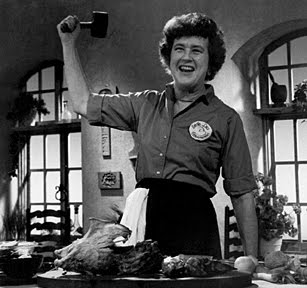
Admittedly, the story by Harold McGee does report Julia Child's hatred for cilantro, and her determination to "pick it out if I saw it and throw it on the floor." But the writer claims the froufy leaf's "soapy" taste has over the years grown on him.

I say: Better on the floor.

I am one of those who cannot bear even to be within nose-shot of it.  When helpful friends assure me that the green bits in the guacamole are only parsley, I catch them in their deception, since the putrid stench wafts from the dip long before its hideous flavor taints my tongue.  I blanch at chopping cilantro, even as a favor to my beloved daughter who savors it, as gagging while holding a knife can be trecherous.  My other daughter inherited the cilantro-despising gene from me; we both recoil from the wretched taste today's article blames on the leaf's aldehyde fat molecules. Scientists explain that such particles combine with air to produce a distinctinctive "bug-infested bedclothes" odor. Mmm-MMMH!

I detailed my disgust with cilantro in a previous post; I am convinced that such loathing is entirely inbred.  I cannot imagine ever imbibing something so repulsive with nonchalance.

(Here's a left-field comparison:  this is the same kind of statement I've heard from gay people who say they can't imagine attraction to one of the opposite sex.)

I suspect that even characteristics that are physiologically based, like the foods we find absolutely abhorrent (as opposed to those we merely dislike, which of course can change over time and throughout life) may have a cultural component.  Perhaps if I'd been exposed to hot chili peppers regularly as a child, I could tolerate pungently heated dishes today.  As it is, spicy foods cause my palate pain. (The same daughter who reviles cilantro, by the way, loves firey food; my other daughter, the one who craves cilantro, shares my discomfort with spiciness.)  We don't understand how these peculiarities are set, though I suspect researchers will soon discover the marker that confirms a biological basis.
So I strongly disagree with the Darwinian hypothesis by neuroscientist Jay Gottfried of Northwestern University that unusual tastes get classified by the brain as safety threats; once they're rationally identified as friendly food, they can be re-sorted into the palatable pile.  He suggests readers re-orient their instinct by... making cilantro pesto.

Well, maybe wearing a face mask I could try...but then it would take a lot of time to pick out the little green flecks and throw them on the floor.

Monday, April 12, 2010

Passover at Lake Las Vegas: Grateful for the Liberation

When you say you went to Lake Las Vegas, people envision some puddle in the middle of a Strip hotel. But after spending the Passover week there, I can tell you that though it's just a half-hour drive, it's a world away from the Spring Break-fed mania of blaring bells, walls of neon, European theme shopping, banks of slot machines and half-empty rows of card tables with their satin-vested attendants in their elastic-secured bow ties.  And it feels even further away from the bondage of housework required to celebrate the holiday at home.

Passover in a hotel program is a vacation from the required tasks of cleaning the kitchen pristine, locking up or dumping all the "chumetz" (leavened foods--mostly anything baked or made with flour--that make up most of a normal diet) and diligently ridding the rest of the house of crushed granola bars, stray Cheerios, and other doughy contraband.  "Turning over" the house for Pesach, clearing out the puffy products that symbolically represent arrogance and egotism, allowing submission to a higher authority, has a cathartic effect for a saintly few, but in my less-than-uplifted state, hold only the threat of chapped hands. Even when the chumetz is cleared out, Passover dishes, cutlery, and specially-certified foods must come in, and the cooking begins.  Preparation for the holiday takes most families about a month, more than enough time to contemplate and crave the transition from slavery to liberation.

My husband and I have been fortunate to be invited to speak at Passover hotel getaways for many years now, replacing a cleaning-buying-cooking frenzy with anticipation of a warmer location, lavish buffets, thought-provoking classes, enjoyable outings, and, best, a week of family time together. My husband's brother and his delightful wife and daughters joined the five of us in the group of 650 people, all observing milleniums-old traditions and fulfilling biblical commandments.

One of the nice aspects of participating in a Passover retreat is that in that context, it's normal to follow Jewish laws and traditions. Nobody thinks you weird for eschewing electric card-key room doors during the four holy days (yomim tovim) and Shabbat (the Sabbath), instead wedging cardboard across the latches. On those days the stairwells throb with crowds avoiding the elevators, and houskeeping staff merely shrug when asked to leave bathroom lights on.

Banquet room servers get used to constant requests for special wines. But it's doubtful they get used to seeing the amount of food consumed, with enormous breakfasts, "kiddush" mid-morning, huge buffet lunch, afternoon "Tea Room" spreads and of course, the six-course dinners, followed by late night "Tea Room" goodies.  At the de rigeur "Western Bar-b-Que," piles of foot-square steaks, mountains of burgers, chicken and hot dogs get quickly devoured by hovering hoards thrilled to return for seconds and thirds some cram into styrofoam "to go" boxes.  The food is so much fancier and more plentiful than the usual fare at home.

One of the lectures I give is about staying naturally thin, by listening to body cues of hunger and satiation, and casting off the many external motivators to eat--like that little voice that says, "it's here, it's free, and I can have as much as I want!"  Many people told me that my talk made a profound impact on them. Some also seemed to profoundly enjoy the Western Bar-b-Que.

Luxury meals aside, the atmosphere at Lake Las Vegas was one of cheer, caring, religious respect and "ohave Yisroyal," love of fellow Jews. There was much serious Torah study, and the synagogues--one in the Ashkenazic traditon and the other Sephardic--were filled for every service.  Family groups conducted seders in a room filled with others following the exact same order of service, the noisy distraction of singing and discussing offset by the gratification of so many families sharing this pivotal historical event and moment, in the same place, in the same way.

In fact, the warm-fuzzies of Lake Las Vegas make me appreciate all the more my friends who stayed home, scrubbing, picking crumbs out of grout, lining refrigerator racks with tin foil and stacking specially-procured chumetz-less foods on newly-lined shelves.  I raise my effortlessly-filled glass to you all, and hope that you and your family can join me next year--if not in Jerusalem, in a cushy, beautiful Passover hotel.